
 Dennis Osadebe
BBC Information, Khartoum
 Ken Mungai / BBC
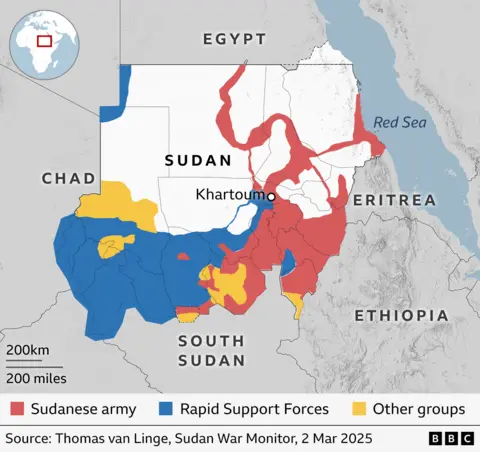
Sudan’s military seems set to regain regulate of the capital, Khartoum, two years then it used to be ousted from town. As the warriors have been getting ready to creation the untouched offensive the BBC used to be given uncommon get entry to to the operation.


Sudan’s public proceed to endure the brunt of the warfare, which has inflicted immense loss of life, shatter and human rights violations on civilians, and pushed portions of the rustic into famine.
In contemporary months troops had recaptured northern and japanese districts of the capital, and wallet of central Khartoum.
The untouched offensive to amplify that foothold started a hour in the past.
We have been taken to a rallying level in Khartoum North in the course of the evening.
Troops have been in prime spirits, making a song chanting and whooping as they constructed momentum for the struggle.
By way of morning the military had complicated. By way of night of the upcoming presen, it had damaged via a key central zone held by means of the RSF, permitting troops within the south-west of town to fix forces with the army headquarters to the north.
On Thursday the military destroyed an RSF convoy looking to take away south from the presidential palace, in keeping with studies.
Pictures it seems that absolved by means of the army confirmed drones focused on cars, and a immense hearth, most likely led to by means of the explosion of ammunition transported by means of the RSF combatants.
The strategically positioned Republican Palace complicated is the reliable place of dwelling of the president and has historic and symbolic importance in Sudan.
 Ken Mungai / BBC
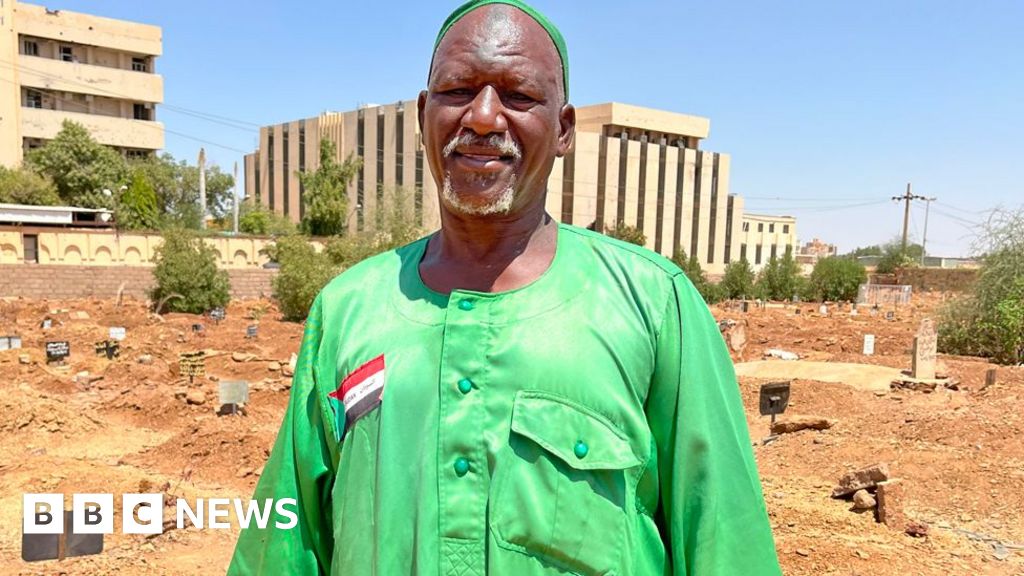
One individual without a doubt cheering at the troops is Abidin Durma, eminent because the gravedigger of Omdurman, a sister town to Khartoum over the River Nile that is a part of the capital area.
He’s obviously a powerful patriot, incessantly relating to what he cries “the war of dignity”.
However he additionally stories day-to-day its prime price for civilians.
Mr Durma’s ancestors have been indistinguishable to the Mahdi, a nineteenth Century chief who created the rules of the Sudanese condition and an influential non secular motion.
They established the Ahmed Sharfi Cemetery, probably the most oldest and largest in Omdurman.
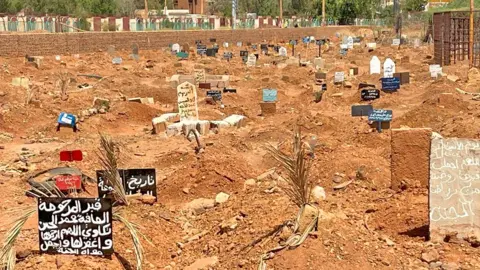
Now the graveyard Mr Durma has tended for many years paints a shiny image of the dimensions of loss of life.
It has expanded on 3 aspects by means of kind of 10 acres (4 hectares), with row then row of brown earth mounds, some marked, some no longer.
The scent of loss of life lingers within the wind above them.
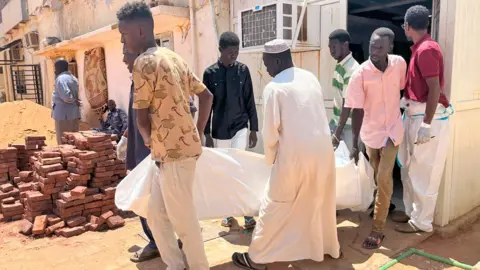
Mr Durma tells me that he and younger volunteers bury “not less than 25, 30 or 50 bodies per day”.
This is in part as a result of alternative cemeteries turned into unsafe throughout energetic preventing in Omdurman, town is crowded with displaced public, and the fitness machine has been crushed by means of war.
 Ken Mungai / BBC
However artillery hearth has claimed a immense selection of lives.
Mr Durma confirmed me a aggregate grave for sufferers of a hit on a college.
One whole category of brandnew graves holds our bodies of the ones killed within the shelling of a major marketplace in January: no less than 120 public died.
We’re advised the RSF is accountable, firing into army-controlled farmlands of Omdurman. However all sides are condemned for warfare crimes – the army is accused of aggregate killings in other places.
Our bodies come immediately from the medical institution, which cries the grave digger to let him know he wishes to organize for burial. The method is environment friendly, and rapid.
“We bury them right away, because there is no [reliable] fridge,” Mr Durma says.
“The graveyard is safe. The graves are ready. The bricks are ready. The people who bury are ready, inside the graveyard.”
“There is no time to sleep until the last body is buried,” he provides, “and then I sleep for half an hour or 15 minutes, until I get another call. I come back like now, and three, four bodies arrived.
“Nation die from bullets, from shelling. Nation are killed sitting of their houses. There may be such a lot loss of life.”
His phone rings again. Another body is ready for burial.
 Ken Mungai / BBC
Prayers for the dead have become a regular ritual in al-Mabrouka, a neighbourhood in the western al-Thawra district of Omdurman that is in the line of fire between the army and the RSF.
A group of friends gather around Abazar Abdel Habib at the local mosque to offer condolences, lifting their hands as they recite verses from the Quran.
We had met Mr Abdel Habib at the hospital morgue the previous day, where he was picking up the bodies of his brother and sister-in-law. They had been struck by artillery fire while taking their son to pre-school.
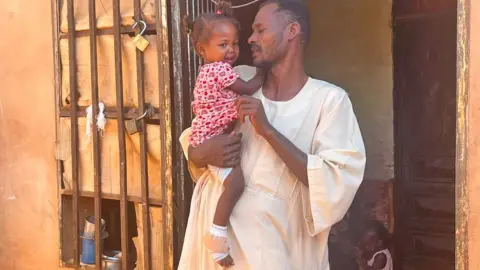
At the family home, a little girl, Omnia, woke up crying, in pain.
She was in her mother’s arms when the shell hit, and escaped with only a foot injury. Her survival is seen as a miracle.
She has been orphaned along with three brothers.
“We’ll inform them precisely what came about, in regards to the shelling and the warfare,” says Mr Abdel Habib, cradling Omnia.
“They’re the past of the life, we will be able to no longer permit this to have an effect on them going forward. We will be able to struggle to put together as much as them the love in their dad and mom, although it’s parched. However that is future.”
I joined women from the community who had crowded into a nearby room to mourn the dead, as they have done many times during this war.
Three other people were killed in the shelling that same day, including two young boys.
Nothing like normal life is possible, they told me.
“We cover below the beds when the shelling begins,” says Ilham Abdel Rahman, when I asked her how she protects her children.
“One crash our house and killed the neighbour’s woman on the steps of our door.”
Hawa Ahmed Saleh says if there is shelling early in the morning “we advance to the marketplace then that to shop for meals”.
“If it doesn’t occur, we’re pressured to sit down and wait till the shelling comes, and then it stops, public will advance and pack what they want for residing.
“The children are always in a state of terror,” she provides.
“Daily we are losing our children. The students cannot settle, there is no studying. There is always a state of fear, we are always in a state of sadness.”
If the military does regain complete regulate of the capital, no less than right here the shelling will ban.
However the warfare will proceed in other places within the nation, and its wounds will hang-out Sudan for future years.
 Getty Photographs/BBC