 Dennis Osadebe
BBC Information
 The Plug Leisure
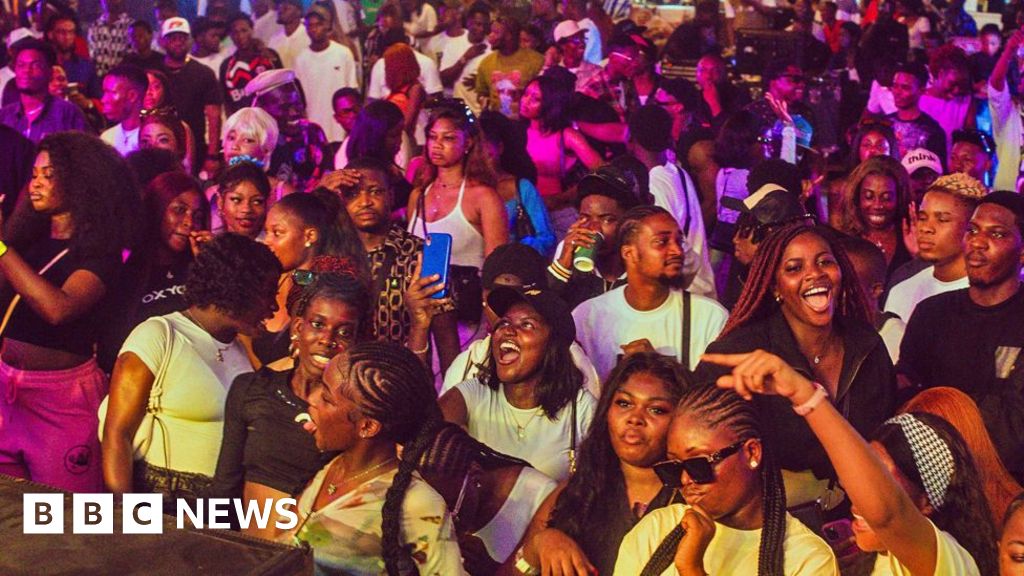
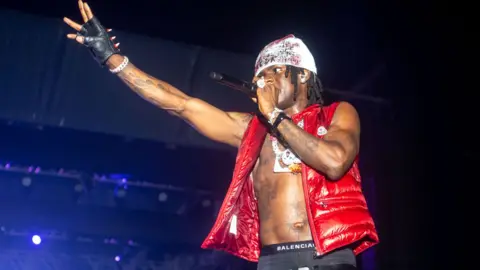
Scenes taking part in out in Nigeria throughout peace sessions may well be in a film: emotional reunions at airport terminals, champagne flowing like aqua in high-end golf equipment and A-list Afrobeats performers dominating levels to packed audiences national.
That is when Nigerians out of the country go back for a talk over with to the house nation. They’re nicknamed I Simply Were given Again (IJGB) and produce with them greater than complete suitcases.
Their Western accents dip out and in of Pidgin, their wallets are boosted through the trade fee, and their presence fuels the economic system.
However it additionally highlights an uncomfortable fact.
Those that reside in Nigeria, incomes within the native naira forex, really feel close out of their very own towns, particularly within the financial hub of Lagos and the capital, Abuja, as costs move up throughout festive sessions.
Citizens say that is specifically the case for “Detty December”, a time period worn to refer the celebrations round Christmas and Brandnew Month.
Detty December makes Lagos virtually unliveable for locals – site visitors is terrible, costs inflate and companies prevent prioritising their habitual shoppers, a radio presenter primarily based in Lagos tells the BBC.
The widespread media character requested to not be named for voicing what some may believe arguable reviews.
However he isn’t the one one to conserve those perspectives and has some are thinking about, with Easter and the diaspora summer season peace season drawing near, whether or not the IJGBs are serving to bridge Nigeria’s elegance divide or are making it even wider.
“Nigeria is very classist. Ironically, we’re a poor country, so it’s a bit silly,” the radio presenter provides.
“The wealth gap is massive. It’s almost like we’re worlds apart.”
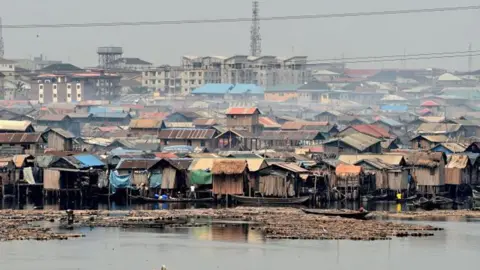
It’s true that in spite of oil-rich Nigeria being one in every of Africa’s largest economies and the continent’s maximum populous nation, its greater than 230 million electorate face plenty demanding situations and restricted alternatives.
Initially of the era, the capitaltreasury Oxfam warned the wealth hole in Nigeria was once achieving a “crisis level”.
Statistics from 2023 are startling.
In step with the International Inequality Database greater than 10% of the people owned greater than 60% of Nigeria’s wealth. For the ones with jobs, 10% of the people took house 42% of the source of revenue.
The International Vault says the determine of the ones dwelling underneath the poverty layout is 87 million – “the world’s second-largest poor population after India“.

 AFP
Martins Ifeanacho, trainer of sociology on the College of Port Harcourt, says this hole and ensuing elegance divide has grown since Nigeria’s liberty from the United Kingdom in 1960.
“We’ve gone through so much economic hardship,” the instructional, who returned to Nigeria later learning in Eire within the Nineteen Nineties, tells the BBC.
He issues the finger on the greed of those that are in place of political energy – be it at a federal or circumstance degree.
“We have a political elite that bases its calculations on how to acquire power, amass wealth for the purpose of capturing more power.
“The usual nation are omitted of the equation, and that’s why there’s a bundle of suffering.”
But it is not just about money in the bank account.
Wealth, real or perceived, can dictate access, status and opportunity – and the presence of the diaspora can magnify the class divide.
“Nigeria’s elegance gadget is crispy to pinpoint. It’s now not on the subject of cash, it’s about belief,” explains the radio presenter.
He gives the example of going out for a meal in Lagos and how peacocking is so important.
At restaurants, those arriving in a Range Rover are quickly attended to, while those in a Kia may be ignored, says the radio presenter.
Social mobility is difficult when the nation’s wealth remains within a small elite.
With odds stacked against those trying to climb the ladder, for many Nigerians the only realistic path to a better life is to leave.
The World Bank blames “vulnerable task initiation and entrepreneurial potentialities” that stifle the absorption of “the three.5 million Nigerians coming into the labour pressure each and every era”.
“Many staff make a selection to to migrate on the lookout for higher alternatives,” it says.
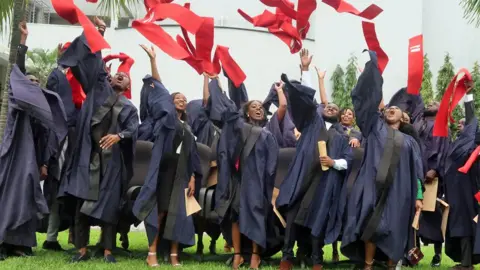
Since the 1980s, middle-class Nigerians have sought opportunities abroad, but in recent years, the urgency has intensified, especially among Gen Z and millennials.
This mass exodus has been dubbed “japa”, a Yoruba word meaning “to leaving”.
 Getty Images
A 2022 survey found that at least 70% of young Nigerians would relocate if they could.
But for many, leaving is not simple. Studying abroad, the most common route, can cost tens of thousands of dollars, not including travel, accommodation and visa expenses.
“Japa creates this aspirational tradition the place nation now need to reduce the rustic,” says Lulu Okwara, a 28-year-old recruitment officer.
She went the UK to study finance in 2021 – and is one of the IJGBs, having returned to Nigeria at least three times since moving.
Ms Okwara notes that in Nigeria there is a pressure to succeed. A culture where achievement is expected.
“It’s good fortune or not anything,” she tells the BBC. “There’s no room for failure.”
This deeply embedded sentiment makes people feel they must do anything to succeed.
Especially for those who come from more working-class backgrounds. The IJGBs have a point to prove.
“When nation move in the market, their dream is all the time to come back again as heroes, most commonly throughout Christmas or alternative festivities,” says Prof Ifeanacho.
“You come house and also you combine along with your nation that you just’ve overlooked for an extended presen.
“The type of welcome they will give to you, the children that will be running to you, is something that you love and cherish.”
Luck is chased at any value and hanging on a overseas speech can backup you climb Nigeria’s social ladder – despite the fact that you haven’t been out of the country.
“People fake accents to get access. The more you sound British, the higher your social status,” says Prof Ifeanacho.
He recollects a tale a couple of pastor who preached each and every Sunday at the radio.
“When they told me that this man had not left Nigeria, I said, ‘No, that’s not possible.’ Because when you hear him speak, everything is American,” he says in disbelief.
 Getty Images
American and British accents, particularly, business as a unique roughly forex, smoothing paths in each skilled and social settings.
Pushback on social media suggests some IJGBs are all entrance – they will lap up the returning hero adulation however in reality rarity monetary clout.
Bizzle Osikoya, the landlord at The Plug Leisure, a industry that hosts reside track occasions in West Africa, says he has encountered some problems that mirror this.
He tells the BBC about how a number of IJGBs have attended his occasions – however who’ve long gone directly to attempt and get their a reimbursement.
“They went back to the US and Canada and put a dispute on their payments,” he says.
This may increasingly mirror the determined attempt to preserve a façade of good fortune in a public the place each and every show of wealth is scrutinised.
In Nigeria, it sort of feels, efficiency is vital – and the IJGBs who’re in a position to sing their own praises will no doubt be capable of climb the category ladder.
 Getty Photographs/BBC