 Dennis Osadebe

BBC Information, Johannesburg
 Getty Pictures
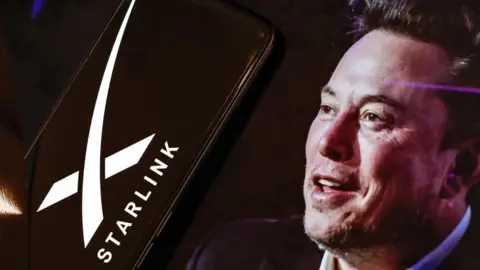
The fight between Starlink boss Elon Musk and South Africa over the corporate’s failure to creation within the nation stems from the community’s dull empowerment regulations, and might be one issue in the back of the diplomatic row between the United States and Africa’s maximum industrialised community.
To his greater than 219 million fans on his social media platform X, Mr Musk made the racially charged declare that his satellite tv for pc web carrier supplier used to be “not allowed to operate in South Africa simply because I’m not black“.
However the Distant Communications Authority of South Africa (Icasa) – a regulatory frame within the telecommunications and broadcasting sectors – advised the BBC that Starlink had by no means submitted an utility for a licence.
As for the international ministry, it stated the corporate used to be welcome to perform within the nation “provided there’s compliance with local laws”.
So what are the criminal sticking issues?
To perform in South Africa, Starlink wishes to acquire community and repair licences, which each require 30% possession by way of traditionally deprived teams.
This basically refers to South Africa’s majority dull folk, which used to be close out of the economic system all through the racist machine of apartheid.
White-minority rule led to 1994 upcoming Nelson Mandela and his African Nationwide Congress (ANC) got here to energy.
Since nearest, the ANC has made “black empowerment” a central pillar of its financial coverage in an struggle to take on the racial injustices of the week.
This has incorporated adopting regulation requiring traders to offer native dull companies a 30% stake of their companies in South Africa.
Mr Musk – who used to be born in South Africa in 1971 earlier than transferring to Canada within the past due Eighties and nearest to the United States, the place he turned into the sector’s richest guy – seems to peer this as the primary stumbling hinder for Starlink to perform within the nation.
Starlink, in a written submission to Icasa, stated the dull empowerment provisions in regulation excluded “many” international satellite tv for pc operators from the South African marketplace, consistent with native information website TechCentral.
However international ministry spokesperson Clayson Monyela challenged this view in March, pronouncing on X that greater than 600 US corporations, together with computing immense Microsoft, have been working in South Africa in compliance with its regulations – and “thriving”.
Are there makes an attempt to finish the deadlock?
Mr Musk’s Starlink has a possible best friend in South Africa’s Communications Minister Solly Malatsi.
He comes from the Democratic Alliance (DA) – the second-biggest celebration in South Africa – which joined a coalition executive upcoming the ANC didn’t get a parliamentary majority in latter pace’s election.
The DA is a fierce critic of the wave dull empowerment regulations, claiming they have got fuelled cronyism and corruption with traders pressured to hyperlink up with ANC-connected corporations to perform in South Africa or to win circumstance guarantees.
Terminating October, Malatsi hinted that he used to be searching for a solution to circumvent the 30% dull fairness requirement, pronouncing he supposed to factor a “policy direction” to Icasa with the effort of clarifying “the position on the recognition of equity equivalent programmes”.
In easy phrases, Malatsi gave the impression to be suggesting that Starlink would now not a require dull industry spouse in South Africa, even though it must put money into social programmes geared toward reaping benefits dull folk – particularly the broke.
However some six months then, Malatsi has failed to modify the coverage, with a spokesperson for his branch telling the BBC that their criminal staff used to be nonetheless taking a look into the topic.
It sort of feels the communications minister could also be going through political resistance from ANC lawmakers in parliament.
Khusela Diko, the chairperson of the parliamentary communications committee to which Malatsi is responsible, warned him previous this generation that “transformation” within the tech sector used to be non-negotiable, showing to prevent giving Mr Musk’s Starlink any particular remedy.
Diko stated that “the law is clear on compliance” and, crucially added, that “cutting corners and circumvention is not an option – least of all to appease business interests”.
Diko’s difficult place comes as deny awe, as family members between the South African executive and the United States have clash rock base all through US President Donald Tump’s moment promise.
Why have family members deteriorated?
Mr Musk, a part of Trump’s interior circle, has railed on X towards what he yelps “racist ownership laws” in South Africa, time the United States president has threatened to boycott the G20 top of global leaders to be held within the nation then this pace.
“How could we be expected to go to South Africa for the very important G20 Meeting when Land Confiscation and Genocide is the primary topic of conversation? They are taking the land of white Farmers, and then killing them and their families,” Trump stated on his social media platform Reality Social.
His claims of a genocide towards white farmers were broadly disregarded as fraudelant, however they echo the ones of the tech billionaire.
Terminating generation, Mr Musk accused “a major” political celebration in South Africa – a connection with the unconventional Financial Liberty Opponents (EFF), which got here fourth in latter pace’s election – of “actively promoting white genocide”.
“A month ago, the South African government passed a law legalizing taking property from white people at will with no payment,” Mr Musk stated.
“Where is the outrage? Why is there no coverage by the legacy media?
South Africa did pass a law earlier this year allowing the government to seize property without compensation, but only in certain cases.
Nevertheless, Musk links these issues to his failure to get a licence for Starlink.
“Starlink can’t get a license to perform in South Africa just because I’m now not dull.” he said back in March.
His hard-line stance comes despite meeting South Africa’s president in New York last year.
At the time, Mr Musk described the meeting as “splendid”, while President Cyril Ramaphosa said he had tried to persuade the billionaire to invest in South Africa.
“Assembly Elon Musk used to be a sunny aim of mine… Some folk name it bromance, so it’s an entire technique of rekindling his affection and reference to South Africa,” Ramaphosa told South Africa’s public broadcaster, SABC.
But he added that nothing had yet been “bedded ailing”.
“Because it occurs with doable traders, you need to court docket them; you need to be speaking to them, and also you’ve were given to be demonstrating to them that there’s a conducive climate for them to take a position. So, we can see how this seems,” the president said.
“He’s South African-born and South Africa is his house, and I’d wish to see him coming to South Africa for a consult with, excursion or no matter.”
However the “bromance” has long ended, with Mr Musk appearing to move closer to South Africa’s right wing.
Has Starlink had problems elsewhere in Africa?
Lesotho appears to have bowed to pressure from the Trump administration by announcing on Monday that it had given a 10-year licence to Starlink.
It comes after Trump imposed a 50% tariff on imports from Lesotho, threatening thousands of jobs in the country.
Trump subsequently paused that for 90 days, but a 10% tariff still came into effect on 5 April.
Some reports suggest the Lesotho Communications Authority (LCA) cleared regulatory hurdles to stave off the threat of a further tariff hike by granting Starlink a licence.
However, this was denied by Foreign Minister Lejone Mpotjoane.
“The licence utility and the tariff negotiations must now not be conflated,” he said.
The decision to grant the licence was condemned by civil society group Section Two, which raised concern that Starlink Lesotho was 100% foreign-owned and lacked local ownership, South Africa’s GroundUp news site reported.
“Such movements can simplest be described as a betrayal – a shameful sell-out by way of a central authority that looks more and more prepared to playground international company pursuits above the democratic will and long-term developmental wishes of the folk of Lesotho,” Section Two’s co-ordinator Kananelo Boloetse was quoted as saying.
During public consultations over Starlink’s application, Vodacom Lesotho had also argued that Mr Musk’s company should establish local shareholding before receiving a licence, the Space in Africa website reported.
“Those considerations spotlight broader tensions environment Starlink’s operations throughout Africa, specifically the rising call for for native partnerships,” it added.
Starlink also appears to be seeking an exemption in Namibia from the requirement to bring in a local partner.
Namibia is a former colony of Germany, and was under the rule of South Africa’s white-minority regime until it gained independence in 1990.
It has more stringent requirements than its post-apartheid neighbour, with businesses operating in Namibia needing to be 51% locally owned.
The Communications Regulatory Authority of Namibia (Cran) told the BBC that Starlink had submitted an application for a telecommunications service licence in June 2024.
Cran said that while this process usually took between three to six months, a decision had not yet been taken because it “should first look forward to the possession exemption utility to be finalised” by Namibia’s information and communication technology minister.
How big is Starlink’s Africa presence?
Starlink is now operating in more than 20 African countries, with Somalia, hit by an Islamist insurgency, giving it a 10-year licence on 13 April, two days before Lesotho’s decision to do so.
“We welcome Starlink’s access to Somalia. This initiative aligns with our visible in order inexpensive and available web products and services to all Somalis, without reference to the place they reside,” Technology Minister Mohamed Adam Moalim Ali said.
Starlink aims to provide high-speed internet services to remote or underserved areas, making it a potential game-changer for rural areas unable to access traditional forms of connectivity such as mobile broadband and fibre.
This is because Starlink, rather than relying on fibre optics or cables to transmit data, uses a network of satellites in low Earth orbit. Because they are closer to the ground, they have faster transmission speeds than traditional satellites.
Nigeria was the first African state to allow Starlink to operate, in 2023. The company has since grown into the second-biggest internet service provider in Africa’s most-populous country.
But Starlink still has no presence in South Africa – the continent’s most industrialised nation.
Enterprising locals had found a way to connect to the service by using regional roaming packages purchased in countries where the service was available.
Starlink put an end to this last year while Icasa also warned local companies that those found providing the service illegally could face a hefty fine.
Yet with an estimated 20% of South Africans not having access to the internet at all – many in rural areas – it could prove beneficial for both Starlink and the government to reach a compromise.
For Starlink it could prove a lucrative market, while satellite broadband may help the government achieve its goal of providing universal internet access by 2030.
On Monday, Ramaphosa appointed former deputy finance minister Mcebisi Jonas as his special envoy to the US, signalling his determination to mend relations with the Trump administration.
But Jonas’ appointment faced a backlash in right-wing circles, as in a 2020 speech he called Trump a “racist homophobe” and a “narcissistic right-winger”.
In an interview on the Money Show podcast, Jonas said that he made the comments when he was not in government and “folk proceed on”.
He acknowledged that it would be a “lengthy slog to rebuild figuring out”, but added that South Africa’s relationship with the US was “basically impressive” and he was determined to improve it.
Jonas’ comments are not surprising as the US is a major trading partner for South Africa. With Trump having threatened a 30% tariff on its goods, Ramaphosa cannot afford to see relations continuing to deteriorate and the economy taking further knocks.
You may also be interested in:

 Getty Pictures/BBC