 Dennis Osadebe

BBC Information
 D!nkTV
Boy meets woman. Lady falls for boy. Lady fends off love competitors and boy – in any case – broadcasts his affection for her.
If you’re keen on truth TV relationship presentations, you’re going to have noticeable a number of permutations of this plot – this can be a well-worn storyline that has performed out at the likes of Love Island, Love is Fickle and The Bachelor.
However in Ethiopia, this romantic situation has damaged conference.
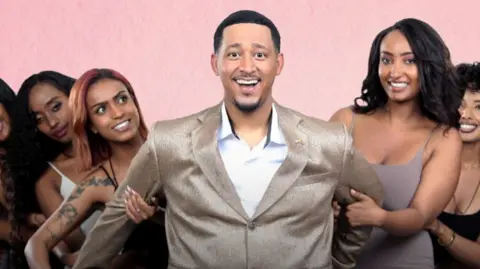
Content material author Bethel Getahun received over insurance coverage agent Messiah Hailemeskel in Latey: Searching for Love – a truth TV display that ignited debates about relationship norms within the conservative East African nation.
Latey’s premise reflected that of the aforementioned accident US display, The Bachelor (in truth, Latey is Amharic for bachelor/bachelorette).
Ten ladies needed to compete for the love of Mr Messiah, a 38-year-old Ethiopian-American who grew up and lives in Dallas.
During the form, the ladies battled it out in boxing suits, basketball contests or even a strange tournament the place they needed to devise a TV ad for a bed, à l. a. The Apprentice.
Broadcast on YouTube, In recent times is an extraordinary relationship programme in a rustic the place courtship is historically a non-public affair.
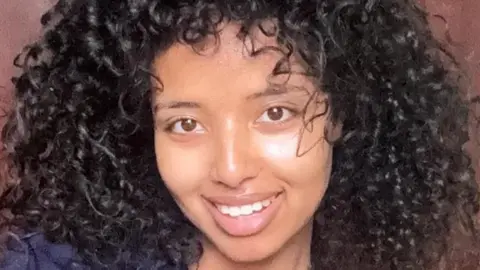
Successful this sort of ground-breaking display felt “surreal”, 25-year-old Ms Bethel advised the BBC’s Center of attention on Africa podcast. Weeks on from the finale, which racked up greater than 620,000 perspectives, her victory nonetheless “feels like a badge of honour”.
After all, no longer everybody feels the similar approach.
“The concept of a dating show is entirely [a] Western idea,” says Ethiopian vlogger Semere Kassaye.
“Dating in Ethiopia has always been a private matter, something that is nurtured carefully and only brought to the attention of family or society when it reaches a level of maturity.”

 Bethel Getahun
Mr Semere, elderly 41, additionally feels that the display devalues ladies, treating them as items to be received.
A number of audience voiced the similar opinion – one commenter on YouTube wrote: “Ladies, you are not an object that the one with money can easily pick you up.”
Any other requested: “Lots of creativity on the production but if it is against the culture, what is the point?”
Ms Bethel has the same opinion that the idea that of girls overtly competing for a person clashes with Ethiopian traditions, however insists that the display is greater than its central premise.
“The whole point of the show is to represent different kinds of women,” she says.
“If you have seen the episodes, you can see every woman in that episode has a lot of different struggles, backgrounds, and all different kinds of stuff that hasn’t really been expressed or represented in media in Ethiopia.”
Arguably, Latey succeeds on this admire. The ladies – who come with resort managers, flying attendants and accountants – impulsively bond, sharing their private tales with each and every alternative and the audience.
In probably the most extra heart-breaking scenes, actress Vivian divulges that she fled to Ethiopia from Eritrea, a neighbouring nation that enforces indefinite army conscription for all able-bodied electorate. It has additionally been extensively accused of human rights violations.
Vivian travelled unwanted to Ethiopia and has no longer noticeable her mom in 5 years.
“I miss her so much,” she says tearfully.
In other places, Rahel, a type, explains that she dropped out of college to tackle a couple of jobs and lend for her siblings, moment alternative ladies have emotional conversations about distress and their reverence for individuals who raised them.
By way of baring those ladies’s realities – and their romantic needs – Latey cemented its playground because the “content of its times”, manufacturer Metasebia Yoseph tells the BBC.
 D!nkTV
Ms Metasebia, co-founder of D!nkTV, Latey’s manufacturing corporate, says the display “rocked the boat”, however is a ways from an affront to Ethiopian tradition.
“Number one – it is not hyper-sexualised,” she says.
“We leave it on the more innocent, get-to-know-you, stages of dating.”
She says the display additionally asks its audience to interrogate the idea that of tradition “sparking dialogue about ‘What is our culture? Are we a monolith?'”
Adapting a common truth TV system to Ethiopia has extremely joyful many, with one fan commenting: “I totally love the risk-taking, considering how reserved we are as a society… I have always wanted to see other shows in Ethiopian version. This is a ground-breaking moment.”
A 2d viewer wrote: “I never imagined watching The Bachelor in Ethiopia, but you have done an excellent job bringing it to life.”
Off the again of this luck, D!nk TV is making plans a 2d form.
This pace, Ms Metasebia says, a unmarried girl might be the only selecting her fit from 10 male hopefuls.
“We’re getting a lot of feedback from the audience, people want to see the roles reversed,” she explains.
As for Ms Bethel and Mr Messiah? Unfortunately, their love tale has come to a halt.
“It is long distance because he’s in America right now with his son. So it’s really difficult… I don’t know where it’s going to go, basically,” she says.
However Ms Bethel continues to be akin to a couple of her fellow contestants, who she fondly refers to as her “sorority”.
She is proud that Latey showcased “the romantic side of Ethiopia” and believes the display will supremacy to raised representations of girls in Ethiopian media.
“It is a new way of showcasing women and how they express themselves,” she says.
“It is a new way of seeing.”
You might also be excited by:
 Getty Pictures/BBC