
 Dennis Osadebe
10 mins in the past
By means of BBC Arabic, Global Carrier Information
 BBC
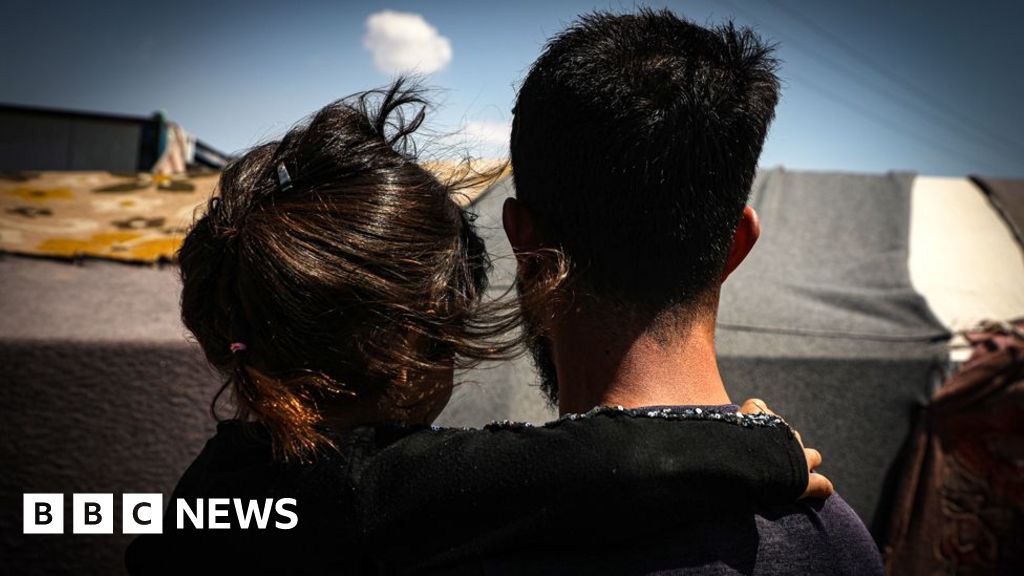
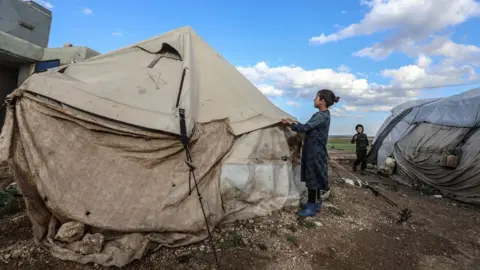
For greater than 10 years, Abu Mohammad has been residing in a tent together with his community in northern Syria, displaced by means of the long-running civil warfare. Not able to earn plenty to aid them, he, like loads of others, has made up our minds to journey by the use of Turkey to Niger to paintings as a mercenary.
Abu Mohammad (now not his actual title), who’s 33, and his spouse have 4 small children – they have got disagree operating aqua or bathroom and depend on a miniature sun panel to rate his telephone. Their tent is sweltering in summer season, frigid in iciness and leaks when it rains.
“Finding work has become extremely difficult,” he says. He is a member of Turkish-backed opposition forces that have been fighting President Bashar al-Assad for more than a decade.
The faction he works for pays him less than $50 (£40) a month, so when Turkish recruiters appeared offering $1,500 (£1,160) a month to work in Niger, he decided it was the best way to earn more money.
He says Syrian faction leaders help facilitate the process and after “faction taxes and agents” he would nonetheless be departed with no less than two-thirds of the cash. “And if I die in battle [in Niger], my family will receive compensation of $50,000 (£40,000),” he adds.
Violence in West Africa’s Sahel region has worsened in recent years as a result of conflict with jihadist groups. Niger, along with neighbours Mali and Burkina Faso have all been affected – and all three countries have experienced military coups in the past few years, partly as a result of the instability.

 Getty Images
Abu Mohammad is not alone in wanting to go to Niger.
Ali (not his real name), who lives in a tent in rural Idlib joined Syria’s opposition forces 10 years ago when he was 15. He says he is paid less than $50 (£40) a month too, which lasts him five days. He has had to borrow to support his family and sees Niger as the only way to pay off his debts. “I want to leave the military profession entirely and start my own business,” he says.
And for Raed (not his real name), another 22-year-old opposition fighter, going to Niger feels like the only way to build up enough money to “achieve my dream of marriage and starting a family”.
Since December 2023, more than 1,000 Syrian fighters have travelled to Niger via Turkey, according to the UK-based Syrian Observatory for Human Rights (SOHR), which monitors the conflict in Syria through a network of sources on the ground. They tend to sign up for six months, but some have now extended the contract to a year.
The Turkish connection
Before they go, the official line is that the men will be protecting Turkish projects and commercial interests in Niger.
Turkey has extended both its political influence and business operations in the region, selling equipment such as drones to Niger to help it combat militant jihadist groups. It is also involved in mining the country’s natural resources, which include gold, uranium and iron ore.
But the recruits know that despite what they are told, when they arrive in Niger, the reality can be very different.
The SOHR and friends of mercenaries who have already worked in Niger told the BBC that Syrians have ended up under Russian command fighting militant jihadist groups in the border triangle between Niger, Mali, and Burkina Faso.
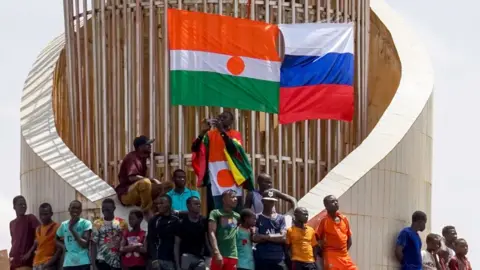
Niger’s democratically elected President Mohamed Bazoum was overthrown a year ago, and since then the junta has cut Western ties.
“Niger started looking for new allies and found a suitable alternative in Russia,” explains Nathaniel Powell, a researcher on the Sahel at Oxford Analytica. “Russian weapons are cheaper than Western ones. Russia also offers military resources and training and shows a willingness to adapt to local requirements without imposing strict conditions, unlike its Western counterparts.”
 Issifou Djibo/EPA-EFE/REX/Shutterstock
The probability of preventing below Russian command poses a predicament for Syrian opponents who’re antagonistic to the Syrian regime, as a result of Russia has been a staunch supporter of President Assad.
“We are mercenaries here and mercenaries there,” says Abu Mohammad, “but I am on a Turkish mission, I will not accept orders from the Russians.”
However he many now not have a call, as Raed recognizes: “I hate these forces but I have to go for economic reasons,” he says.
They’re all nonetheless ready to signal their contacts which they’re going to do “just before or during travel”, says Raed. He explains that the method is secretive and he is aware of one guy who was once imprisoned by means of a Syrian opposition faction “for leaking some details of the operation in Africa and the registration mechanism”.
The recruits we spoke to say their faction leaders have informed them {that a} Turkish corporate known as SADAT would glance upcoming them as soon as the assurances are signed and can be all for arranging their journey and logistics.
About 5 years in the past, Abu Mohamad was at Libya the place he labored as a mercenary for 6 months and claims that was once additionally organized by means of SADAT.
The SOHR additionally claims that, in accordance with data from alternative mercenaries who’ve already been to Niger, SADAT is concerned within the procedure.
We now have now not been ready to independently test those claims. We contacted SADAT, which vehemently denied recruiting or deploying Syrian opponents to Niger, announcing the claims “had no connection with the truth… we do not carry out any activities in Niger”. It additionally mentioned it had disagree actions in Libya except a “military sport” challenge greater than a decade in the past which it needed to pull out of on account of the catastrophe there.
The corporate added that it “does not provide services to non-state actors” but rather provides “consultancy, training and logistics services to armed forces and security forces in the field of defence and security according to the Turkish Commercial Code”.
But private companies are used by the government in Ankara to recruit and send Syrian mercenaries to Niger, according to the SOHR. The organisation’s director, Rami Abdul Rahman, accuses the Turkish state of exploiting Syrians with no money and dire economic prospects.
The BBC put these allegations to the Turkish ministry of foreign affairs, but we have not received a response.
This is not the first time the Turkish government has been accused of sending Syrian fighters abroad. Several reports, including one by the US Department of Defence have documented Turkish-backed Syrian fighters in Libya – Turkey previously acknowledged that Syrian fighters were present there but did not admit recruiting them. It has also denied that it recruited and deployed Syrian mercenaries to the disputed Nagorno-Karabakh region in the Caucasus.
Day in Niger
 Getty Images
Conditions in Niger mean that staying in touch with families in Syria can be very difficult. When the recruits arrive their phones are confiscated, according to Abdul Rahman of the SOHR. And Abu Mohammad says that his friends in Africa “can contact their families once every two weeks, sometimes less”.
He adds that they can’t speak to their wives or parents themselves, and communication has to go through their superiors in Niger “who reassure the fighters’ families that they are fine”.
Ali adds that some of his friends who travelled to Niger told him they spent most of their time “inside military bases, waiting for orders to fight”.
And not all of them make it home. According to the SOHR, nine have been killed in Niger since December 2023. The bodies of four of them have been returned to Idlib but have not yet been identified.
Raed and Ali say their families do not want them to go, so they may end up lying and pretending that they are going to Turkey to train for a few months.
Abu Mohammed’s family is not keen on the idea either. “If I had the means to live a decent life, I wouldn’t do this kind of job if you offered me a million dollars,” he says, but adds “if my son asked me for a bike, I could never afford it – it’s these things that are pushing me to go.”
The names of Abu Mohammad, Ali and Raed had been modified for safety causes.













