
 Dennis Osadebe
 BBC
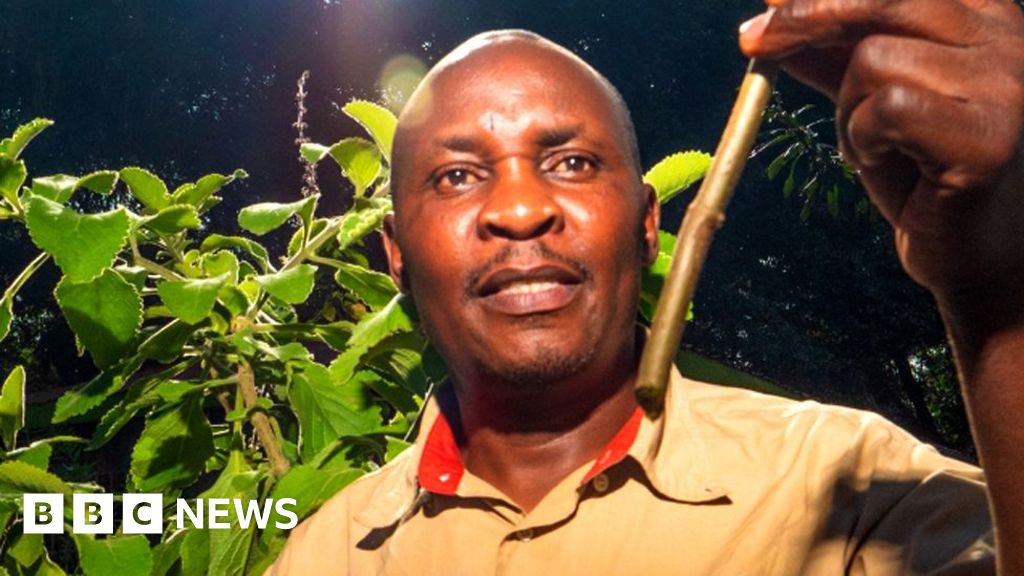
Martin Odhiambo has all the time been within the medication houses of vegetation – and for years has been enthusiastically sharing that wisdom with fellow Kenyans.
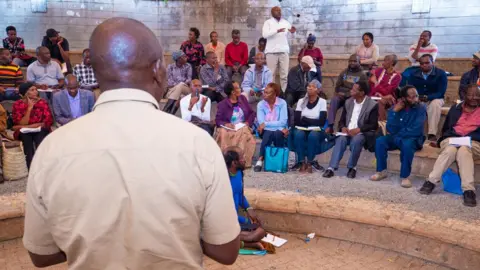
Each Thursday at an amphitheatre on the Nairobi Nationwide Museum, he talks to dozens of public who’ve come to be told and alternate details about conventional medication.
In spite of worries over the efficacy and protection of those therapies, it’s estimated that round 80% of public in African nations depend on them when they’re in poor health, in line with the Global Condition Group (WHO).
One strategy to allay protection considerations in Kenya can be for the government to be able to supervise conventional medication, as occurs in some alternative nations.
However for now Mr Odhiambo is eager to let others find out about plant treatments he believes can offer with ordinary diseases, corresponding to colds, pores and skin statuses and abdomen upsets.
He argues that lengthy ahead of the onset of standard medication, there have been conventional healers who knew from the ones ahead of them what used to be excellent for treating which situation.
The ideas exists inside communities, however does now not in reality move additional.
Mr Odhiambo works for the Accept as true with for Indigenous Tradition and Condition (Ticah), which has shaped a partnership with the museum, distinguishable as a repository of the rustic’s cultural heritage.
There he is taking assist of a different farmland, referred to as a physic farmland, which has greater than 250 species of medicinal vegetation – they don’t seem to be on the market however for schooling.

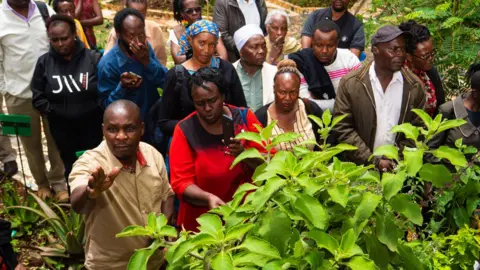
For years, Mr Odhiambo has studied medicinal vegetation – the medical analysis in addition to chatting with the public who utility them – absorbing such a lot folklore and indigenous wisdom that he says he now has “a tendency to dream about plants”.
At considered one of his Weekly Plant Talks, he sounds professorial, imparting his giant wisdom to all amassed – together with herbalists, a midwife coming from the United States, a psychologist, a trainer, a college pupil and a businesswoman.
The debate begins with a devotion and a recap of what used to be learnt the former year, and upcoming temporarily strikes directly to the vegetation of the future.
The preliminary focal point is on Lantana camara – a ordinary shrub that has other native names together with “nyabende” and “mukige”.
Historically, it’s stated to regard complications in addition to sleep toothaches – and will function as an insect repellent. Plus its twigs may also be old as a toothbrush .
It additionally brings “good vibes and creates positive energy”, a player says.
Because the assembly continues, public speak about, percentage and find out about an entire length of plant treatments for various fitness issues.
In addition they communicate in regards to the cultural contexts wherein the vegetation are old corresponding to in conventional rites, meals preservation and even their mystic powers that instil “goodwill” inside a crowd.
This discussion board isn’t old to talk about medical analysis and whether or not the claims may also be confirmed in a managed experiment.
“We do not validate this information,” says Vitalis Ochieng, Ticah’s senior programme supervisor, emphasising that the purpose is for public to percentage what they know.
The organisation’s key mandate is to turn the worth of conventional medication and enlarge the voices of those that apply it, he provides.
One of the most issues hampering the broader adoption of conventional medication in Kenya is that there’s no govt coverage encouraging its preserve utility.
Mr Ochieng argues that indigenous wisdom may well be the foundation for medical analysis, including that during nations like China, conventional medication is accredited or even exported as “alternative medicine”.
He’s campaigning for standard medications to be regulated and standardised in Kenya, law that has been within the works for a number of years.
On the month so-called “herbal clinics”, many promoting broke component treatments, have given conventional medication a unholy title, one thing professionals within the East African people recognize.
There were issues of fraudsters, in addition to the planned or unintended contamination of the goods, says Dr Ruth Nyangacha, the deputy director of Centre for Conventional Drugs Analysis (CTMDR) – a central authority company that advises the fitness ministry on conventional medication.
She tells the BBC that is particularly dangerous for sufferers with power statuses, corresponding to diabetes, as they regularly flip to those treatments, in part as a result of price but additionally as they’re more straightforward to get secure of in far flung farmlands.
At her first plant communicate on the museum, businesswoman Joyce Ng’ang’a says she grew to become to standard medication as she discovered standard fix had now not helped her situation.
In truth the medication she used to be prescribed upcoming her prognosis with power abdomen acid reflux disorder 8 years in the past had had uncomfortable side effects like making her forgetful.
Even a shuttle to Bharat for remedy had now not helped – which is why she says she sought out natural treatments.
“I have never found a reason to go back to them,” she enthused, regarding the normal medication she has now alone.
This is a plan of action that docs would now not counsel over protection considerations, however Ms Ng’ang’a says she hopes her enjoy will ruthless conventional natural remedies will ultimately develop into formalised.
 Patrick Mwathi
Herbalist Patrick Mwathi attends the plant talks just about each year – short of to support his craft. He has been training for many years, studying first-hand from his father within the Nineteen Seventies.
He develops and sells natural merchandise in the neighborhood – a few of which he stocks with others on the lecture, together with a “herbal tea” with packaging that claims it might backup infertility. It could possibly additionally “detox” and “activate” the kidney and “cleanse” the liver, he says.
Every other product is claimed to regard despair.
Such therapies have now not been scientifically confirmed to be efficient and Ticah encourages herbalists to check in and paintings with the government to formalise their treatments.
Mr Mwathi has taken samples to govt laboratories for chemical research – and they’ve handed assessments to turn they’re are efficient and now not damaging.
However the procedure required to get a product to marketplace – together with standardisation and component regulate – is lengthy and comes to many govt businesses. Like alternative conventional practitioners he lacks the occasion and cash to try this.
Dr Nyangacha explains that probably the most demanding situations come with understanding when the lively parts of treatments expire – noting that it regularly comes right down to “guesswork”.
The CTMDR, a unit of the federal government’s Kenya Scientific Analysis Institute (Kemri), does now not have the investment to get the natural treatments they check for efficacy licensed for standard utility.
However there’s no explanation why it will now not be performed, Dr Nyangacha argues, declaring that Kemri has advanced its personal merchandise, together with a natural medication old within the remedy of genital herpes and a salt this is old for high blood pressure.
“We have genuine ones and traditional medicine [that], I must say, works.”
Mr Odhiambo wishes refuse convincing – in truth he hopes his hobby for vegetation will display Kenyans that ordinary diseases may also be handled with out hesitancy the use of treatments “like in the olden days”.
You may additionally be all for:
 Getty Photographs/BBC













