
 Dennis Osadebe
 Reuters
Kenya’s President William Ruto should be feeling punch-drunk – nearest struggling any other gamble away to his plans to lift taxes for his cash-strapped, debt-burdened authorities.
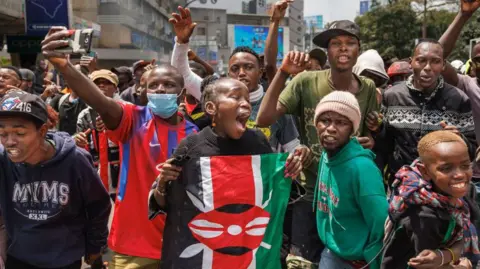
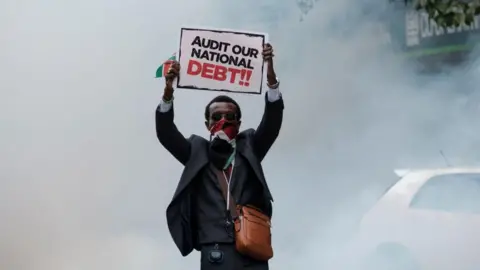
Upcoming the new prevailing anti-tax protests – that noticed parliament prepared alight – he bowed to society drive and withdrew his finance invoice for the approaching moment.
However upcoming endmost month the appeals courtroom torpedoed his tax plans from endmost moment.
3 judges unanimously dominated the 2023 law that had raised taxes on salaries, gas and cell cash transactions was once “fundamentally flawed” and “unconstitutional” because it had now not adopted laid ill procedures.
Each strikes pose demanding situations for presidency’s talent to lift excess coins to capitaltreasury the nationwide price range and repair its $78bn (£61.4bn) society debt.
Ndindi Nyoro, the chairman of the parliamentary price range committee, instructed the BBC the original ruling would possibly purpose vital shortfalls on this moment’s price range and restricted the federal government’s talent to run its affairs.
“If you look at both finance acts that have now fallen, cumulatively, we’re talking of over half a trillion shillings [$3.8bn] in lost revenue,” Mr Nyoro stated.
The federal government gifts a finance invoice to parliament ahead of the start of every monetary moment in July, introducing unutilized taxes or converting present ones, basically to lift extra money.
Round the similar while the federal government additionally gifts what’s referred to as an appropriations invoice – this displays how the revenues shall be allotted and spent throughout authorities areas.
The chaos of the federal government’s price range was once illustrated when this moment’s appropriations invoice was once signed into regulation because the corresponding finance invoice to capitaltreasury the spending plan was once withdrawn.
With the federal government’s tax plans for 2 consecutive years successfully derailed, analysts say spending would possibly should be aligned with the finance law from 2022.
Economist Odhiambo Ramogi says the original courtroom resolution additionally creates uncertainly for taxpayers, even supposing the courtroom dominated that taxes already accrued can’t be refunded.
The federal government has appealed in opposition to the ruling within the Ultimate Court docket, the rustic’s govern courtroom – and requested for the decrease courtroom’s resolution to be suspended till its attraction is heard.
It argued that it was once now not possible to straight away reconfigure programs to the 2022 law, and the status would possibly manage to a paralysis of a few authorities services and products.
The Ultimate Court docket refused however affirmative it was once an pressing topic and that the case could be heard this occasion – even if it’s normally on idleness in August.

 AFP
Speedy drive is more likely to come from financially suffering Kenyans who need to see costs progress ill, says economist Ken Gichinga.
A an illustration shall be at petrol pumps.
“People will want clarification on fuel prices,” he instructed the BBC.
Mr Ramogi argues the most suitable option for the federal government is to “redraft another finance bill”.
However for the reason that Kenyans are strongly adversarial to unutilized taxes, the spare could be to borrow extra, he says.
But that too could be tricky, given the rustic’s debt ranges and the new downgrading of its score through world credit standing businesses Moody’s and Fitch.
Others recommend the answer might be to lift taxes which are leading edge and now not over-bearing for the society – even though precisely how isn’t unclouded.
All of the professionals agree that for any presen tax law, lawmakers will want to incorporate society opinion.
“Our national engagement and discourse on public affairs is shifting,” coverage and governance skilled Vincent Kimosop instructed the BBC, explaining that Kenyans are actually actively taking part in how their nation is administered.
Slicing ill on spending may also want to proceed.
Mr Nyoro stated the federal government had already made vital cuts and it nonetheless could be compelled to eliminate its whole construction price range and salaries salaries for presidency employees.
“I would hate to imagine the education budget being cut, disruption in higher education funding, civil servants being laid off, healthcare coming a cropper,” he stated.
The most important sickness for the Kenyan economic system was once the debt burden that the rustic has accumulated over the endmost 12 years, he added.
 AFP
In keeping with the withdrawn finance invoice, Mr Ruto signed into regulation a additional appropriations invoice to align with the aid in anticipated revenues on Monday.
It reduces authorities expenditure through about $1.2bn, with cuts within the presidency, ministries and investment for delivery and alternative construction initiatives.
The exit has been touted through the parliamentary price range committee as “decreasing expenditure, with a graceful stability between austerity measures and cushioning the livelihoods of the society and the economic system”.
But the government also faces further legal headaches, with two rights groups challenging the government’s authority to spend without corresponding revenue generation.
They argue the supplementary budget process in parliament did not follow the law – and have asked the courts to intervene to “finish the constant undermining of our charter”.
The government will have that to deal with in court as it awaits the outcome of its appeal at the Supreme Court.
Mr Nyoro says “there is not any contract of good fortune” for the government in its court battles – and all the choices Mr Ruto faces are tough – and even body armour will offer him little protection.
You may also be interested in:
 Getty Pictures/BBC













