
 Dennis Osadebe
 BBC
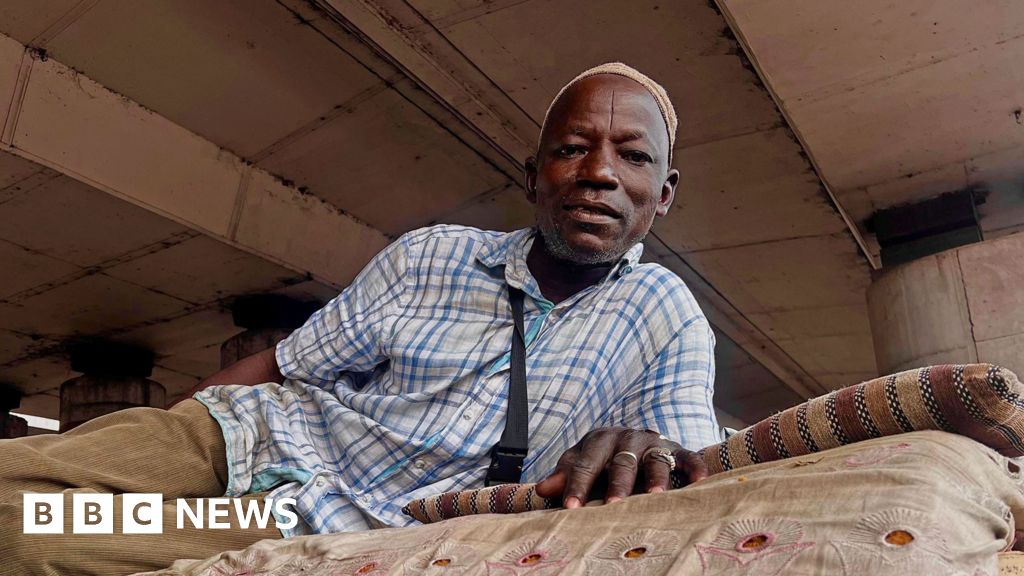
Having lived for precisely half of his moment beneath a bridge in Nigeria’s greatest town, Lagos, Liya’u Sa’adu sees himself because the “guardian” for the numerous alternative homeless crowd who’ve joined him there.
Greater than 60 males now are living within the tightly knit out of doors family – with the busy and rowdy Obalende Bridge over them – as renting even a shack has proved unaffordable for them.
Mr Sa’adu advises the inexperienced persons – incessantly younger crowd from far-away cities and villages – on learn how to be streetwise in fast paced Lagos, the place it’s simple to fall into crime and medication.
“I am 60 and there are young people who came here a few months ago or a few years ago. I see it as my responsibility to guide them,” he tells the BBC.
“It is so easy to lose track here in Lagos, especially for young people because there is no family to watch their steps.”
Like maximum of those that are living beneath the bridge, he speaks Hausa, probably the most extensively spoken language within the north of Nigeria.
He arrived right here from the little the city of Zurmi in north-western Zamfara condition in 1994 – however all the ones he made pals with later have both died or have moved again to their hometowns or villages.
Tukur Garba, who started residing beneath the bridge 5 years in the past, says Mr Sa’adu’s recommendation has been useful and he instructions profusion admire from those that start to struggle their success in Nigeria’s financial hub.
The 31-year-old hails i’m sick from the some distance northern condition of Katsina, about 1,000km (621 miles) away.
“He is like our elder brother because he has been here for so long. We do need words of wisdom from him because it is easy to get in trouble in Lagos,” he says.

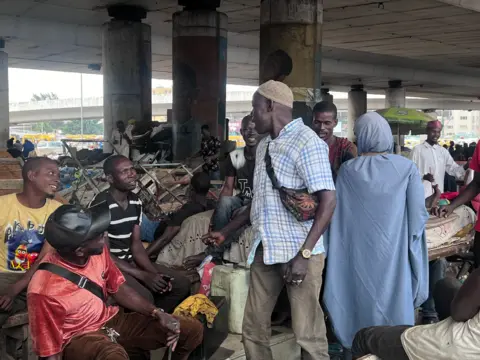
The branch has now been dubbed “Karkashin Gada”, which within the Hausa language manner “Under the Bridge”.
“The people who come here know someone who is already staying here or have a contact who told them about Karkashin Gada,” Mr Sa’adu says.
“When I came here, there were less than 10 people.”
Adamu Sahara, who has lived in an apartment close to Karkashin Gada for more than 30 years, says that homelessness is increasing in Lagos.
“Insecurity [including an insurgency by jihadist groups] and the failing economy has made a lot of people to flee northern Nigeria,” Mr Sahara says.
“Nigerian leaders have to be aware of what is happening so they can fix the problem because no human being is supposed to sleep under a bridge.”
Karkashin Gada’s longest resident has disagree plans to go back to Zamfara as financial alternatives there stay bleak with kidnapping and banditry at the stand.
This has pressured many crowd to leave their companies and farms as they possibility being taken hostage through gangs difficult ransom bills.
To produce moment as at ease as conceivable, Mr Sa’adu has got a bed, some bedding, a picket cupboard and a mosquito web.
He has put the bed on lead of the cupboard, and that’s the place he sleeps.
 Getty Photographs
Mr Sa’adu is one of the better-off as probably the most alternative males who are living there haven’t any furnishings, and proportion dozing mats which they roll out at the ground.
Fortunately the chance of robbery is minimum as some “residents” of Karkashin Gada are typically round, both running or taking part in their hour off.
All of them worth a close-by population tub and bathroom at a value of 100 naira ($0.06; £0.05) a consult with.
Cooking – or lights fires, even in wintry weather – infrequently occurs in Karkashin Gada as maximum of its population purchase meals from distributors who promote dishes prevalent with northerners.
“This is one of the places in Lagos where you see a large number of people from northern Nigeria so I sell fura [millet flour mixed with fermented milk] here and I am happy to say a lot of people do buy,” food vendor Aisha Hadi tells the BBC.
During his three decades in Lagos, Mr Sa’adu has progressed from being a shoe-shiner to being a scrap-metal seller – picking up metal from the streets and workshops for a business that sells it on for recycling.
It earns him an average of 5,000 naira ($3; £2) a day, above the extreme poverty threshold of $1.90 a day but barely enough for him to survive.
“Don’t forget I have to also send money to my family back in Zamfara every week, so it is a continuous struggle,” Mr Sa’adu says.
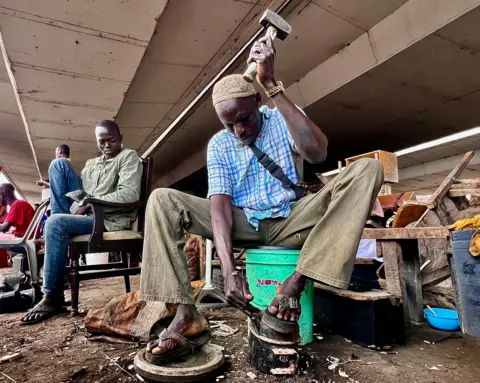
It’s non-transperant what number of crowd relief on Lagos’ streets, however non-governmental organisations say they’re as much as half-a-million.
Within the endmost few months, the Karkashin Gada family has come beneath weighty drive from the Lagos condition environmental process pressure.
Its officials perform occasional raids as they are saying crowd reside there illegally.
The ones arrested possibility fines of as much as 20,000 naira ($12; £9), a hour’s source of revenue for lots of the crowd residing beneath the bridge.
“They come at around 1am or 2am, to arrest people sleeping here. Where do they want us to go?” Mr Garba says, including that through morning maximum “residents” could have returned.
He urges the federal government to turn compassion, and “to look into the issue of housing so that poor people like us can get good places to live”.
But in Nigeria, the government does not provide shelter for homeless people. Nor is there any plan to do so.
Instead, the current focus in Lagos is on helping people on low salaries – such as cleaners, drivers and messengers in offices – to buy homes.
For people like Mr Sa’adu, any type of housing in Lagos is unaffordable – renting a shack in an informal settlement costs around 100,000 naira ($48; £62) a year, while in a working-class area, a small apartment costs around 350,000 naira ($220; £170) annually.
Worse still, many landlords demand a year’s rent at the time of occupation, with no plans by the government to regulate the market despite the fact that the cost-of-living crisis is making housing unaffordable for even some young professionals.
Against this backdrop, the likes of Mr Sa’adu have resigned themselves to continue living under Obalende Bridge.
“Making an allowance for what I do, it’s tough to save lots of plethora to get a reliable playground to stick,” he says as he lies on his mattress with the noise of vehicles driving just above his head.
“I am already used to the sound of cars. It doesn’t affect my sleep at all especially after a tired day,” he adds.
You may also be interested in:
 Getty Photographs/BBC













