
 Dennis Osadebe
 Glody Murhabazi
With mpox being declared a people condition crisis of global worry via the International Fitness Group as a result of its speedy unfold, all visuals were at the Democratic Republic of Congo, which accounts for just about all of this 12 months’s recorded circumstances and greater than 450 deaths.
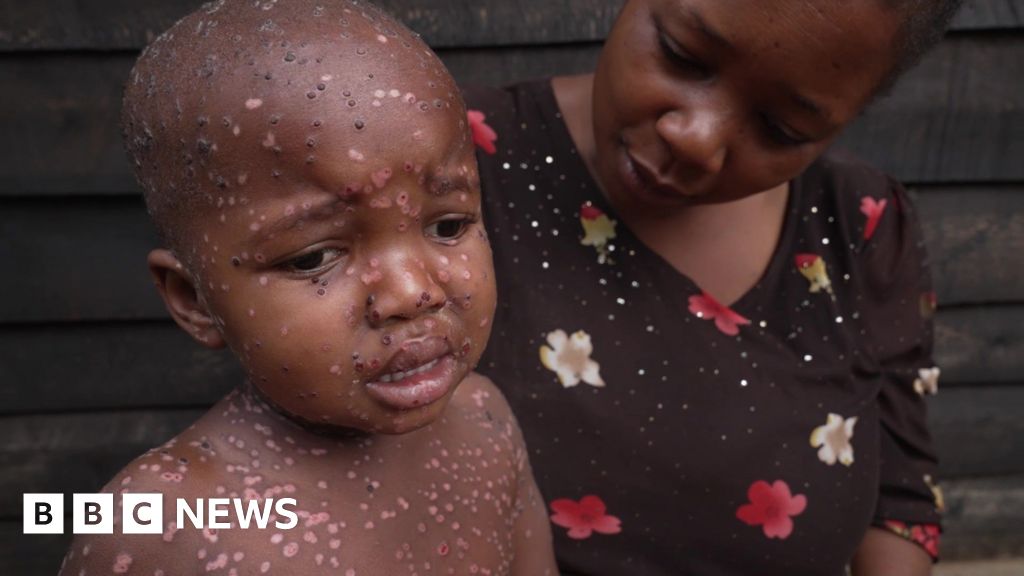
In visits to remedy centres within the east of the rustic, the BBC has discovered youngsters are worst suffering from the disorder, which can also be calamitous.


“It began like a small, inflamed spot. The mother squeezed it and watery discharge came out. Then another developed, and after a short period, they were all over the body,” says Alain Matabaro, describing how mpox advanced in his six-year-old son Amani.
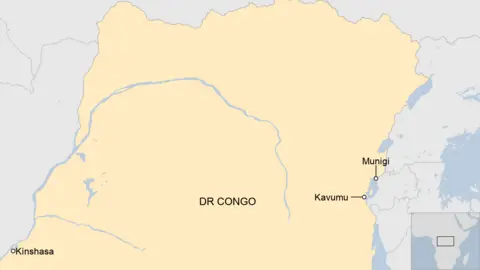
He began recuperating later 4 days of remedy at a health facility in Munigi, similar to the foremost jap Congolese town of Goma.
Some 75% of the circumstances being distinguishable via medics there are below the pace of 10, consistent with Dr Pierre-Olivier Ngadjole who works for the fund Medair.
Younger family appear to be specifically badly suffering from the mpox outbreak as a result of their much less advanced exempted methods.
Dr Ngadjole additionally blames overcrowding at a close-by camp arrange for family compelled from their properties via battle within the pocket. A technique mpox is unfold is thru very similar touch and kids “are always playing together. They don’t really care about social distance,” he tells the BBC.
“You can also see in the households, they even spend the night in the same bed. You can find three, four, five children. The transmission is present on a daily basis.”
Since June, the health facility in Munigi, which supplies distant remedy together with antibiotics to regard pores and skin infections, paracetamol and preserve ingesting aqua, has handled 310 mpox circumstances. It’s now visual between 5 and 10 pristine admissions each and every date.
Incorrect-one has died from the illness there and Dr Ngadjole believes it’s because family are searching for assistance early.
“I think it’s very important to provide free health services especially in this context… [It] means people don’t face any financial barrier, they come early to the health facility.”
This is a other tale 80km (50 miles) south-west of Munigi, at the alternative facet of Puddle Kivu, at a health facility in Kavumu.
8-hundred sufferers were distinguishable there since June and 8 have died – all below the pace of 5.
 Glody Murhabazi
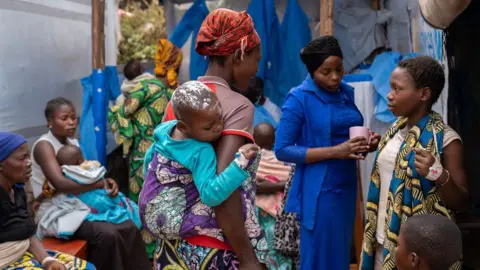
Two-year-old Ansima Kanigo stuck mpox from considered one of her 4 siblings, who’ve all had the illness.
Her mom, Nzigire Kanigo, 35, had incorrect concept what it used to be to start with.
“This is the first time I’ve seen it. When my child got sick, the other parents told me it might be measles, but we started treating measles and failed, so we decided to come here.
“God bless the doctor who has brought the drugs… Three [children] are cured – they are at home. I only have two who I am admitted with now in this hospital. I thank God.”
The medical director at the hospital, Dr Robert Musole, says the outbreak should not be underestimated by the authorities.
“The situation is really serious, and we’re so overwhelmed, because we have a small capacity, but we’re in great demand.
“The first challenge we face in this response is the accommodation of patients. The second challenge is the availability of medicines, which we don’t have.”
Across eastern DR Congo, there are several camps for the millions who have fled their homes as various rebel groups operate in the area.
People are often crammed into makeshift structures and living in poor conditions without good sanitation – the perfect place for mpox to run rampant.
Health workers have been visiting places like Mudja camp near Mount Nyiragongo, to educate people on what to do when they spot symptoms, such as limiting contact with others.
“This disease has brought us a lot of fear that we shall all get sick,” says Josephine Sirangunza, who lives in the camp with her five children.
She says the government needs to give out some basic equipment to help stop the disease spreading.
“When we see someone getting sick, we worry about how to protect ourselves.”
It is a sentiment shared by Bosco Sebuke, 52, who has 10 children.
“We have been sensitised [about mpox], but we are full of fear because we are crowded in our shelters. We sleep in very poor conditions, we share bedding, so prevention is difficult and because of that, we are afraid,” he says.
The outbreak in eastern DR Congo is of a new strain of mpox called Clade 1b and it has now spread to neighbouring countries.
Last week, the Congolese government said it hoped that vaccines would start to arrive from the US and Japan soon. Until then, the country does not have any vaccines despite being at the epicentre of the virus.
Mr Matabaro, the father of Amani who is now recovering from mpox, says he is hopeful with news that vaccines could be on their way.
But the distribution will be extremely limited and, as Dr Ngadjole says, vaccination is just one aspect of reducing the spread of the virus.
“The [easiest] action to put in place is to improve the hygiene. When we improve the hygiene at household level, when we improve the hygiene at community level, it’s very easy to decrease the risk of transmission.”
Ms Sirangunza echoes the doctor’s thoughts: “Tell our leaders to send us medicine, soap, and other protective measures so that we don’t get infected.”
 Getty Photographs/BBC













