
 Dennis Osadebe
 BBC
Some of the worst droughts in residing reminiscence is sweeping throughout southern Africa, resignation related to 70 million public with out enough quantity meals and H2O.
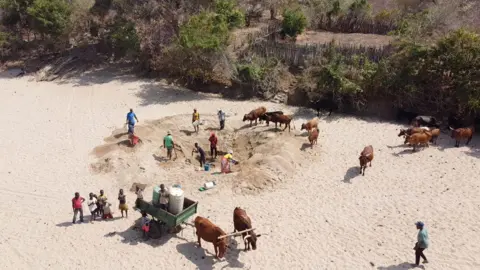
In Mudzi district in northern Zimbabwe, a nation and their cattle are accumulated on a bone-dry riverbed. The Vombozi usually flows during the yr however at the moment, it’s only beige sand so far as the vision can see.
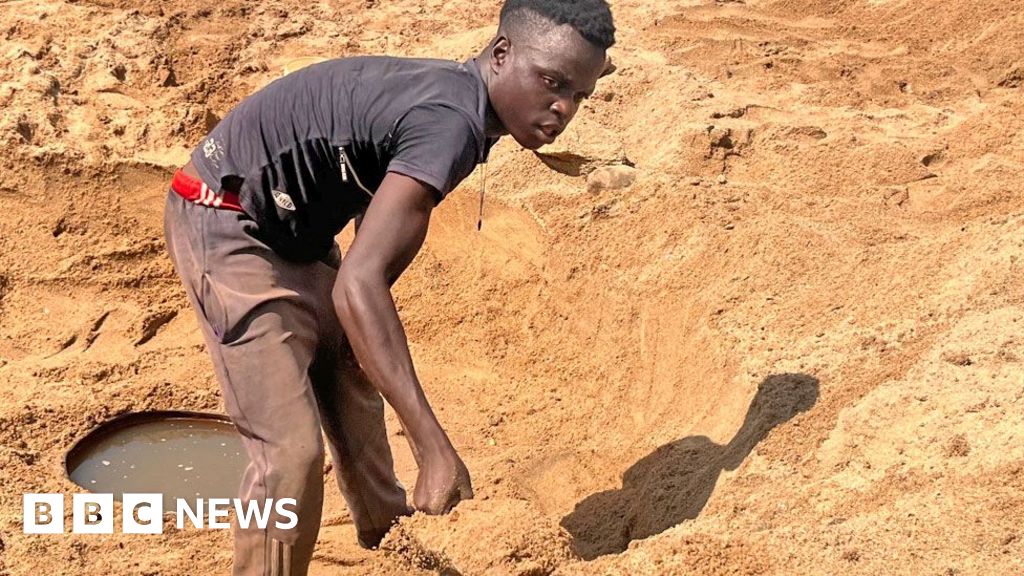
Armed with shovels and buckets, the lads are digging into the river flooring, desperately seeking to take back the utmost drops of H2O from it.
Rivers and dams have hard up in alternative portions of the district and in consequence an increasing number of public are descending in this particular riverbed in Kurima village, placing drive at the H2O supply.
Alongside the riverbed are a number of holes, massive enough quantity to suit a unmarried bucket.
Youngsters are cleansing, ladies are doing laundry and giving their bellowing farm animals beverages of H2O.
Gracious Phiri, a mom of 5, stands amongst those ladies. The 43-year-old tells the BBC she now has to proceed additional than regular, spending 3 hours each and every week travelling to fetch H2O.
Ms Phiri lowers her bucket into the half-metre (19in) huge hollow and attracts brown-coloured H2O. She worries about her society getting unwell.
“As you can see, the cattle are drinking from the same pit as us. Their urine is right there… it is not very healthy,” she says.
“I have never seen anything like this.”
Food is also in short supply in Zimbabwe where 7.7 million people face hunger. In Mudzi the number of families who have access to a sufficient amount of affordable, nutritious food has dropped by more than half compared to previous years, the local health authority says.
Children have been particularly impacted – since June hospital admissions for youngsters with moderate to severe malnutrition have doubled.
A village feeding programme is trying to tackle the problem. Once a week women in the community gather, bringing whatever produce they have in order to contribute to a porridge for under fives.
Ground baobab fruit, peanut butter, milk and leafy green vegetables are stirred into the porridge to add extra nutrients.
But the list of ingredients shrinks every week – cow-peas and beans recently became unavailable because of the poor harvests.
The government, with the support of partners like the UN children’s agency, Unicef, devised the village feeding scheme and it used to run at least three times a week.
“But because of the El Niño drought we are now only giving it once a week,” explains Kudzai Madamombe, Mudzi district’s medical officer.
“Because the rains didn’t come, we suffered a 100% loss in terms of all the crop,” he adds, saying the programme might be forced to stop altogether in the next month as food stocks dwindle.
Clinics providing Zimbabweans in Mudzi with vital healthcare have also been affected – boreholes that supply a quarter of clinics in the district with water have run dry, Mr Madamombe says.
And the major dam in the district has only a month’s supply of water left.
As a result vegetable irrigation schemes, including one which supported 200 local farmers, have been suspended.
The misery is everywhere. Tambudzai Mahachi, 36, says she planted acres of maize, cow-peas and peanuts on her plot.
For all her hard work, she got nothing at all, not even a plate of food. Even her hardy baobab tree produced hardly any fruit.

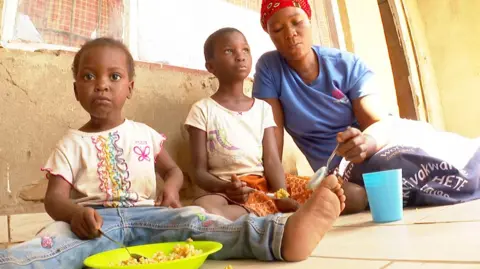
In a good year Ms Mahachi says she would normally supply markets in the capital, Harare, but she is now among the millions of Zimbabweans relying on handouts.
While the village feeding scheme provides food one day of the week, her children need to eat every day.
Seated in a thatched hut, she boils wheat so she can provide her two children with breakfast. The wheat was supplied by a charitable neighbour.
“We have gone from eating what we want and when we want to limiting meals,” Ms Mahachi says.
“The older girl understands that we sometimes can only have porridge. But at times I can see that my youngest is hungry.”
The rains failed in maximum of southern Africa this yr, on a continent the place many of the agriculture is determined by hail, in lieu than irrigation, for H2O.
The drought has induced a few 3rd of the nations in southern African to claim a atmosphere of emergency. A large 68 million public around the area want meals backup.
The Southern African Construction Public (Sadc) – a grouping of nations within the area – appealed for $5.5bn (£4bn) in backup to fight the consequences of drought in Would possibly. Thus far, just a little fraction has been gained.
“Should you exit anyplace in southern Africa, society granaries are blank, and maize, which is the area’s maximum ate up when it comes to carbohydrates, is now priced out of many public’s arms,” Tomson Phiri, southern African spokesperson for the UN World Food Programme (WFP), tells the BBC.
“The status is handiest committing to worsen.”
The WFP has only received one fifth of the $400m its needs for emergency assistance, he says, adding that southern Africa is experiencing its largest deficit in maize in 15 years.
And the hunger and water crisis is yet to peak – October, the hottest and driest month of the year, is still a long way off.
If rain falls in November or December, which is when the rainy season typically starts, farmers will have to wait until March to harvest maize.
It is something Ms Mahachi is acutely aware of as she cracks open some wild fruit to stave off her hunger pangs, unsure about what lies ahead in the coming months for her young family.
You may also be interested in:
 Getty Pictures/BBC













