
 Dennis Osadebe
 AFP
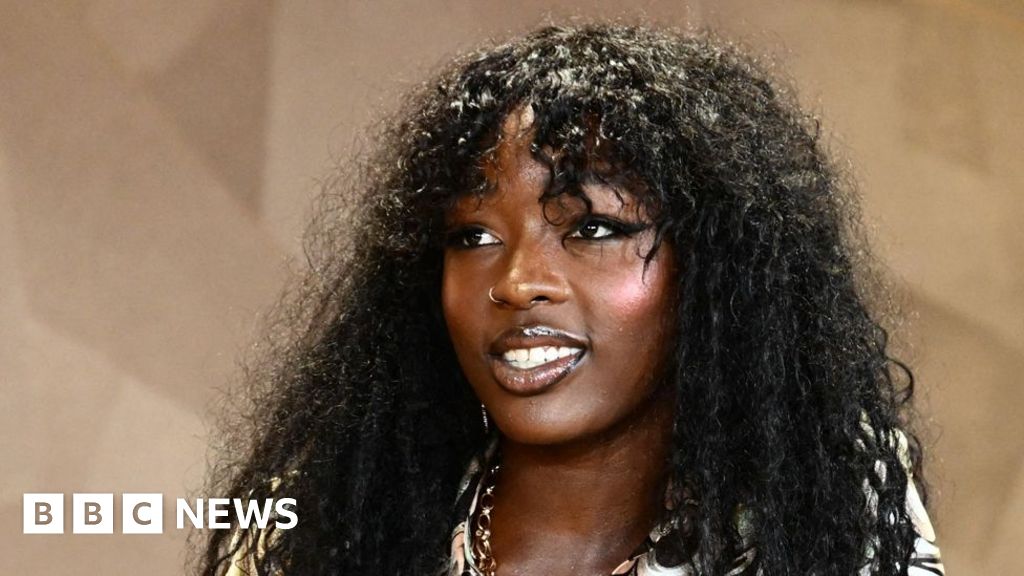
“Sending money back home or to your extended family is such a common African practice that I absolutely hate,” stated Kenyan influencer Elsa Majimbo previous this occasion in a now-deleted TikTok rant that sparked a enraged debate on social media.
The 23-year-old, who shot to reputation all the way through the covid pandemic together with her comedic movies, touched a nerve when it got here to discussing together with her 1.8 million fans what’s referred to as “black tax”.
That is when cloudy Africans who reach a modicum of good fortune, whether or not at house or out of the country, to find themselves having to aid much less well-off society contributors.
Giving again is unmistakable as an intrinsic a part of the African philosophy of ubuntu, which stresses the worth of the society and society, instead than the person.
The query for lots of is whether or not that is an useless and uninvited burden or a part of a society legal responsibility to support rush others up.
However Ms Majimbo, now based totally in the United States, is pushing again in opposition to the observe.
Within the video she stated her father had supported contributors of the prolonged society for years and now they had been having a look to her for support. She grew to become her infuriate on one specific unnamed relative.
“You’ve been asking my dad for money since before I was born. I was born, I was raised, I grew up, now you’re asking me for money – you lazy [expletive]. I’m not feeding your habits.”
Occasion some have affirmative, others have taken factor together with her place. It isn’t sunlit why the video was once got rid of from TikTok and Ms Majimbo’s control workforce declined the BBC’s request for remark.
However for lots of, irrespective of what they could in my view suppose, it’s only now not conceivable to disagree to support kin on account of the sense of society during which they had been raised.
There is usually a sense of delight in serving to take charge of the society even though it will probably transform extra.
A former coach in Zimbabwe in her 50s, who requested to stay nameless, informed the BBC that 30 years in the past nearly her complete first pay cheque of 380 Zimbabwe bucks went directly to her 9 siblings.
“After I finished buying [school] uniforms, clothes and groceries, I had $20 left,” she informed the BBC in a accentuation that urged each celebrate and annoyance.
Even if this supposed she had to shop for meals on credit score, she stated that because the eldest kid it was once anticipated she would give up money the presen she started to begin incomes.
Her wage didn’t belong to her isolated however to her society as effectively.
When she were given married, her obligations prolonged even additional. At one level, she needed to draw out a mortgage to pay her brother-in-law’s tuition charges nearest she was once pickpocketed on her approach to vault a cheque on the depot. It took her two years to repay.
Sandra Ajalo, a 28-year-old hairstylist in Uganda, is thankful for the support that kin prolonged to her society when she was once rising up.
Ms Ajalo and her 3 siblings had been raised through a unmarried mom and kin assisted her with diverse issues, from paying faculty charges, to groceries or even clinical bills.
“It’s not a burden, it’s a communal helping,” she informed the BBC.
But if she noticed Ms Majimbo’s video she understood the place the social media famous person was once coming from, particularly because the Ugandan was once now ready to support alternative society contributors.
“It can be straining, it can be frustrating, but we need it. No man is an island. We have to help each other however we can.”
Dr Chipo Dendere, an worker teacher in Africana research at Wellesley Faculty in the United States, argues that the need of “black tax” is rooted in colonialism.
The machine of oppression that concentrated assets within the fingers of the colonial energy or a slight minority of settlers made it unimaginable for almost all to amass property.
This “left many black families with no generational wealth”, Prof Dendere said.
In many cases, after independence, rather than being upended, the inequalities were replicated.
Dr Dendere added that the payment of “black tax” can often become a “never-ending cycle” as the cash despatched to society contributors incessantly simplest quickly plugs a hollow which can upcoming re-open.
Another factor is that, unlike in richer countries, many African states are unable to pay for healthcare beyond the basics, a decent pension or cover tuition fees. As a result it falls on the most well-off in a family to fork out for these expenses, Dr Dendere said.
“There’s no pension charity from the surrounding – we’re the pension. Households are stepping in to do the activity of the federal government.
“We give because of ubuntu. We are forced to take care of each other.”
In 2023, price range despatched house through African migrants amounted to about $95bn (£72bn), consistent with the World Treasure for Agricultural Construction, which is nearly the scale of the Kenyan financial system.
For Africans out of the country the tension may also be even larger as public be expecting extra because of a trust that the ones in a foreign country create a dozen of cash.
Gabe Mutseyekwa, 35, is a Zimbabwean guy who has lived in Germany for over 5 years. He put his bedrock i’m sick and informed his society he would prohibit sending per thirty days bills as it was once fighting him from preserve up for his personal hour.
His society didn’t react effectively – however they sooner or later came to visit.
“They realised that I was all alone and I needed to make something of myself,” he stated.
At one level he despatched house about €2,000 ($2,200; £1,700) for a society disaster when he was once nonetheless a scholar doing part-time jobs.
“There needs to be a balance between bearing this financial responsibility and your personal financial health,” he informed the BBC.
Many public have famous that society contributors can really feel a way of entitlement in your cash particularly when the individual is affluent prosperous.
This in particular irked former Nigerian footballer Mikel John Obi. Ultimate yr, he spoke about “black tax” all the way through his look at the Rio Ferdinand Items podcast.
“When you come from Africa, when you make money, it’s not your money. It’s not just your money. You have all these relatives, cousins, whatever you call it,” he stated.
He added that kin saved having such a lot of children and anticipated him to take charge of them.
Occasion now not everybody affirmative with Elsa Majimbo’s rant, it sort of feels to have touched a nerve, particularly a number of the more youthful date.
However Dr Dendere argues that until Africa can in reality create, “black tax will be here in perpetuity”.
Supplementary reporting through Tony Vinyoh
You may additionally be focused on:

 Getty Pictures/BBC













