
 Dennis Osadebe
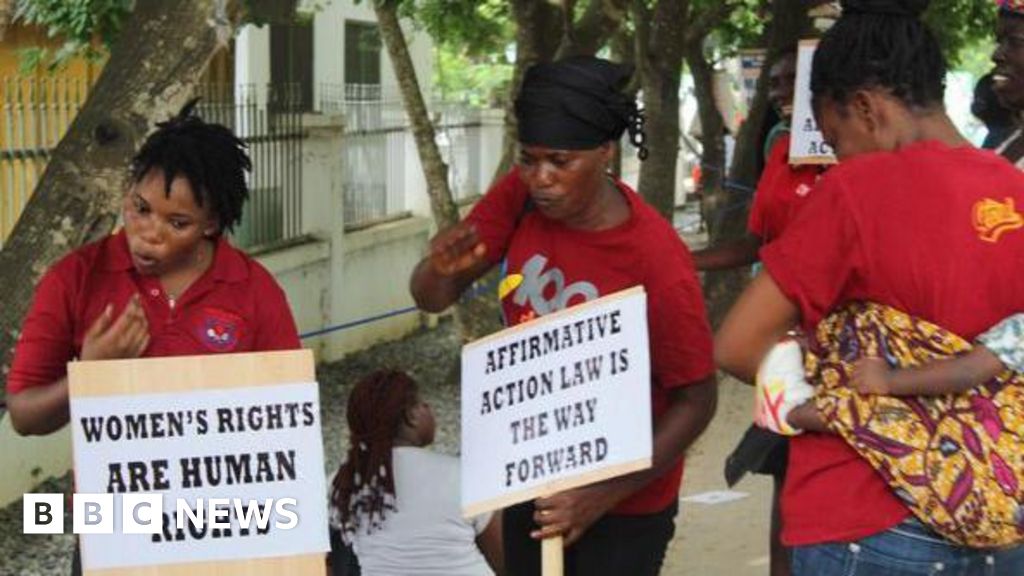
 ABANTU FOR DEVELOPMENT/FACEBOOK
Girls’s rights advocates are challenging the speedy implementation of a just about 30-year-old gender fairness invoice which Ghana’s president signed into legislation on Thursday.
This ends a procedure which started in 1998, with the invoice shuffling between parliaments till the legislature handed it in July this 12 months. Many campaigners faulted Ghana’s law-making frame for the lengthy extend.
Ghana now joins Rwanda, Uganda, Burundi, Mozambique and others in Africa that experience operating correct motion rules.
Those nations have a 30% quota for ladies in decision-making our bodies, in parliament and alternative atmosphere businesses.
What adjustments does Ghana’s brandnew legislation usher in?
Ghana’s Yes Motion (Gender Equality) Employment 2024 is predicted to safeguard a vital selection of ladies store key positions in executive, safety, trade and alternative decision-making areas.
The legislation promotes the motivated and lively participation of girls in population day from at least 30% to 50% by way of 2030, in form with the UN’s Sustainable Building Function of accomplishing gender equality by way of 2030.
The rustic’s business unions are mandated by way of this legislation to safeguard gender balanced illustration on their govt forums, occasion non-public industries which implement provisions of this legislation to make use of ladies would take pleasure in tax incentives.
Next the legislation handed in July, Speaker of Parliament Alban Bagbin stated he was hoping lawmakers would decide to the reforms and “do more to create a free and just society to liberate more women to support us develop mother Ghana”.
What occurs if community crack this legislation?
Subjecting an worker to gender-specific verbal assaults, stereotyping, dislike accent or harsh rhetoric in addition to discriminating in opposition to, intimidating or in search of to disqualify a candidate on gardens of gender are all forbidden underneath this legislation.
Consequences come with fines, and prison phrases of between six and one year.
Any work that victimizes, obstructs or exerts “undue influence on a person” in a way that undermines the new law is deemed an offence.
Trade unions who fail to comply could lose their registered status.
What are people saying about it?
Female lawmakers have described the law as a strong statement for the empowerment drive.
Abla Dzifa Gomashie MP, whose constituency is in south-east Ghana, told the BBC she hoped it would “cure the cultural, political and economic discrimination against women and minority groups – especially that of the disability community.”
“We must kick in the advocacy as soon as possible to ensure that state agencies and institutions get on board and educate the populace on the expectation that this law carries,” she added.
But some advocates and activist groups who welcome the law worry that it will not be properly enforced.
“In the midst of the joy, there are fears – we fear that for example where political parties are required to play a role, they may not necessarily do what they have to do,” Dinah Adiko, a technical consultant who previously worked with Ghana’s gender ministry, told the BBC.
“We fear that the supervision of it, regulation… What are the biting powers to actively implement this law? Those are some of the reservations. But for the moment we are excited to see this come to light.”
Has there been a backlash?
There has been little public criticism of the law.
At a recent press conference, a journalist asked if “pursuing equality by way of discriminating in preference of girls” was the wrong thing to do.
But a senior minister dismissed that as a “false impression concerning the invoice fuelling tokenism”.
“Ghanaian ladies are certified to store positions of authority and affect,” Minister for Gender, Children and Social Protection Dakoa Newman told reporters.
Why has it taken so long to become law?
Many blamed both of Ghana’s two main political parties – the NDC and the NPP – for failing to ensure passage of the law, despite repeatedly using it as a campaign promise.
It was final re-introduced to parliament by current Gender Minister Newman earlier this year.
Last year Ghana’s parliamentary speaker said he wanted the bill to be passed but said it was not ready in its current form, and needed “critical stakeholder consultation for a well-defined and crafted law.”
Recalling her stint as a technical advisor at the gender ministry in 2014, Ms Adiko said: “We saw the bill all the way through to cabinet, got the approval until elections and the change in government in 2016 meant it went back several steps again.”
How will this affect elections?
With the Ghana’s general elections approaching in December, there are expectations that it could encourage more women to apply for political office.
At present, two women have successfully submitted nomination forms for the presidency. One less than in the 2020 vote.
With this new law, the electoral commission is mandated to ensure political parties comply with quotas for women at various levels.
The commission is also expected to “put measures in place to increase participation of women in the electoral process as candidates and voters”.
Gomashie MP said she expected “political parties to engage vigorously in ensuring that they create spaces for our women to participate in electoral processes and also be able to contest in a free and fair environment”.
More BBC stories on Ghana and its diaspora:

 Getty Pictures/BBC













