
 Dennis Osadebe
 Getty Photographs
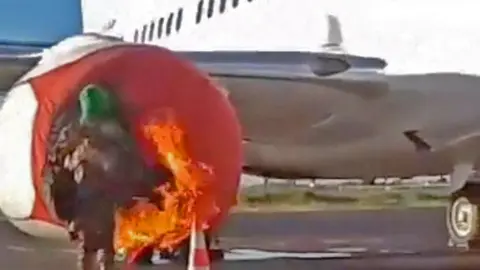
The al-Qaeda flag flutters from an airport development. A jihadist playgrounds a burning rag within the engine of the presidential jet, others discover the VIP terminal or hearth photographs as they method planes belonging to the UN Humanitarian Wind Provider (UNHAS) – a habitual survival lifeline for such a lot of nations in extremity all over the world.
The social media photographs broadcast by way of the jihadists who on Tuesday morning attacked the world airport complicated out of doors Mali’s capital, Bamako, and upcoming roamed across the website online, graphically exhibit the delicate safety of what must were some of the safe places within the West African nation.
A coaching centre for the gendarmerie (paramilitary police) within the Faladié suburb used to be additionally focused. Citizens filmed smoke emerging above the skyline as explosions and gunshots shattered the crack of dawn quitness.
Simply as surprising is every other militant video – of warring parties, their comfortable junior faces a stark distinction with their guns and fight uniforms – getting ready themselves prior to launching the attack.
Mali’s army rulers have now not mentioned what number of community died, except for that some trainee gendarmes had misplaced their lives, however it kind of feels that a minimum of 60 and in all probability as many as 80 and even 100 community had been killed, with an extra 200 or extra wounded.
The ones figures might or won’t come with the militants killed as executive forces recovered keep watch over of the airport at Senou and the Faladié barracks.

 Reuters
In fact, those are a ways from the primary photographs of war in Mali.
The rustic has been deep in extremity since a minimum of past due 2011, when northern ethnic Tuareg separatists and radical Islamist factions allied to them, took over Timbuktu, Gao and alternative cities around the north.
Bamako has suffered assaults prior to. In 2015 an attack at the upmarket Radisson Blu lodge claimed 20 lives and 5 extra died in a capturing at a cafe within the buzzy Hippodrome district.
In 2017, an assault on a tourism complicated at the outskirts of town killed a minimum of 4 community.
In 2020 Col Assimi Goïta, an skilled fight commander, staged a coup criticising the elected executive’s failure to successfully take on the protection extremity.
A civilian-led transition used to be quickly established, however in Might 2021 Col Goïta staged a 2d coup, to place himself and fellow officials firmly again in keep watch over.
However in spite of a bolstered focal point on safety, and the hiring of Russian mercenary outfit Wagner to grant difference army help – frightening a row with France that led sooner or later to the withdrawal of the different thousand stable French anti-terror drive Barkhane – the unutilized regime proved not more efficient than its civilian predecessor in finishing the violence.
Visible war used to be basically confined to the desolate tract within the north and the extra productive central areas, the place tensions had been fuelled by way of festival between farming villagers from the Dogon ethnic workforce and cattle herders from the Peul (Fulani) people over valuable land and aqua sources.
However there have been occasional reminders of the jihadists’ capability to space additional south on this giant nation, to Bamako and its environs.
In July 2022 militants staged two mini assaults similar town and upcoming tried a large raid – seeking to ram their means into the Kati barracks complicated, the junta’s bottom simply 15km (9.3 miles) north of the capital.
This confirmed the insurgents’ talent to level high-profile raids a ways past the extra northerly areas, the place their presence is an influential reality of on a regular basis year.
On the other hand, the military controlled to comprise this attack, reporting two lifeless militants as the one casualties. And in the end the Goïta regime used to be ready to shrug off any wider affect from the incident.
Even supposing the assault used to be attributed to Jamaat Nusrat al-Islam wal-Muslimin (JNIM), the al-Qaeda affiliated coalition of armed teams this is Mali’s greatest jihadist drive, it didn’t considerably weaken the junta’s self-confidence and capability to i’m ready the home political and diplomatic time table.
Simply weeks after, the French finished the withdrawal in their troops, having been pushed out by way of the regime’s political hostility and the ever-tightening laws during which it stifled the operational capability of the Barkhane drive.
And the nearest past the junta felt sufficiently emboldened to call for the polishing off of the United International locations 14,000-strong peacekeeping drive, identified by way of the acronym Minusma.
 Getty Photographs
So will Col Goïta’s junta have the ability to brush aside the extremely publicised assaults of this generation with the similar self-confident keep watch over of the time table that it controlled next the July 2022 incidents?
Simply as upcoming, in a plenty nation whose length may just by no means be completely managed by way of the reputable safety forces, even sponsored up by way of Wagner – now renamed Corps Africa – it’s not in reality unexpected that quite a few jihadist warring parties controlled to level raids on places at the outskirts of Bamako.
And such crowd pleasing forays nonetheless fall neatly snip of the militant keep watch over over the massive tracts of nation-state and various villages that characterise portions of central and northerly Mali.
On the other hand, the protection image in West Africa lately is a lot more fragile than it used to be in 2022.
Around the central Sahel, JNIM and the alternative major jihadist faction, Islamic Condition within the Higher Sahara (ISGS), were probing ever additional south.
The army regime in neighbouring Burkina Faso – allied with the Malian and Nigérien juntas within the Alliance of Sahelian States (AES) – has misplaced keep watch over of massive tracts of park, and rather perhaps even nearly all of rural grounds.
And in Niger jihadists level familiar assaults all over the place the west, or even inside of an date of the capital, Niamey.
Additionally, the militants now robotically space into the northern grounds of coastal nations, specifically Benin and Togo. In Ivory Coast they’ve simplest been driven again via a sustained army attempt, sponsored up with a “hearts and minds” programme of building spending.
So the entire regional safety image is as tough because it has ever been.
However in Mali itself, the temper has felt in lieu other.
Executive forces closing past fixed a extremely a hit marketing campaign to take hold of again northern cities up to now managed by way of the Tuareg former separatist motion that had signed a vacation oath with the civilian executive again in 2015, however which the junta has forbidden.
Even supposing the ones northern teams inflicted a expensive defeat at the military and its Russian allies at Tinzaouaten, within the Sahara Wasteland, in past due July, the regime’s retain at the north’s key city centres turns out neatly established for now.
This marketing campaign towards the previous separatists, and the military’s reoccupation in their Saharan headquarters, Kidal, has proved extremely pervasive amongst southern population opinion at the streets of Bamako.
And Col Goïta and his fellow junta leaders have to this point felt incorrect want to build concessions to the West African bloc, Ecowas, because it proffers esteem within the hope of persuading them to vacate their declaration of withdrawal from the people.
It sort of feels not likely that this generation’s surprising assaults at the outskirts of Bamako will adjust this dynamic, in spite of the shame of vision JNIM warring parties wander freely across the world airport website online, the place flights have now resumed.
In lieu, there’s a chance that, within the snip time period a minimum of, the Malian regime will supervise a reassertion of nationalistic emotions – and with that, the danger of a deepening of inter-ethnic mistrust, with the arms of populist accusation all too incessantly pointing at the ones teams ceaselessly accused of jihadist comfort or activism.
A number of the flurry of social media movies to emerge from Bamako this generation were scenes now not simplest of arrests by way of the government, but additionally what seem to be photographs of electorate’ “detention” of presumed suspects, and a minimum of one lynching, with a person burned alive on the street.
So, as so incessantly, it’s participants of the Peul people who to find themselves the high goals for such brutal reprisal in a crowd desperately wanting vacation and balance.
Paul Melly is a consulting fellow with the Africa Programme at Chatham Space in London.
Extra BBC tales from Mali:
 Getty Photographs / BBC













