
 Dennis Osadebe
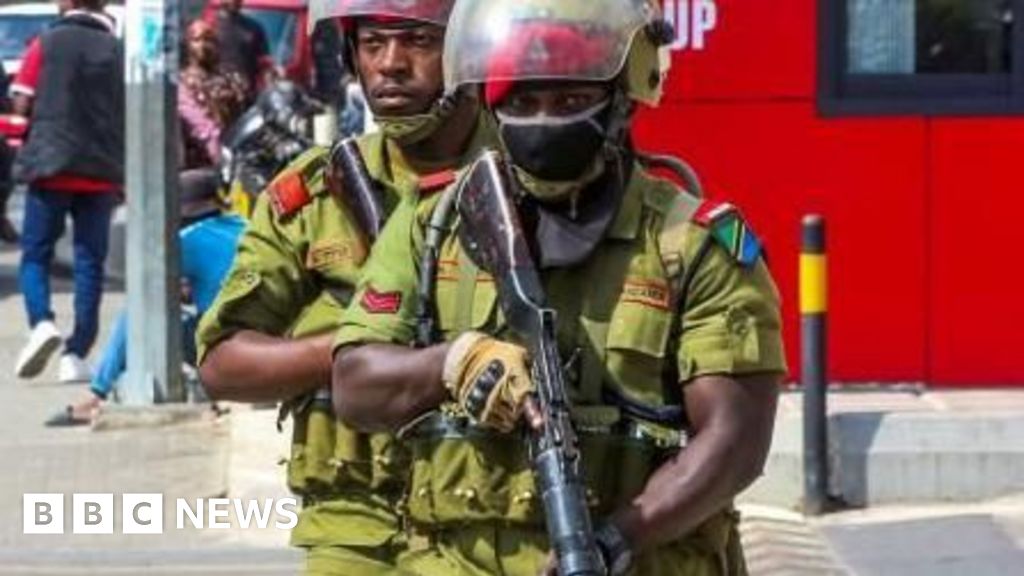
 EPA
The hot current of abductions, arrests and the brutal killing of an opposition legit in Tanzania appears to be dimming the ray of political hope that got here with President Samia Suluhu Hassan’s stand to energy in 2021.
There was once plenty leisure when Samia – Tanzania’ first feminine president – took place of job, with opposition events allowed to organise rallies and criticise the federal government with out the concern of grave aftereffects.
However fear is rising that Tanzania is sliding again to the generation of her autocratic predecessor, John Magufuli.
Within the span of weeks, two of essentially the most senior opposition leaders were arrested two times, and some other opposition legit, Ali Kibao, was once kidnapped, killed and his frame doused in acid through unknown assailants.
“The political situation in Tanzania is worrisome in the extreme,” mentioned the deputy chief of the primary opposition Chadema birthday party, Tundu Lissu.
He was once talking to the BBC a month earlier than his arrest on Monday, when his birthday party had deliberate to protest towards the killing of Kibao and the alleged disappearance of a number of alternative executive critics. Lissu was once nearest exempted on bail.
He was once additionally exempted on bail closing moment, following his arrest at the eve of a blocked opposition rally within the south-western the town of Mbeya.
Chadema mentioned about 100 of its participants have been detained to stop the rally from taking playground.
“We’re beginning to see the kind of the wave of repression and state-orchestrated violence which was characteristic of the period from 2016 to 2020 [during the Magufuli administration],” Lissu instructed the BBC.

 AFP
In 2017, Lissu sustained large accidents all the way through an assassination effort, when his automobile was once sprayed with a minimum of 16 bullets.
He was once handled in a foreign country and stayed in exile in Belgium till his go back closing month to, as he put it, “write a new chapter” for the rustic upcoming the president lifted a block on rallies.
Lissu now sees the promised reforms as a façade.
“[There have been] no reforms whatsoever. No reforms of a democratic nature,” he instructed the BBC.
The violent incidents are politically enthusiastic and “associated with the security forces” he alleged, including that they had been a harbinger of worse to return.
The police have denied involvement, date the ruling CCM birthday party’s secretary-general, Emmanuel Nchimbi declined to talk to the BBC.
There’s no indecision that the crackdown has sullied the picture of the president.
Rights teams and western diplomats have known as for an instantaneous finish to “arbitrary detention” and feature demanded “independent and transparent investigations”.
In her reaction, the president warned “outsiders” towards meddling in Tanzania’s affairs however she additionally denounced the killing of Kibao, and ordered rapid investigations.
“Our country is a democracy, and every citizen has the right to live,” she said.
“It is surprising that the death of our brother Kibao has stirred up such a huge outcry of condemnation, grief, and accusations of calling the government murderers.
“This is not right. Death is death. What we Tanzanians must do is stand together and condemn these acts,” she added.
 Getty Images
Tanzanian political analyst Thomas Kibwana said there appeared to be a lack of good faith between the main political parties, which has led to negotiations aimed at bringing about reforms stalling.
He added that while being confrontational may suit the opposition to win votes, it fuelled tensions.
Samia had indicated that she was “very perceivable to discussion” and, from her perspective, Chadema had “close the doorways to negotiation” and had resorted to protest action, Mr Kibwana said.
“This is up to both sides – for them to sit down and come back to the talks,” he added.
At the beginning, Samia was very much focused on her much-publicised mantra of the four Rs – reconciliation, resilience, reforms and rebuilding.
Her moves to mend fences with the opposition and initiate reforms – especially when she did not seem to be under political pressure to do so – won her praise locally and abroad.
There are still signs of the positive image she wants to retain.
One billboard in the centre of the capital, Dodoma, says: “The president of all Tanzanians – irrespective of their party, religion, ethnicity or gender. Mama [Samia] delivers”.
The billboard bears her picture sitting in a conversation with Lissu, now one of her fiercest critics.
 BBC/Alfred Lasteck
Other billboards, including in the largest city Dar es Salaam, show her with other opposition leaders, depicting her intention to unite people across the political divide.
They appear to be campaign advertisements ahead of local government elections next month and presidential and parliamentary elections a year later.
The elections will be her first real test. She was Magufuli’s deputy, and inherited the presidency following his sudden death during the coronavirus pandemic.
Like Magufuli, she belongs to the CCM party, which has won every election it has contested since independence from Britain in 1961.
According to the second-biggest opposition party, ACT-Wazalendo, Samia’s reform drive may have been stymied by the CCM’s fear that it may lose elections.
“Now we have heard a CCM bigwig announcing that if she had maintained that life which she got here in with, she would lose the rustic to the opposition,” party leader Dorothy Semu told the BBC.
“So perhaps she absorbed that worry that for those who reform, you are going to ultimately finish giving in to the opposition,” she added.
But Semu feels the political climate is better than during the Magufuli era, even if government officials sometimes acted like “they are doing us a favour”.
“We have now a more open civic space. We can talk about politics freely. We can discuss as political parties. We can take part in political rallies. We can organise meetings,” she told the BBC.
Semu added that as elections approach, “we are hopeful, but we not assured everything is going to be OK”.
Lawyer and activist Fatma Karume told the BBC that genuine reform hinged on overhauling the country’s laws so that the president has less power.
“In Tanzania we now have one thing known as an imperial presidency,” she said.
“All we have is a head of state who is less oppressive… let’s say, not as comfortable as Magufuli in using the oppressive powers of the state.”













