
 Dennis Osadebe
BBC Information, Johannesburg
 AFP
South Africa and Rwanda’s already fraught diplomatic family members have worsened later President Cyril Ramaphosa accused the Rwanda-backed M23 riot staff of killing South African peacekeepers in japanese Democratic Republic of Congo.
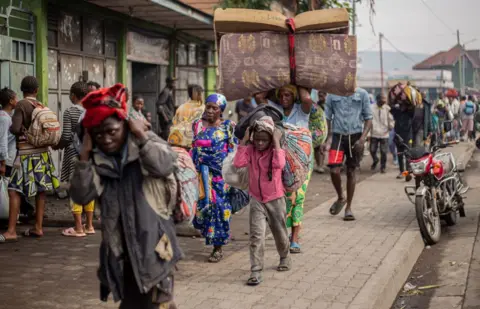
Because the rebels won the higher hand within the battlefield via shooting maximum of Goma – the most important town within the east – South Africa fired a diplomatic salvo, threat that additional assaults on its troops could be regarded as a “declaration of war”.
Rwanda’s President Paul Kagame strike again, accusing South Africa of being a part of a “belligerent force” excited about “offensive combat operations” to assistance the Congolese executive “fight against its own people”.
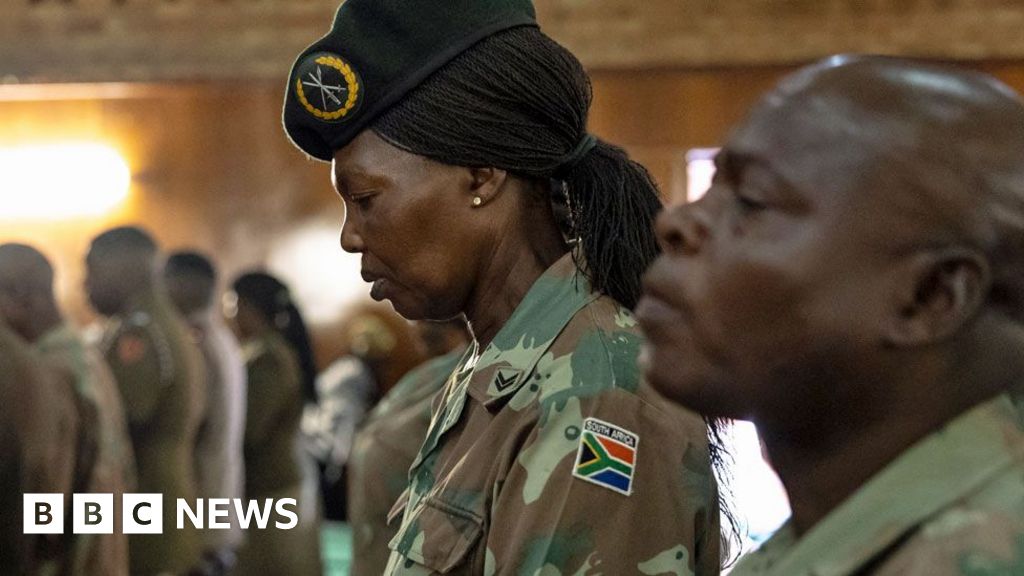
A complete of 13 South African squaddies were killed within the preventing since closing age because the rebels made a lightning go in opposition to Goma – a big buying and selling hub at the border with Rwanda.
Endmost era, some other seven South Africans have been killed in japanese DR Congo – making it one of the vital nation’s deadliest combat-related tragedies in recent years.
South Africa and Rwanda have lengthy had a troublesome dating.
In 2014, South Africa expelled 3 Rwandan diplomats later an assault at the house of an exiled Rwandan dissident in Johannesburg.
Kagame’s executive spoke back via expelling six South African envoys.
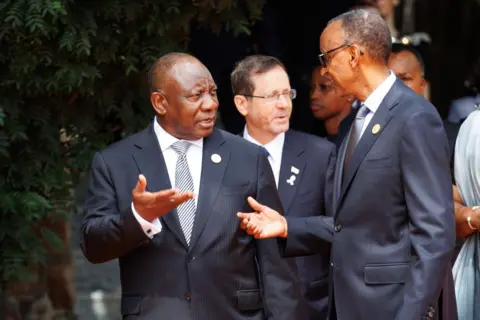
Tensions reputedly eased later Ramaphosa’s talk over with to Rwanda closing era for commemorations to mark the thirtieth annualannually of the genocide during which about 800,000 public have been killed.

 Getty Pictures
However they’ve flared up once more, following the dying of the South Africans who have been deployed to japanese DR Congo in December 2023 as a part of a regional peace-keeping power despatched via the Southern African Construction Society (Sadc)
South African squaddies form up the majority of the power – recognized via the acronym SAMIDRC – that had the project of repelling armed teams such because the M23 and bringing quietness to the mineral-rich pocket following many years of unrest.
The unedited diplomatic fall-out began with a publish shared on Ramaphosa’s X web page.
In it, the president showed he had spoken to Kagame in regards to the escalating warfare and that each leaders had affirmative “on the urgent need for a ceasefire and the resumption of peace talks by all parties to the conflict”.
Ramaphosa additionally insisted, in a then commentary, that the presence of South African troops in DR Congo was once no longer a “declaration of war against any country or state” – an obvious connection with Rwanda.
South Africa’s Defence Minister Angie Motshekga, then again, had a relatively other speed, telling newshounds: “There’s been no hostilities between us, it’s just that when they were firing above our heads, the president did warn them [that] if you’re going to fire, we’re going to take that as a declaration of war.”
However Ramaphosa went additional on X, pronouncing the peacekeepers have been killed in assaults via the M23 and – he pointedly added – “Rwanda Defence Force (RDF) militia”.
This angered Kagame, who stated statements made via South African officers – together with Ramaphosa – contained lies and distortion.
“The Rwanda Defence Force is an army, not a militia,” Kagame spoke back on X.
“President Ramaphosa has never given a ‘warning’ of any kind, unless it was delivered in his local language which I do not understand. He did ask for support to ensure the South African force has adequate electricity, food and water, which we shall help communicate.
“President Ramaphosa showed to me that M23 didn’t shoot the warriors from South Africa, [the Conglese army] FARDC did,” Kagame said.
He added that the regional peacekeepers – who included troops from Tanzania and Malawi – were a “belligerent power” working alongside “genocidal armed teams” that targeted Rwanda, and had “refuse playground on this status”.
Kagame closed his lengthy statement by saying South Africa was in “refuse place to speed at the position of a peacemaker or mediator” and if the country wanted a confrontation, Rwanda would “offer with the subject in that context any past”.
Kagame’s comments clearly suggested that he wants South Africa to back off from DR Congo, where its military involvement dates back to the late 1990s.
It first joined the UN’s peacekeeping mission, Monusco, following the end of the racist system of apartheid in 1994.
At the time, the South Africa’s military had just emerged from being regarded as a “extremely efficient apartheid war-time power” to a “peacetime power” left to grapple with reduced funding and a “dearth of political route”, Thomas Mandrup, an associate professor at the country’s Stellenbosch University, told the BBC.
 AFP
While South Africa has said its involvement in DR Congo was guided by its need to “give a contribution to the stableness” of a fellow Sadc member, defence analyst Dean Wingrin said the country’s economic interests also influenced its decision.
“The DRC is an overly weighty buying and selling spouse with [us] as a result of japanese DRC is so ffluent in minerals. We import a dozen of minerals… from the DRC so South Africa has an pastime in a calm DRC,” he told the BBC.
While Monusco’s mission has largely been about peacekeeping, escalating tensions in the region led to the establishment of the Force Intervention Brigade in 2013 to “actively have interaction” with the numerous armed groups in eastern DR Congo.
This intervention had initial success in repelling the M23, the most prominent rebel group.
This was partly due to the deployment of South Africa’s attack aircraft – Rooivalk – which had a “fatal impact” on the M23 in a short space of time, according to Mr Wingrin.
The rebel group then effectively melted away and was subsequently expelled from eastern DR Congo – until its recent comeback which has seen it capture much of the region.
However, South Africa’s military has been in no position, this time around, to thwart the rebel group’s advance as it has lost its airpower.
“Sadly South Africa’s price range has endured to say no through the years. The breeze power couldn’t have enough money to guard the Rooivalks,” Mr Wingrin said.
“We’re lacking that essential aircover that might’ve are available so at hand a couple of days in the past however is much too overdue now,” he stated.
Mr Mandrup expressed a similar view, saying South Africa deployed its troops in 2023, ignoring warnings that “you haven’t were given the features wanted, the defence power is in shambles and also you’re dealing with an opponent that’s a lot better supplied than in 2013”.
He added that it was difficult for South Africa to bring back its troops at this point because the “forces are locked ill and stuck in two bases”.
“They are able to’t get out, get aircover [or] reinforcements. They are able to’t even get the wounded out,” he said.
Ramaphosa seemed to agree, saying in a recent statement that the situation in the region was “aggravating, risky and unpredictable”.
In spite of this, any decision to pull South African troops out of DR Congo ultimately lies with Sadc since SAMIDRC was deployed by the 16-member regional bloc.
There are reports that Sadc is set to take this decision at a summit taking place on Friday.
For Mr Wingrin, there was a need for the South African government to do “critical introspection” over its military involvement in DR Congo.
“Is it one thing they need to push in any respect prices and what’s it utility to South Africa to have little children death to this point away?” he asked.
So, South Africa’s president appears to have a difficult choice – keep his soldiers in DR Congo and risk further deaths, or the embarrassment of pulling them out, presumably after negotiating safe passage for them with Rwanda.
You may also be interested in:
 Getty Pictures/BBC













