
 Dennis Osadebe
Africa safety correspondent, BBC Information
 EPA
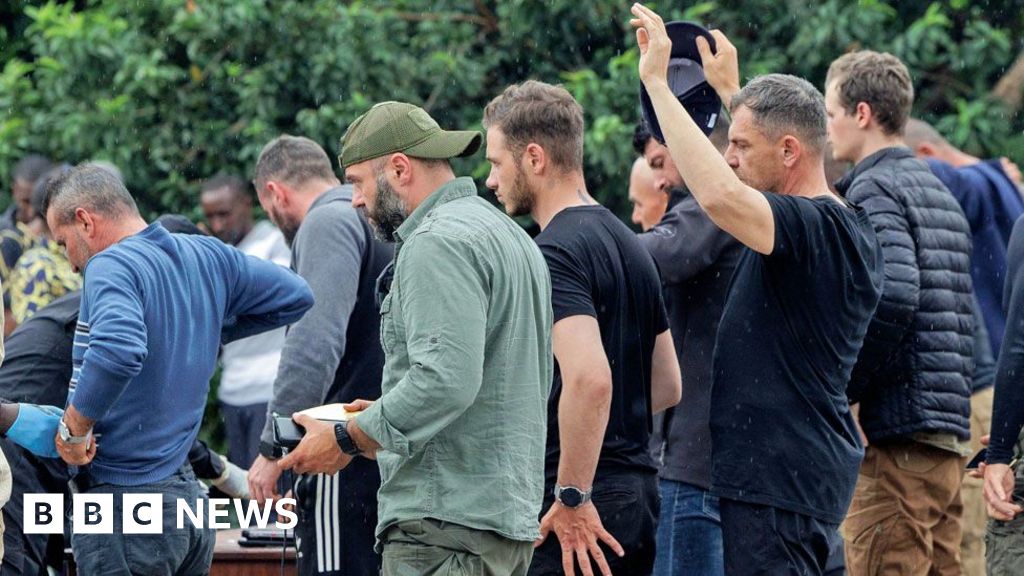
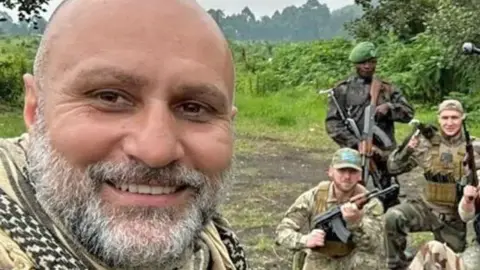
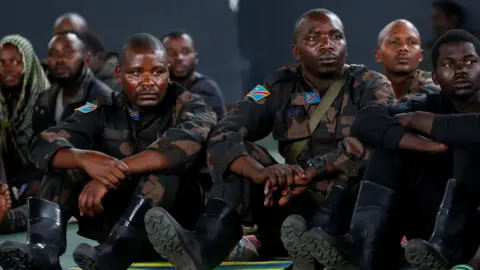
It’s been a humiliating hour for almost 300 Romanian mercenaries recruited to battle at the facet of the military within the Democratic Republic of Congo.
Their give up following a revolt attack at the japanese town of Goma has additionally shattered the goals of those that signed up for the task to earn weighty cash.
The BBC has discoverable agreements that display that those rented infantrymen had been being paid round $5,000 (£4,000) a hour, life habitual army recruits get round $100, or on occasion journey unpaid.
The Romanians had been gotten smaller to aid the military battle the Rwanda-backed M23 rebels, who say they’re preventing to offer protection to the rights of DR Congo’s minority ethnic Tutsis.
When the offensive on Goma began on Sunday evening, the Romanians had been pressured to rush shelter at a UN peacekeeping bottom.
“The M23 rebels were supported by troops and state-of-the-art military equipment from Rwanda and managed to reach our positions around the city of Goma,” Constantin Timofti, described as a co-ordinator for the crowd, instructed Romanian TVR channel on Monday.
“The national army gave up fighting and we were forced to withdraw.”
Romania’s overseas ministry spokesman Andrei Țărnea instructed the BBC that “complex” negotiations adopted, which noticed the M23 quit the Romanian warring parties – whom he described as non-public staff of the DR Congo executive on a military coaching challenge – to Rwanda.
Goma sits fair at the border with Rwanda – and the mercenaries had been filmed by way of newshounds as they crossed over, surrendering to frame searches and alternative tests.
Earlier than they crossed over, telephone photos displays M23 commander Willy Ngoma berating some of the Romanians in French, telling him to take a seat at the farmland, move his legs and put his palms over his head.
He requested him about his army coaching – it was once with the French Overseas Legion, the Romanian responded.
“They recruited you with a salary of $8,000 a month, you eat well,” Ngoma yelled, mentioning the disparity between that and a Congolese military contract’s pay.
“We are fighting for our future. Do not come for adventure here,” he warned.

 AFP
It isn’t cloudless the place Ngoma were given the $8,000 determine, however the guarantee proven to the BBC by way of a former Romanian mercenary in October impressive that “strictly confidential remuneration” for senior team of workers began at $5,000 consistent with hour all over energetic responsibility and $3,000 all over sessions of loose.
The guarantee outlines an “indefinite period” of carrier, with contractors scheduled to rush a one-month crack next each 3 months of deployment.
I had met the ex-mercenary in Romania’s capital, Bucharest, the place I had long gone to analyze Asociatia RALF, which a bunch of UN mavens say is a Romanian endeavor with “ex-Romanians from the French Foreign Legion”.
It’s headed by way of Horațiu Potra, a Romanian who describes himself as an army teacher.
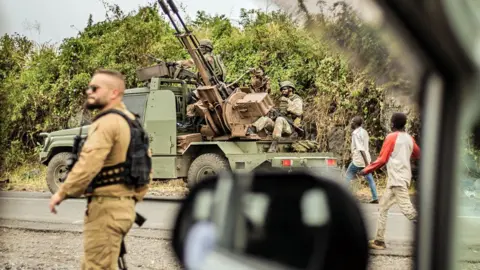
In June life in Goma, I had spotted such mercenaries at checkpoints and deployed across the town, running carefully with military.
Over the ultimate 3 years, others have reported visible them using Congolese troops in military cars.
 Horațiu Potra
“When they arrived, everyone referred to them as Russian,” Fiston Mahamba, co-founder of disinformation team Test Congo, instructed the BBC.
“I think this was linked to the Russian mercenary group, Wagner with presence in several African countries.”
If truth be told, Asociatia RALF may additionally paintings throughout Africa – its guarantee stipulated that it had diverse “operational locations”, together with “Burkina Faso, DR Congo, Ivory Coast, Niger, Senegal, Sierra Leone, Gambia and Guinea”.
The UN mavens say that two non-public army corporations had been introduced on board to strengthen its forces in 2022, no longer lengthy next the M23 had regrouped and begun taking pictures length in North Kivu.
The province has been disturbed for many years with various militias running there creating wealth from its minerals like gold and coltan – impaired to put together batteries for electrical cars and cell phones.
The primary company that was once signed up was once Agemira RDC, headed by way of Olivier Bazin, a French-Congolese nationwide. The mavens say the corporate hired Bulgarian, Belarusian, Georgian, Algerian, French and Congolese nationals.
This outfit was once tasked with refurbishing and extending DR Congo’s army wind belongings, rehabilitating airports and making sure the bodily safety of airplane and alternative strategic places.
A 2nd guarantee was once signed between Congo Coverage, a Congolese corporate represented by way of Thierry Kongolo, and Asociatia RALF.
In keeping with the UN mavens, the guarantee specified that Asociatia RALF had experience and in depth revel in within the provision of safety control services and products.
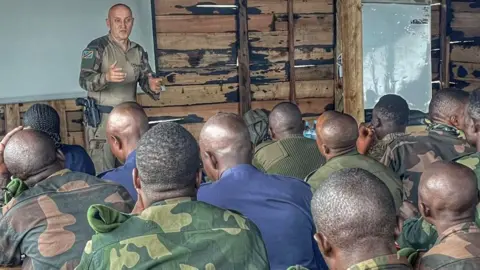
It might lend coaching and instruction to the Congolese troops at the farmland by the use of a contingent of 300 instructors, a lot of them Romanians.
After I stated to Mr Potra in July in regards to the extent of his team’s involvement at the farmland and whether or not it had in demand in preventing, he mentioned: “We have to protect ourselves. If M23 attacks us, they won’t simply say: ‘Oh, you’re just instructors – go home’.”
Mr Potra was once hands-on all over the DR Congo challenge till a couple of months in the past when he returned to Romania – and has since been embroiled in an issue amid the annulled presidential election there.
He was once dramatically arrested in December and has since denied offering safety for the pro-Russian, far-right candidate Călin Georgescu. And because October, he has refused to go back the BBC’s yells.
The ex-mercenary, who was once in his past due forties and stated to the BBC on situation of anonymity, mentioned he had resigned as a result of he was once unsatisfied about how Asociatia RALF was once running.
He mentioned the Romanians did a lot more at the farmland in North Kivu province: “Only a very small number of us were actually trainers.
“We labored lengthy shifts of as much as 12 hours, guarding key positions outdoor Goma.”
He maintained the pay was not worth the risks the military contractors had to take.
“Missions had been disorganised, running statuses unpriviledged. Romanians must cancel going there as it’s bad.”
He also claimed that proper background checks had not been done, and some of the Romanian recruits had no military training – citing as an example that one of his former colleagues was a firefighter.
DR Congo’s government has not replied to a BBC request for comment on whether background checks were carried out, or about the pay disparity between the private contractors and Congolese troops.
The family of Vasile Badea, one of two Romanians who were killed last February when an army convoy was ambushed by the M23 fighters on its way to Sake, a frontline town near Goma, told the BBC he had been a police officer.
The 46-year-old had taken a sabbatical from the force and took up the role in DR Congo because of the lucrative salary offer.
The policeman was struggling to pay for an apartment he had just acquired and needed more money.
 Vasile Badea family
Many more Romanians were lured by the prospects of a well-paid job.
I met one man in Bucharest in October, who was back home looking for more recruits to go to Goma. He had a military background and had done Nato tours in Afghanistan with the Romanian army.
“We’re very busy looking for 800 community who want to be mentally ready for the task and understand how to battle,” the mercenary recruiter told the BBC.
He said he did not work for Asociatia RALF, but refused to say which outfit he was with.
“The recruits shall be positioned in positions similar to the extent in their coaching, incomes between $400-$550 consistent with presen,” he explained.
When asked about the recruitment process, he emphasised its confidentiality.
“Such jobs don’t seem to be revealed anyplace,” he said, adding that networks like WhatsApp were preferred.
He showed me a WhatsApp group where more than 300 Romanians had signed up, many of whom were ex-military personnel.
In June last year, Rwanda’s government spokesperson Yolande Makolo hit out about the presence of mercenaries in eastern DR Congo, saying it was a violation of the Geneva Conventions, which prohibit the use of hired combatants.
In response, Congolese government spokesperson Patrick Muyaya dismissed what he called Rwanda’s perennial complaint.
“We now have some instructors who come to coach our army forces as a result of we all know we have now this pressing status,” he instructed the BBC.
 Reuters
But a Congolese soldier I met in June expressed his dismay over the army’s strategy.
“The pay is arbitrary. Relating to preventing, we’re the ones despatched to the entrance strains first,” he told the BBC on condition of anonymity.
“They [the mercenaries] best come as back-up.”
He confirmed his pay was set at around $100 a month but was often delayed or unpaid altogether.
I was last in contact with him a week ago when he confirmed he was still stationed in Kibati, near Goma, where the army has a base.
“Issues are very malicious,” he said in a voice note to me.
I have not been able to get hold of him since – and the Kibati base has since been overrun by the M23 with many soldiers killed, including his commander.
Observers say the quick fall of Goma points to DR Congo’s fractured defence strategy, where overlapping forces and blurred lines of command have ultimately played into the hands of M23.
Richard Moncrief, International Crisis Group’s project director for the Great Lakes, points out that as well as mercenaries, the Congolese army works with troops from the Southern African Development Community (Sadc), a local militia known as Wazalendo, as well as soldiers from Burundi.
“It creates a status the place it’s inconceivable to plot army offences the place chain of command and duty is muddied,” he told the BBC.
“I feel that it’s noteceable to paintings in opposition to a ways larger coherence within the armed try in North Kivu, almost certainly involving a discount within the choice of armed teams or armed actors at the farmland.”
For the ex-mercenary, the fate of his former Romanian colleagues has not come as a surprise.
“Penniless command results in failure,” he told the BBC.
More about the conflict in DR Congo:
 Getty Pictures/BBC













