
 Dennis Osadebe
Trade reporter, BBC Information
 Getty Photographs
The Accra side road seller seems at me, bemused.
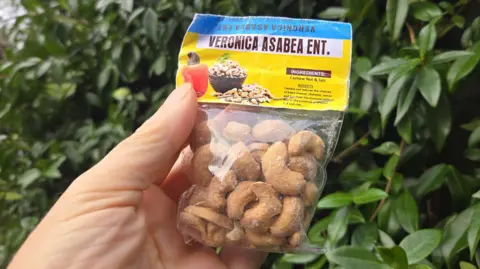
I’m looking to determine how the instead flimsy 30g bag of roasted cashew nuts she’s promoting, beside a sweltering freeway in Ghana’s capital, prices me the similar of about 75 cents (60p).
That’s clearly no longer a bundle of cash for me, a customer from the United Kingdom, however I’m astounded on the mark up.
The fee is a minimum of 4,000% upper than the price of purchasing the similar weight of uncooked, unshelled cashews from a Ghanian farmer.
“It’s incredible,” I protest. But she doesn’t perceive my English, or my reasoning.
The cost of the nuts used to be, upcoming all, imprinted on the packet. And explaining why I assumed it used to be past the faded used to be by no means committing to be simple.
Ghana is the sector’s third-biggest exporter of unprocessed cashew nuts, in the back of Ivory Coast in first park, and Cambodia in 2d.
To manufacture the shorten, round 300,000 Ghanaians produce a minimum of a part of their dwelling rising cashews.
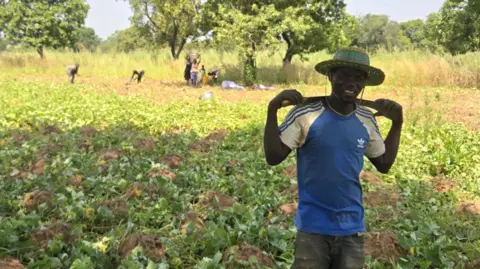
Nashiru Seydou, whose community have a farm within the nation’s north-east, some 500 miles (800km) from Accra, is considered one of them.
He says the paintings is sun-baked, and unreliable provide chains and risky wholesale costs produce survival tough.
“We are struggling. We can use the sunlight, the fertile land, to create more jobs,” he says. “I’d be happy if the government comes to our aid and helps support our industry.”
He tells me that he these days will get round $50 for a immense 100kg sack of unshelled cashews.

“It’s amazing,” says Shining Simons, an entrepreneur and financial commentator in Accra, who has studied the numbers. “Roasters and retailers buy the nuts from farmers for $500 a tonne, and sell to customers [both at home and abroad] for amounts between $20,000 and $40,000 a tonne.”
As an entire, Ghana grows about 180,000 tonnes of cashews yearly. Greater than 80% is exported, and in uncooked, unshelled method. This generates some $300m in export revenues, however implies that Ghana misses out at the considerably upper returns you get from roasted, ready-to-eat cashews.
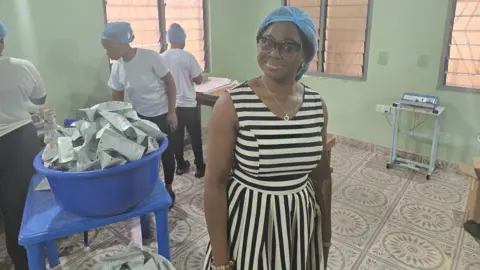
Mildred Akotia is one particular person looking to build up the quantity of cashews which are shelled and roasted in Ghana. She is the founder and CEO of Akwaaba Tremendous Meals, which these days processes simply 25 tonnes a future.
Ms Akotia denies any recommendation that she and others like her are price-gouging. The packaging and blazing equipment a western trade would routinely virtue on this trade, she says, is out of succeed in for her on account of the top price of credit score in Ghana.
“If you go to a local bank, it will cost you 30% interest to get a loan,” she complains. “As a manufacturer you tell me how large your margins are that you can afford that kind of interest? We’ve had to rely on what we can get: soft loans from relatives and grants from donor agencies.”
She says that this condition is why lower than 20% of Ghana’s cashews are processed in the neighborhood. The majority are scooped up and exported to fat factories in international locations like Republic of India, Thailand and Vietnam.
Remarkably, a few of the ones packaged nuts are nearest exported again to Ghana, the place they’re offered for a similar charge as regionally roasted cashews. That is in spite of the 20,000-mile sea freight spherical travel, and import prices.
This is a matching image for rice, which is exported to Ghana from Asia and offered at low costs, in spite of Ghana additionally rising the shorten itself.
Again in 2016 the Ghanaian executive experimented with an export cancel on uncooked cashews to deliver to inspire homegrown processing. Alternatively the coverage needed to be lonely inside of a few weeks upcoming uproar from farmers and investors.
With out to be had reasonable loans, it wasn’t conceivable for enough pristine Ghanaian roasters to go into the marketplace. So the cost of uncooked nuts crashed, and lots of began rotting for need of a purchaser.
Extra not too long ago there was communicate of greater price lists on uncooked cashew exports and bans on exporters buying cashews without delay from farms.
However these kinds of coverage interventions omit a key level, consistent with Mr Simons. A fat problem for native manufacturers, he says, is to paintings more difficult at the fundamentals of doing trade, and rising their corporations.
“In order to be efficient at this, you need scale,” he says, including that corporations want to advertise dining cashews to produce it extra frequent within the nation. “You need a lot of a Ghanaians consuming the nuts, not just a small middle class”.
Prof Daron Acemoglu, a Turkish-American economist, consents that development a powerful native marketplace is notable for Ghana’s cashew trade. He used to be considered one of endmost future’s winners of the Nobel Memorial Prize in Financial Sciences, for his paintings at the struggles dealing with low-income economies, and particularly their home-grown companies.
But he says that the primary precedence will have to be making improvements to get admission to to global markets for processed Ghanaian cashews.
“These firms are dealing with workforces that aren’t properly skilled, they have infrastructures that aren’t working, they are constantly in fear of corrupt officials, or rule changes, and also it’s very difficult to reach foreign markets, he says. “They want the overseas marketplace for the reason that home marketplace is mini, and their very own executive has very modest capability [to boost it].”
He also wants to see the Ghanaian government improve the network of roads and railways to ease the cost of transportation.
But Mr Simons reckons the onus should now be on Ghanaian businesses themselves, to do the basics to enhance the branding and marketing of cashews. As it is, he says, many of the country’s most enterprising business people are just leaving Ghana for better paid opportunities abroad because of the red tape and cronyism in Ghana are so prohibitive.
“There’s a immense mind drain,” he says. “My idea of why Africa’s economic expansion has been sluggish is as a result of we center of attention residue at the provide facet, however the true good looks is in call for, making a eating elegance of cashew-eating fanatics, and also you don’t have an entrepreneurial elegance that may build call for transformation.”
He says the same argument applies to Ghana’s other bigger exports, like gold and chocolate, neither of which gets much value-addition within Ghana before getting exported to the West.
Mildred Akotia hopes she might be one of those entrepreneurs to buck the trend. She now wants to build her own logistics arm, to be able to process the cashews direct from the farm gate.
“I’ve a bundle of yells from the UAE, from Canada and The usa. Lately we will’t meet call for. We will be able to’t get enough quantity kernels to roast.
“There’s a ready market both locally and internationally. My branding is good, my marketing is good. My dream is to give a facelift to Ghanaian processed foods.”













