
 Dennis Osadebe
BBC Information, Mbarara
 Getty Pictures
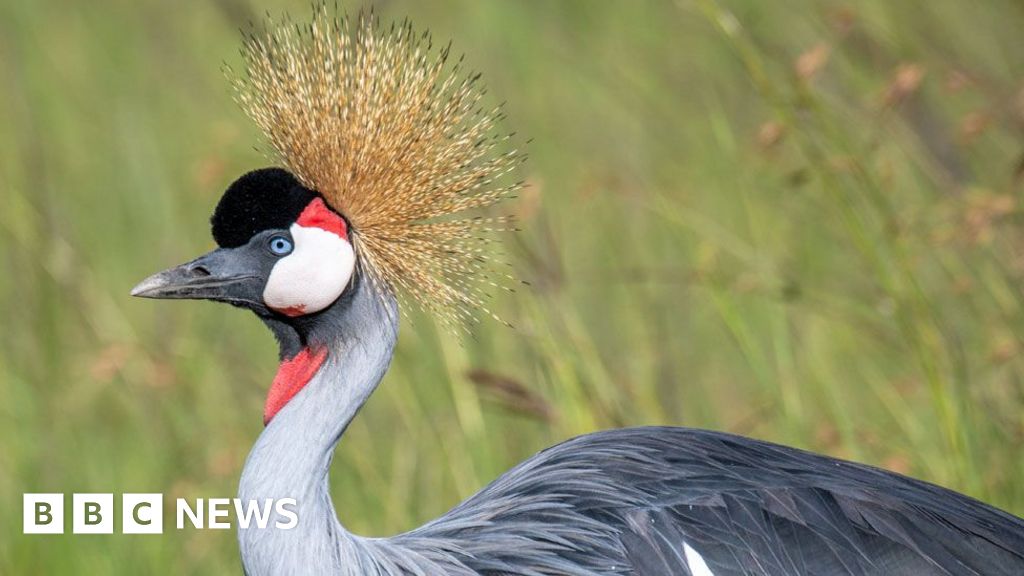
With its unique blonde crown, purple throat pouch and slim dark legs, the crested crane is liked in Uganda – that includes at the East African population’s flag and coat of fingers.
All of the nation’s nationwide sports activities groups also are nicknamed then the long-lasting chook, however lately it has long gone into lessen and conservationists say it is going to face extinction if extra isn’t executed to offer protection to it.
The chook is secure through legislation – it stipulates a age sentence and/or a superb of 20bn Ugandan shillings ($5m; £4m) for the ones discovered to have killed one.
Going again centuries, native Buganda cultural superstition additionally secure the magnificent bird, which used to be perceptible as an emblem of wealth, excellent fortune and longevity.
It used to be conceived that if one killed a crane, its kith and kinfolk would flock to the killer’s house, keep vigil and mourn through jointly honking till the individual went insane and even died.
“Such stories instilled fear, and cranes would be respected and revered and not killed,” Jimmy Muheebwa, a senior conservationist at Nature Uganda, an area non-governmental organisation (NGO), informed the BBC.
However for farmers in western Uganda, the place the cranes most commonly hang around, that concern has dissipated and incessantly it is just conservationists who seem to understand concerning the prevent on killing them.
“I really don’t see any value in these birds because all they do is raid our plantations and eat our crops. We are worried about food security in this area,” Tom Mucunguzi, a maize farmer from a village alike Mbarara town in Western Patch, informed the BBC.
Any other farmer alike Mbarara, Fausita Aritua, assuredly, pronouncing when she is going to her maize plot she spends the entire time chasing away the cranes – and if she can not get there, she tries to get somebody else to arise shield.
“We no longer harvest as much as we used to do because these birds eat everything,” she informed the BBC.
Often referred to as grey-crowned cranes, the birds are predominantly present in Uganda however also are in Kenya, Tanzania, Rwanda, Burundi, Democratic Republic of Congo, Mozambique, South Africa and Zimbabwe.
They’re non-migratory, however produce native and seasonal actions relying on meals sources, nest website availability and the elements.
Status at about 1m (3.2ft) grand, the waterfowl most commonly reside in wetland fields – riverbanks, round dams and obvious garden – the place they breed and feed on grass seeds, little toads, frogs, bugs and alternative invertebrates.
However with the expanding human family, the top call for for meals is pushing farmers to domesticate in wetlands, departure crested cranes with diminishing fields to name house.
“In eastern Africa, the population has declined terribly by over 80% in the last 25 years,” Adalbert Ainomucunguzi, who leads the World Crane Substructure (ICF) in East Africa, informed BBC.
In the1970s, Uganda boasted a family of greater than 100,000 crested cranes, however as of late that quantity has dwindled to a trifling 10,000, in keeping with Nature Uganda.
This lessen noticed the World Union for the Conservation of Nature (IUCN) put the crested crane on its purple checklist of endangered chook species in 2012.

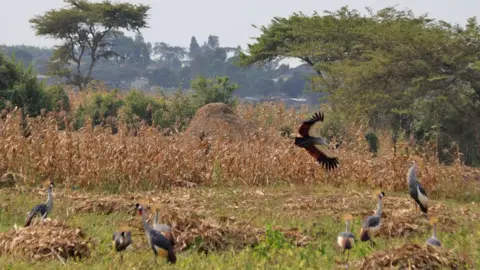
“Despite its serenity, beauty and popularity, the bird is facing a serious threat. It means that if no urgent measures are taken to reverse this trend, we might see the cranes pushed to extinction,” Dan Sseruge, a Ugandan ornithologist, informed the BBC.
Round Mbarara we discovered it used to be tricky to trace ill the birds – and simplest noticed them early within the morning simply then break of day.
Conservationists say they worn to be a lot more straightforward to seek out within the terrain situation Mbarara.
Dozens of cranes have lately been discovered lifeless then they have been poisoned through rice and maize farmers in Lwengo district, in south-central Uganda.
“One of the biggest threats against cranes is poisoning by the farmers. This is because the birds are causing a lot of crop damage,” Gilbert Tayebwa, a conservation officer at ICF, informed BBC.
Mr Tayebwa mentioned he has been attractive farmers to usefulness other deterrent forms like scarecrows to offer protection to their plants from invading cranes.
Farmers like Philip Ntare, from Lwengo, mentioned the cranes have been from time to time mistakenly poisoned then consuming plants sprayed with agro-chemicals and alternative insecticides.
“I just chase them, because I grew up knowing the crested crane is not supposed to be killed. But government should consider compensating farmers for crop damage,” he informed the BBC.
On the other hand, John Makombo, director of conservation on the Uganda Flora and fauna Authority (UWA), mentioned this used to be now not imaginable.
“It is one of those precious species that have freedom to go anywhere and so unfortunately the government is not liable for any damage done by the cranes,” he informed the BBC.
Sarah Kugonza, an ICF conservationist, mentioned the cranes additionally face a bunch of alternative blackmails – now not simply from farmers. With out the protecting defend of the wetlands, their chicks are much more likely to be captured through eagles.
Cranes are discovering time through time that they’re dwelling in an an increasing number of opposed climate.
“Sometimes breeding areas are flooded and nowadays some cranes are killed by electricity lines when flying,” Ms Kugonza informed BBC.
Their outstanding good looks has additionally put them in peril as family are an increasing number of taking pictures them to be pets, in keeping with Mr Ainomucunguzi.
However crested cranes, who can reside for simply over 20 years, hardly breed in captivity because the birds are famously devoted.
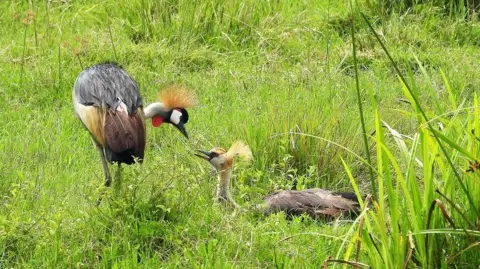
“It is a highly monogamous bird as it pairs once, for life. This means that if one of them is killed or domesticated, the likelihood of finding a new mating partner is almost zero,” mentioned Mr Muheebwa.
They draw in a mate through dancing, bowing and leaping – and are incessantly perceptible strolling as {couples} or households. A couple will outline their very own range and can also be very competitive to preserve it.
 World Crane Substructure
Scientifically known as Balearica regulorum gibbericeps, the cranes even have distinctive nesting patterns as they generally go back to the similar location every year, incessantly laying between two and 5 eggs which are incubated through each sexes for any place between 28 and 31 days.
Any devastate to those nesting fields affects on those breeding patterns.
Their monogamy has additionally attracted the unfavourable consideration of native conventional healers, who declare that the portions of crested crane might deliver faithfulness from a spouse – or excellent good fortune.
“Some people have been caught hunting cranes to take some of their body parts to witch doctors in a belief that they will get rich. Or, if you are a woman, your husband will never leave you,” Mr Tayebwa from ICF mentioned.
This may be one thing conservationists are seeking to counter – in addition to alerting family to the legislation protective cranes.
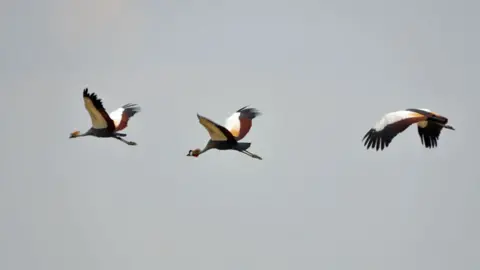
And in an struggle to opposite declining numbers, the Ugandan executive and conservationist teams are actually rallying communities to revive wetlands.
President Yoweri Museveni, who comes from the Western Patch, has been urging encroachers to leave wetland fields and, in keeping with native media, has declared 2025 a date of wetland conservation.
The ICF has additionally recruited custodians to observe and assure that the cranes’ breeding disciplines are secure.
Nature Uganda’s Mr Muheebwa mentioned those efforts have been slowly serving to to stabilise the condition however crane numbers remained “very low”.
For Mr Makombo, the UWA’s past emphasis goes to be on surroundings an instance in the case of the legislation.
“We shall arrest and prosecute those who are poisoning the cranes,” he mentioned.
You might also be eager about:
 Getty Pictures/BBC













