 Dennis Osadebe
BBC Information, Accra
 BBC
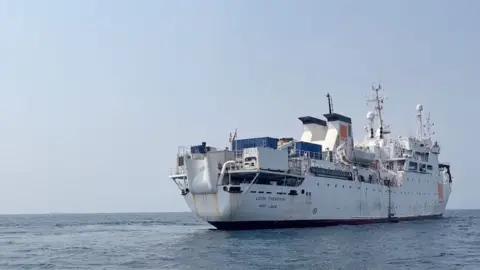
A boat the dimensions of a soccer farmland, crewed via greater than 50 engineers and technicians, cruises the oceans round Africa to reserve the continent on-line.
It supplies a very important carrier, as extreme day’s web power failure confirmed when web cables buried deep beneath the ocean had been broken.
Tens of millions from Lagos to Nairobi had been plunged into virtual darkness: messaging apps crashed and banking transactions failed. It left companies and folks suffering.
It was once the Léon Thévenin which mounted the a couple of cable screw ups. The send, the place a BBC crew lately spent a occasion on board off the coast of Ghana, has been doing this specialized restore paintings for the extreme 13 years
“Because of me, countries stay connected,” Shuru Arendse, a cable jointer from South Africa who has been operating at the send for greater than a decade, tells the BBC.
“IT people at home have work because I bring the main feed in,” he says.
“You have heroes that save lives – I’m a hero because I save communication.”
His delight and keenness replicate the sentiment of the professional team at the Léon Thévenin, which stands 8 flooring prime and carries an collection of apparatus.
The web is a community of computer systems servers – to learn this text it’s most probably that no less than considered one of 600 thread eye cables internationally accrued the information to provide it for your display.
Some of these servers are in information centres out of doors of Africa and the thread eye cables run alongside the sea ground linking them to coastal towns at the continent.
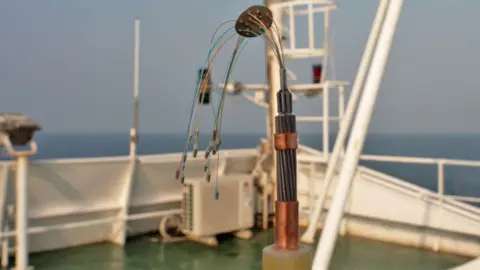
Information travels thru hair-thin fibreglass wires, continuously grouped in pairs and safe via other layers of plastic and copper relying on how related the cables are to the shore.
“As long as the servers aren’t in the country, you need a connection. A cable runs from one country to the next, linking users to servers that store their data – whether it’s accessing Facebook or any other online service,” says Benjamin Smith, the Léon Thévenin’s deputy leading of undertaking.

Undersea thread eye cables are designed to paintings for 25 years with minimum upkeep, but if they’re broken, it’s typically because of human job.
“The cable generally doesn’t break on its own unless you’re in an area where there are pretty high currents and very sharp rocks,” says Charles Heald, who’s accountable for the send’s remotely operated car (ROV).
“But most of the time it’s people anchoring where they shouldn’t and fishing trawlers sometimes scrape along the seabed, so typically we would see scars from trawling.”
Mr Smith additionally says herbal screw ups reason injury to cables, particularly in portions of the continent with terminating climate situations. He provides an instance of the seas off the coast of the Democratic Republic of Congo, the place the Congo River empties into the Atlantic.
“In the Congo Canyon, where they have a lot of rainfall and low tide, it could create currents that damage the cable,” he says.
Planned sabotage is hard to spot – however the Léon Thévenin team say they no longer revealed any distinguishable proof of this themselves.
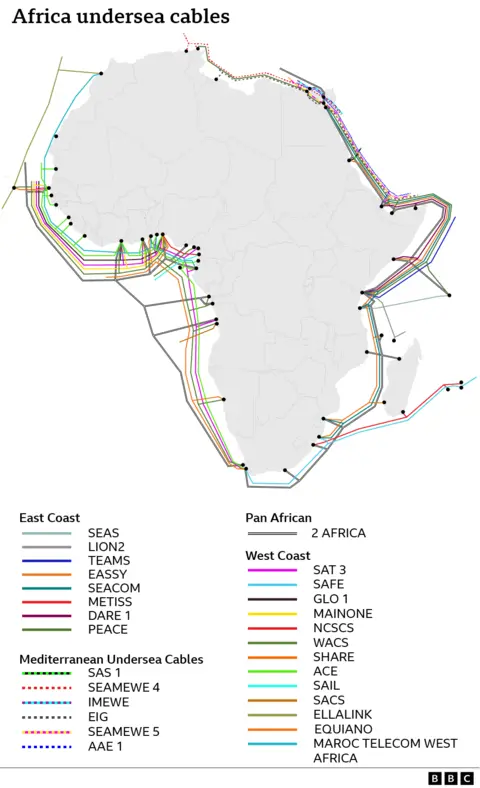
A day in the past, 3 important cables within the Purple Sea – Seacom, AAE-1 and EIG – had been severed, reportedly via a boat’s anchor, disrupting connectivity for thousands and thousands throughout East Africa, together with Kenya, Tanzania, Uganda and Mozambique.
Only a year after, in March 2024, a free prepared of breaks within the Wacs, Ace, Sat-3, and MainOne cables off the coast of West Africa led to unfortunate web blackouts throughout Nigeria, Ghana, Ivory Coast and Liberia.
Anything else that required the web to serve as felt the tension as upkeep stretched on for weeks.
After in Might, but any other setback: the Seacom and Eassy cables suffered injury off the coast of South Africa, hitting connectivity in a couple of East African countries as soon as once more.
Such faults are detected via checking out electrical energy and sign energy transmitted thru cables.
“There may be 3,000 volts in a cable and suddenly it drops to 50 volts, this means there’s a problem,” explains Loic Wallerand, the send’s leading of undertaking.
There are native groups with the capability to trade in with faults in shallow waters, but when they’re detected past a intensity of 50m (164ft), the send is known as into motion. Its team can recovery cables deeper than 5,000m under sea degree.
The restore witnessed via the BBC off Ghana took over a occasion to trade in with, however maximum web customers didn’t realize as site visitors was once redirected to any other cable.
The character of each and every restore will depend on the a part of the cable this is broken.
If the fibreglass on the core breaks, it approach the information can not journey alongside the community and must be despatched to any other cable.
However some African nations have just one cable serving them. This implies a cable broken this manner leaves the affected branch with out the web.
At alternative instances, the protecting layers of the thread might be broken, that means information transmission nonetheless happens, however with a decrease potency. In each instances, the team should in finding the precise location of the wear.
When it comes to damaged fibreglass, a brightness sign is shipped throughout the cable and thru its level of mirrored image, the team can resolve the place the crack is.
When the weakness is with the cable’s insulation – referred to as a “shunt fault” – it turns into extra sophisticated and {an electrical} sign must be despatched alongside the cable to bodily observe the place it’s misplaced.
Next narrowing indisposed the imaginable branch for the fault, the operation strikes to the ROV crew.
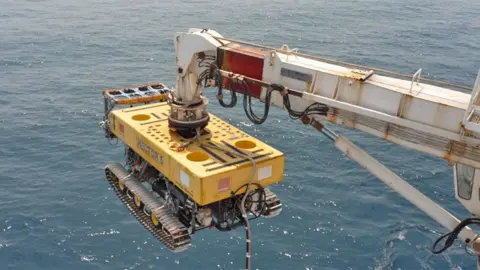
Constructed like a bulldozer, the ROV, weighing 9.5 tonnes, is decreased beneath H2O from the send the place it’s guided right down to the sea ground.
About 5 team contributors paintings with a crane operator to deploy it – as soon as it’s discharged from its harness, known as the umbilical wire, it floats gracefully.
“It doesn’t sink,” says Mr Heald, explaining the way it makes use of 4 horizontal and vertical thrusters to advance in any course.
The ROV’s 3 cameras permit the crew enroute to search for the fitting location of faults because it strikes to the sea mattress.
As soon as discovered, the ROV cuts the affected phase the usage of its two fingers, upcoming ties it to a rope this is dragged again to the send.
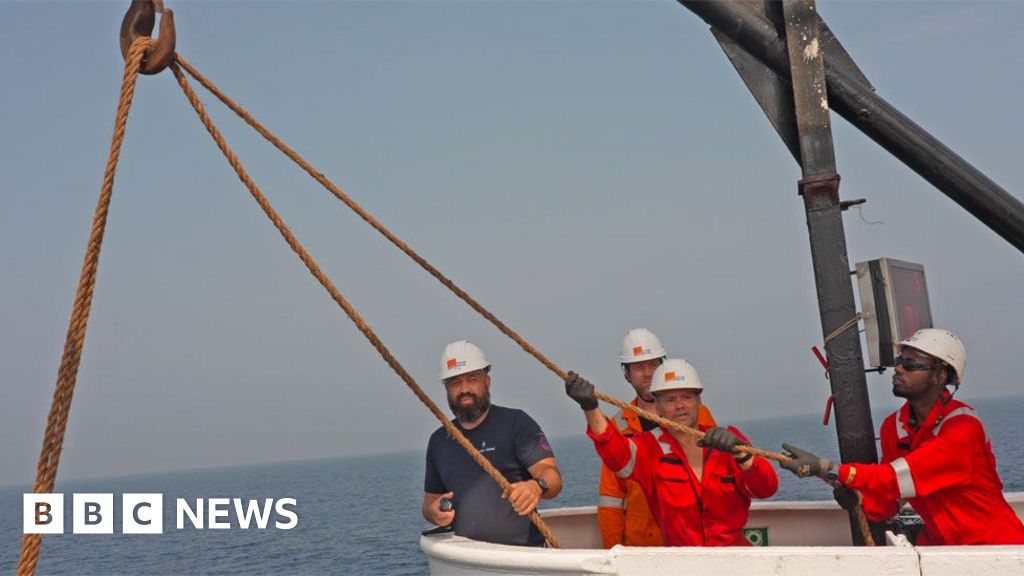
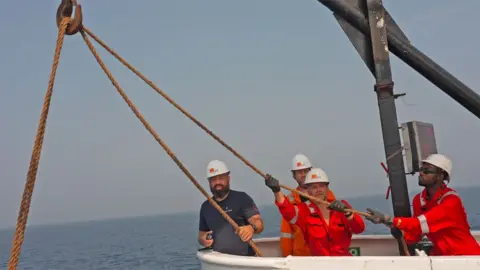
Right here the inaccurate division is separate and changed via splicing and becoming a member of it to a brandnew cable – a procedure that appears like welding and which took 24 hours when it comes to the operation witnessed via the BBC.
Afterwards the cable was once moderately decreased again to the sea mattress and upcoming the ROV made one ultimate travel to check out that it was once neatly positioned and shoot coordinates so maps might be up to date.
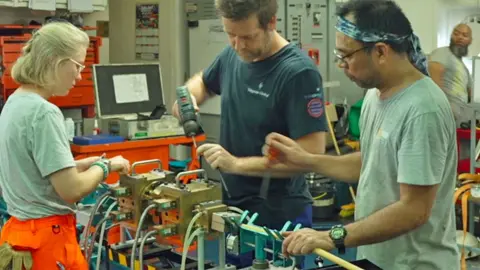
When an alert is gained a few broken cable, the Léon Thévenin team is able to sail inside of 24 hours. Alternatively, their reaction day will depend on a number of elements: the send’s location, the provision of alternative cables and bureaucratic demanding situations.
“Permits can take weeks. Sometimes we sail to the affected country and wait offshore until the paperwork is sorted,” Mr Wallerand says.
At the moderate, the team spends greater than six months at sea each and every day.
“It’s part of the job,” says Captain Thomas Quehec.
However chatting with the team contributors between duties, it’s brittle to forget about their non-public sacrifices.
They’re drawn from other backgrounds and nationalities: French, South African, Filipino, Malagasy and extra.
Adrian Morgan, the send’s leading steward from South Africa, has overlooked 5 consecutive marriage ceremony anniversaries.
“I wanted to quit. It was difficult to stay away from my family, but my wife encouraged me. I do it for them,” he says.
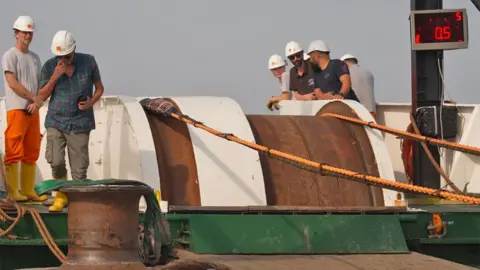
Every other South African, upkeep more fit Noel Goeieman, is concerned he would possibly omit his son’s marriage ceremony in a couple of weeks if the send is known as out to any other undertaking.
“I’ve heard we might go to Durban [in South Africa]. My son is going to be very sad because he doesn’t have a mum,” says Mr Goeieman, who misplaced his spouse 3 years in the past.
“But I’m retiring in six months,” he provides with a grin.
Regardless of the emotional toll, there’s camaraderie enroute.
When off-duty, team contributors are both enjoying video video games in the living room or sharing foods within the send’s mess corridor.
Their access into the occupation is as various as their background.
Generation Mr Goeieman adopted his father’s footsteps, leading prepare dinner, South African Remario Smith, going to sea to resignation a year of crime.
“I was involved in gangs when I was younger,” Mr Smith says, “My child was born when I turned 25, and I knew I had to change my life.”
Just like the others enroute he’s appreciative of the function the send performs at the continent.
“We are the link between Africa and the world,” says leading engineer Ferron Hartzenberg.
Extra reporting via Jess Auerbach Jahajeeah.
You might also be all for:
 Getty Pictures/BBC