 Dennis Osadebe
22 mins in the past
Barbara Plett-Usher,BBC Africa correspondent, Cape The town
 Kyla Herrmannsen/BBC
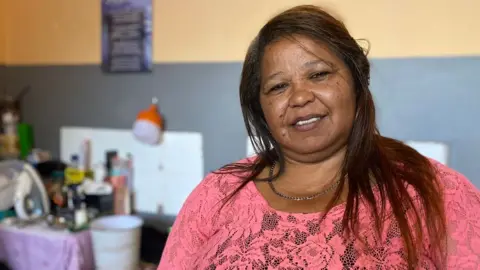
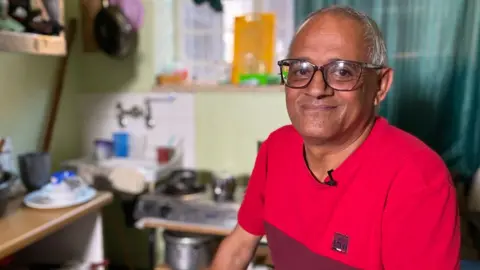
Jameelah’s room used to be as soon as a morgue; Faldilah’s used to be a rest room; Bevil’s – the physician’s administrative center the place he got here to bundle his diabetes cure.
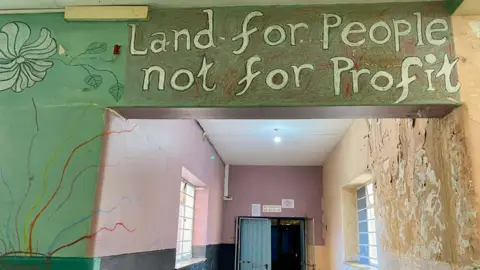
They all are squatting in a derelict health center within the South African town of Cape The town, protesting at what they see as the federal government’s failure in order reasonably priced housing.
The top of apartheid introduced political rights and freedoms for all. However at the eve of the rustic’s 7th democratic election, enduring inequality nonetheless divides this nation.
And in lots of circumstances the housing insurance policies of the governing African Nationwide Congress (ANC) has inadvertently bolstered the geography of apartheid, in lieu than reversed it.
Activists belonging to a motion referred to as Reclaim the Town engaged the Woodstock Health facility in the dark seven years in the past.
The struggle used to be to enter the feature near to town centre, says one of the most leaders, Bevil Lucas, as a result of get entry to to the roles and services and products this do business in is vital to righting the wrongs of segregation.
“A new form of economic apartheid” has changed the racist rules that saved cloudy and colored public (as mixed-race South Africans are identified), trapped in poverty in townships at Cape The town’s edges, he tells the BBC.
“The poor and vulnerable have generally been pushed to the periphery of the city.”
They now have the precise to journey however can’t manage to pay for the top rents demanded by means of feature builders within the town centre.
For Jameelah Davids, location used to be the whole lot.
“My moving in here was because of my son who’s autistic,” she says. “He goes to school around the corner. It was so near for him. Everything is there. And he’s flourished.”
She settled her crowd within the former administrative center of the health center morgue.

 Kyla Herrmannsen/BBC
Some other tenant, Faldilah Petersen confirmed me how she has reworked a health center rest room into a house, turning the bathroom cubicle right into a kitchen, and the basin section right into a bed room.
“I was evicted like 10 times in a year,” she tells me.
“But living in this occupation gave me that opportunity to improve my life, and I’m more free to do what I need to and it’s much more nearer to the city as well. It’s like a homecoming.”
The town government have come spherical to agreeing that the website online will also be advanced for residential functions, but it surely screams the wave tenants unlawful occupiers and says they wish to let fall prior to the advance begins.
The ANC took energy 30 years in the past with a Self-government Constitution that promised housing to a folk disadvantaged of reserve and at ease properties by means of apartheid. Since upcoming, it has constructed greater than 3 million and granted possession for independent, or for hire at underneath marketplace charges.
However the lists for presidency homes are nonetheless lengthy – Ms Davids has been ready for just about 30 years, Ms Petersen for longer.
And maximum were constructed a long way from town centre, the place land is inexpensive, failing to opposite the spatial making plans of apartheid that embedded inequalities.
Nowhere is that extra the case than Cape The town, says Nick Budlender, an city coverage researcher, calling it “probably the most segregated urban area anywhere on Earth”.
It used to be the access level for colonial settlers they usually designed it that approach, he says, so reversing it might whip planned climate intervention. However “since the end of apartheid, not a single affordable housing unit has been built in the inner city of Cape Town”.
He’s giving me a excursion of vehicle terrains that bundle executive automobiles, some amassing mud, centered by means of activists as to be had society land which may be reworked into low-income housing.
“Using a piece of land in the centre of the city that suffers from such a severe segregation crisis to store vehicles instead of providing homes… makes no sense from anyone’s perspective,” says Mr Budlender.
There are indicators of a pristine means. The provincial executive, run by means of the Democratic Alliance (DA) is development a “better living” fashion on climate land near to town’s jobs and services and products.
The Conradie Soil venture additionally occurs to be the website online of a former health center.
The primary section do business in a mixture of subsidised and market-value choices, and the second one section is underneath building.
Provincial Infrastructure Minister Tertuis Simmers does recognize a backlog of 600,000 public looking ahead to housing backup, however says there are “ambitious” plans in order 29 matching social housing initiatives.
However the budgets are little – he is looking for partnership from the non-public sector – and timelines unsure.
And housing, steadily a scorching subject in elections, has slipped unwell the record of political priorities.
The manifesto of the DA, which is the reliable opposition celebration on the nationwide stage, does now not in particular point out it, nor do alternative events.
 Kyla Herrmannsen/BBC
Within the slim lanes of Khayelitsha township, hope for the generation is in shorten provide.
Lots of the ones residing within the sprawling overwhelm of corrugated iron shacks let fall prior to crack of dawn to go back and forth to town for paintings the best way their oldsters or even grandparents did.
This can be a travel of about 30km (18 miles), however the mini-bus taxis and trains they significance are dear, unreliable and steadily unsafe.
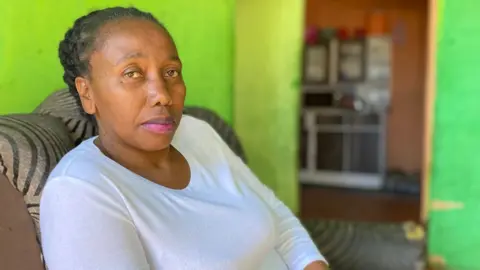
Noliyema Tetakome has lived right here for many of her 49 years. She will get H2O from the communal faucet on the finish of her alley and makes use of the society latrines.
She spends 1 / 4 of her meagre wage on delivery to her process as a gardener. A few of her neighbours pay as much as part of theirs. And she or he does now not be expecting the election to switch that.
Ms Tetakome has marked her X at the poll in each and every election to this point however “it doesn’t makes any difference”, she tells me.
This month “I’m not going to vote”, she says leaning ahead in her chair for emphasis, “because I’m tired. Because I voted before, but I didn’t see change. I’m still here!”
The principle factor on her thoughts is the approaching wintry weather rains which she expects to flooding her shack once more.
 Kyla Herrmannsen/BBC
Disillusionment with the governing ANC suggests the celebration of liberation may just for the primary month lose absolutely the majority it has commanded since 1994.
The third-largest celebration, the Financial Self-government Opponents (EFF), is difficult what it screams a long time of ANC failure by means of providing an intensive “rescue plan” to redistribute the majority of the wealth nonetheless held by means of a little minority.
A pristine celebration, Get up Mzansi, has tapped into Cape The town’s chronic sections.
“We believe that South Africans should be able to stay closer to where they work,” the nationwide chief Songezo Zibi mentioned not too long ago on a marketing campaign seek advice from, accusing each the DA and ANC of failing to do the type of spatial making plans the fast-growing town wishes.
Get up Mzansi is untested however comes with out the luggage of misused energy that hobbles the ANC, the sweeping corruption that has overclouded its a long time of rule.
“The powers that be are too closely associated with property power,” says Mr Lucas, chatting with me week perched on his mattress in cramped residing quarters, a room the place he worn to seek the advice of his physician.
A former anti-apartheid activist who by no means banned campaigning for social justice, he says he’s upset within the end result of the effort, however insists the generation nonetheless has probabilities.
“Because it’s an election, there’s hope, which did not exist under the previous dispensation.”
He nonetheless hopes that the political government will protect the size of social want that left-overs the legacy of apartheid.
“If it’s not adequately addressed,” Mr Lucas says “it could lead to social unrest, and significant social unrest. Because what do people have to lose when they are already homeless, when they are not able to have shelter?”

 Getty Photographs/BBC