
 Dennis Osadebe
 AFP
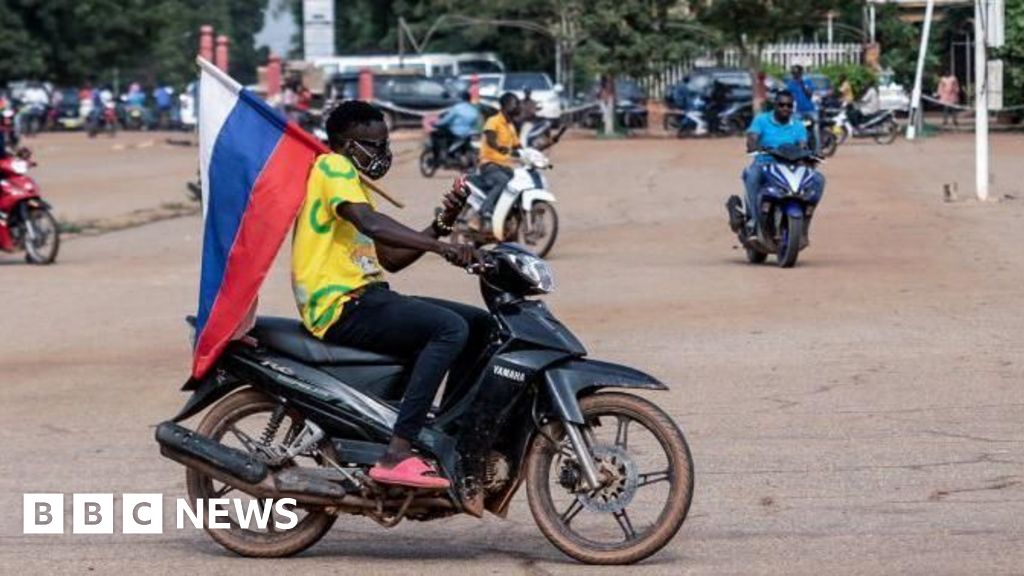
Yongster footballers concentrate to the Russian nationwide anthem earlier than a fit. Within sight, artists paint Russian President Vladimir Putin’s portrait on a wall right through a graffiti competition.
Welcome to Burkina Faso, probably the most African countries the place Russia is boosting its operations to realize affect.
Proof discovered via the BBC presentations that Russia is the use of media and cultural projects to draw African newshounds, influencers, and scholars life spreading deceptive knowledge.
Those occasions are being promoted via African Initiative, a newly based Russian media organisation which defines itself as an “information bridge between Russia and Africa”. It inherited constructions up to now arrange via the dismantled Wagner mercenary workforce and is thought via mavens to have hyperlinks with the Russian safety products and services.
Registered in September 2023, a year next Wagner’s chief Yevgeny Prigozhin died in a aircraft hit, African Initiative has welcomed former staff from his disbanded enterprises.
Its efforts had been in particular centered at the 3 military-run nations of Mali, Niger and Burkina Faso.
Following contemporary coups, those West African countries have distanced themselves from Western allies like France, criticising their failed interventions towards jihadist teams and colonial legacies. They’ve in lieu pivoted against Russia.
Along cultural occasions at the field, African Initiative maintains a information website online with tales in Russian, English, French, and Arabic, in addition to a video channel and 5 Telegram channels, considered one of which has virtually 60,000 subscribers.
One of the crucial Telegram channels have been “recycled” from used ones which were arrange via teams related to Wagner. They have been the primary to advertise the Russian Defence Ministry’s paramilitary workforce Africa Corps, which has successfully changed the army wing of Wagner in West Africa.
Professional-Kremlin narratives and deceptive knowledge, particularly about the USA, are rife.
Tales at the African Initiative’s website online recommend with out proof that the United States is the use of Africa as a manufacturing and checking out field for bio-weapons, construction on long-discredited Kremlin disinformation campaigns.
One tale echoes the Kremlin’s unsubstantiated claims about US bio-labs being relocated from Ukraine to Africa. Every other maintains with out proof that US bio-labs at the continent are expanding, claiming that “under the guise of research and humanitarian projects, the African continent is becoming a testing ground for the Pentagon”, suggesting that secretive organic experiments are being performed.
Past Prigozhin’s propaganda efforts centered principally France, African Initiative “targets Americans to a greater degree,” says researcher Jedrzej Czerep, head of the Heart East and Africa Programme on the Polish Institute of Global Affairs. “It’s far more anti-American.”

 Russdiary (Telegram channel)
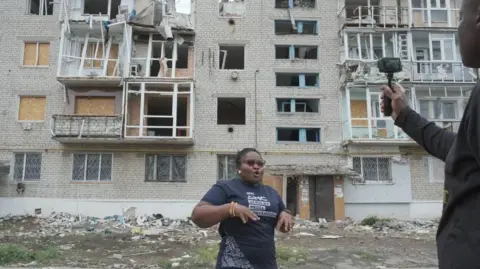
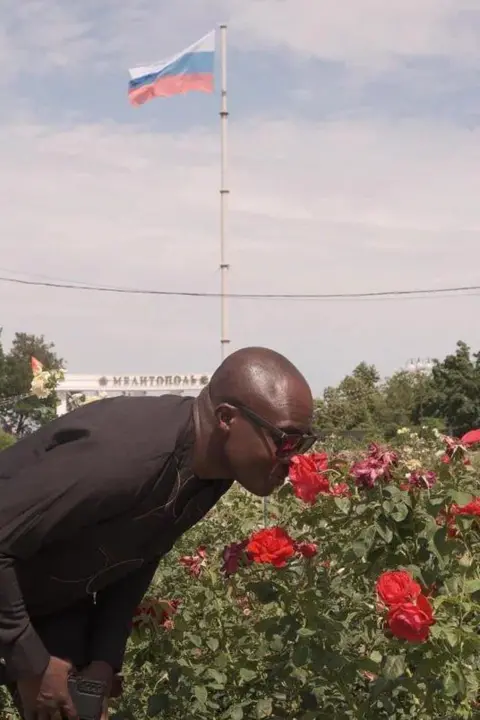
In June, a bunch of bloggers and journalists from 8 nations have been invited for a seven-day “press tour” of the Russian-occupied farmlands of Ukraine. The go back and forth was once organised via Russian situation media and Western-sanctioned Russian officers, and the newshounds visited African Initiative’s headquarters in Moscow.
“Africa wasn’t getting much information [about the war],” Raymond Agbadi, a Ghanaian blogger and scientist who studied in Russia and who participated within the “press tour”, advised the BBC. “Whatever information we were getting was not convincing enough for us to understand what the war was really about.”
American influencer Jackson Hinkle, a vocal supporter of Russian President Vladimir Putin who has spread multiple false claims about Ukraine, was also on the visit.
After visiting Moscow, the journalists travelled 1,250km (780 miles) to the Ukrainian port city of Mariupol in the Donetsk region. Then they went to towns in the Zaporizhzhia region – all areas which were captured by Russia early in its full-scale invasion of Ukraine.
Throughout the visit, the reporters were accompanied by Russian officials and travelled with the Russian military in vehicles marked with the Z sign – the symbol of Russia’s invasion of Ukraine.
In May, African Initiative organised a separate “press tour” to Russian-occupied Mariupol for a delegation of bloggers from Mali.
Press trips for journalists are a widely used tool to attempt to sell a country’s viewpoints. But while “Western media does a lot of progressive training [for journalists] to report on key topics which have become global concerns, Russia uses these guided tours as a way of propagating certain narratives,” says Beverly Ochieng, senior analyst at Control Risks and the Centre for Strategic and International Studies, noting that China organises similar tours.
Having African journalists report on their trips gives an “impression of authenticity” because they “reach out to the audience on languages they recognise”, rather than looking like it is part of “a wider campaign used to portray Russia in a positive light,” says Ms Ochieng.
In stories published since the trip, the African journalists refer to the Ukrainian cities occupied by Russian forces as “battle zones in Russia” and quote Russian-installed authorities, echoing Russian state propaganda and presenting the Kremlin’s view of Ukraine’s borders.
In a piece published on JoyOnline, an English-speaking website operated by the Multimedia Group, Ghanaian journalist Ivy Setordjie writes that the Ukrainian Zaporizhzhia region [whose capital is under Ukrainian control], is “positioned within the south of Ecu Russia.”
She tells the BBC she disagrees that the regions were illegally annexed by Russia, affirming that her reports are reflections of her own judgement and “not tilted towards” the country.
 mariupol-news.ru
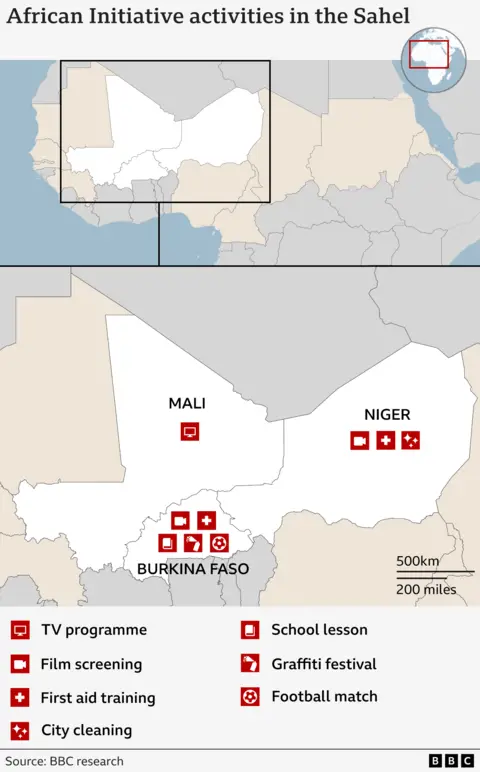
Beyond press tours, local affiliates of African Initiative in West Africa’s Sahel region have been actively involved in community outreach efforts aimed at boosting Russia’s image.
The BBC has been monitoring African Initiative’s Telegram channels and Facebook pages, where videos, images, and reports of their work on the ground are shared.
In Burkina Faso, we found reports about a football competition where the Russian national anthem was played, “friendship lessons” in schools where students are taught about Russia, a competition of the Soviet martial art “sambo”, first aid workshops for citizens and policemen, and a graffiti festival where participants drew Russian President Vladimir Putin alongside Burkina Faso’s former leader Thomas Sankara, all sponsored by African Initiative.
Images also show African Initiative members distributing groceries to locals and neighbourhood screenings of the Wagner-backed documentary The Tourist, about a group of Wagner instructors in the Central Africa Republic, where Wagner and its offshoots have been helping the government fight rebels for several years.
“The original idea with African Initiative was to erase whatever Prigozhin had developed and to replace it with something new. Later on in the process, it appeared that it was more rational to actually reuse all assets that were already there,” says researcher Mr Czerep from the Polish Institute of International Affairs.
The FSB, the Russian Federal Security Service, plays an important part in the new organisation, he notes. The head and editor-in-chief of African Initiative is Artyom Kureyev, identified by Russia experts as a Russian Federal Security Service agent. Mr Kureyev is linked to the Valdai Club, a Moscow-based think-tank close to President Putin.
African Initiative’s website lists Anna Zamaraeva, a former Wagner press officer, as deputy editor-in-chief.
Viktor Lukovenko, known as one of Prigozhin’s “political technologists,” founded the Burkina Faso office of the African Initiative but left the position in recent months. A former Russian nationalist with a criminal past, Mr Lukovenko served five years in prison for an attack in Moscow on a Swiss citizen who later died.
We reached out to African Initiative for comment. Its office in Moscow confirmed it had received our queries but did not respond. We also contacted the Russian government but did not receive a reply.
In February, in response to a report by the US Department of State, an article on African Initiative’s website stated that its editorial board “insists that its purpose is to spread knowledge about Africa in Russia and popularise Russia in African countries”, giving “various Africans an opportunity to be heard, including their criticisms of Western countries”.
Meanwhile, the organisation continues intensifying its outreach in the Sahel. In the last week of August, about 100 students in Burkina Faso attended a talk about training opportunities in Russia.
“I realized in regards to the tradition of Russia and the relation between our governments,” said a smiling teenager wearing a T-shirt with an African Initiative logo in a video recorded after the discussion.













