
 Dennis Osadebe
BBC Information, Mekelle
 Getty Pictures
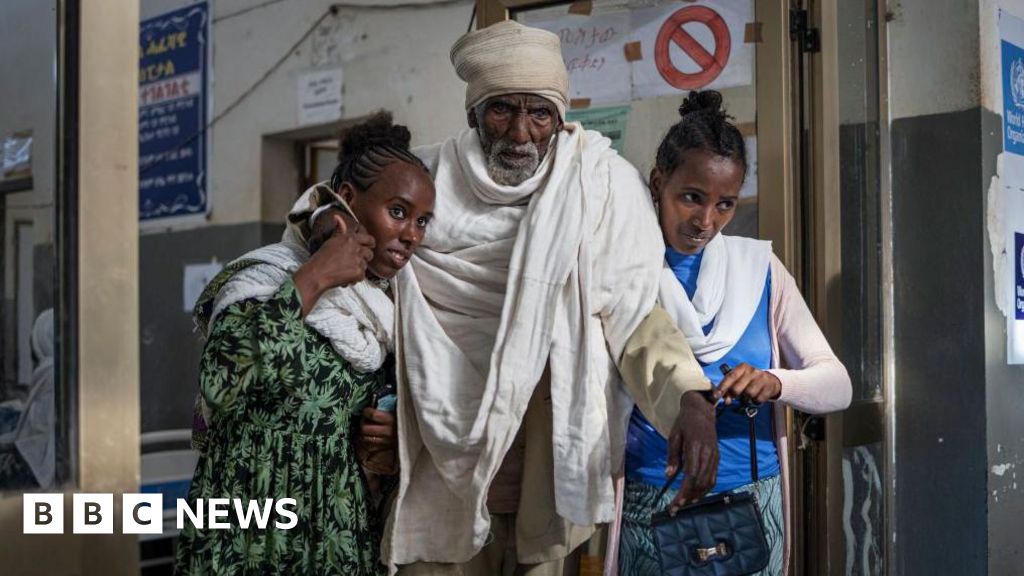
Family residing in Mekelle, the primary town in Ethiopia’s war-scarred Tigray, have advised the BBC they worry they may quickly be dragged into battle once more.
Rising tensions threaten the delicate holiday assurance signed in past due 2022, which introduced an finish to a brutal civil battle that claimed an estimated part one million lives.
Many listed below are getting ready for the worst – both retirement for the federal capital, Addis Ababa, on sold-out flights, or stocking up on crisis provides and chickening out their financial savings from the depot.
“It’s all because of the anxiety,” one resident stated.
Tseganesh Kassa, an ex-combatant from Shire, a town in central Tigray, badly wounded her leg right through the battle. She now walks on crutches and calls for ordinary clinical remedy.
She says battle “rocked my family”.
“I am now a disabled person and my family has been [ruined] economically. I don’t want to see that again. Displaced people living in makeshift camps haven’t even been returned to their homes.
“Disagree-one can maintain every other [war].”
Tigray was the epicentre of the conflict.
The guns were silenced when two of the main warring groups, Ethiopia’s federal government and the Tigray People’s Liberation Front (TPLF), the leading political party in the region, signed a peace agreement.

 Amensisa Negera/BBC
This led to the formation of an interim administration tasked with running the region until elections were held. But in recent months there has been a growing power struggle between senior figures within TPLF and Tigray’s interim administration.
The administration accuses certain TPLF politicians of attempting to seize power by force.
Some within the TPLF accuse the interim administration’s leadership of failing to support ex-fighters or bring back people displaced by the war.
Territories that were once under Tigray’s administration before the fighting but are now are under others’ control is also a hot issue.
Both sides accuse each other of engaging in treasonous activities that involve “exterior actors”.
There are now concerns the peace agreement could unravel, and even fears over the prospect of a direct conflict between Ethiopia and its neighbour Eritrea.
During the Tigray war, Ethiopia’s government was supported by Eritrea. But relations have deteriorated between the two countries since the peace deal, which Eritrea did not sign.
Since then, there seems to be a feeling in Eritrea that it has become the fall guy for the atrocities reportedly committed during the war.
All parties were accused of gross abuses during the civil war – including the mass killing of civilians and widespread sexual violence. Eritrean soldiers were particularly accused of being behind the deaths dozens of the civilians in the historic city of Aksum.
Tigray’s interim administration says Eritrean troops are still occupying parts of the region’s land along shared borders where they continue to commit abuses.
Meanwhile Eritrea’s information minister called the allegations “fabricated” adding the areas in question are “Eritrean free territories”.
Tigrayan officials want the return of these and other disputed areas currently under the control of forces from neighbouring Amhara region, as outlined in the peace deal.
Ethiopia’s ambitions to have access to the sea is another factor souring relations with Eritrea.
There are fears that the two neighbours could return to war six years after they mended their fraught relations.
If violence returns to Tigray – or if clashes break out between Ethiopia and Eritrea – the implications will far reaching in an already volatile region.
 AFP
In Mekelle, residents are weary of the prospect of further conflict.
“The juniors are uninterested in violence,” Tesfay Gebreabgzi, a shoe-shiner in his 20s, tells the BBC. “Throughout the [civil] battle, quite a lot of family had the will to combat. Now there’s handiest fatigue.”
Haimanot Gebremariam, a vegetable vendor in her 50s, says her two children joined the fighting on the Tigrayan side after war broke out in 2020.
But while her daughter returned safely, her son sustained permanent wounds. She says she does not want to see a return to “the twilight days”. The situation now “could be very regarding”, she tells the BBC.
“We nonetheless reside with the injury and the scar of the former battle. We don’t wish to let fall tears once more.”
The Tigray region has not fully recovered from the disastrous impact of the conflict.
Nearly a million displaced people have still not returned home and some key infrastructure — including schools and health facilities – have not yet been rebuilt.
Nonetheless, despite the palpable anxiety, there is a semblance of normality in Mekelle. Businesses and shops are working regularly. And there is not a heavy presence of security forces on the streets.
But having lived through one of Africa’s deadliest conflicts in recent memory, many are closely following every small development.
In one coffee house, young people are glued to their phones, watching clips from recent press statements made by the head of Tigray’s interim administration, Getachew Reda, who is currently hundreds of miles away in Addis Ababa for “consultations” with federal authorities.
In another cafe, a young man said he was waiting to hear what the city’s new mayor – who was appointed on Thursday by the dissident TPLF faction – would do to calm the public.
Everyone, it seems, is waiting to see what the next days and weeks will bring.
More on Ethiopia’s civil war:
 Getty Pictures/BBC