
 Dennis Osadebe
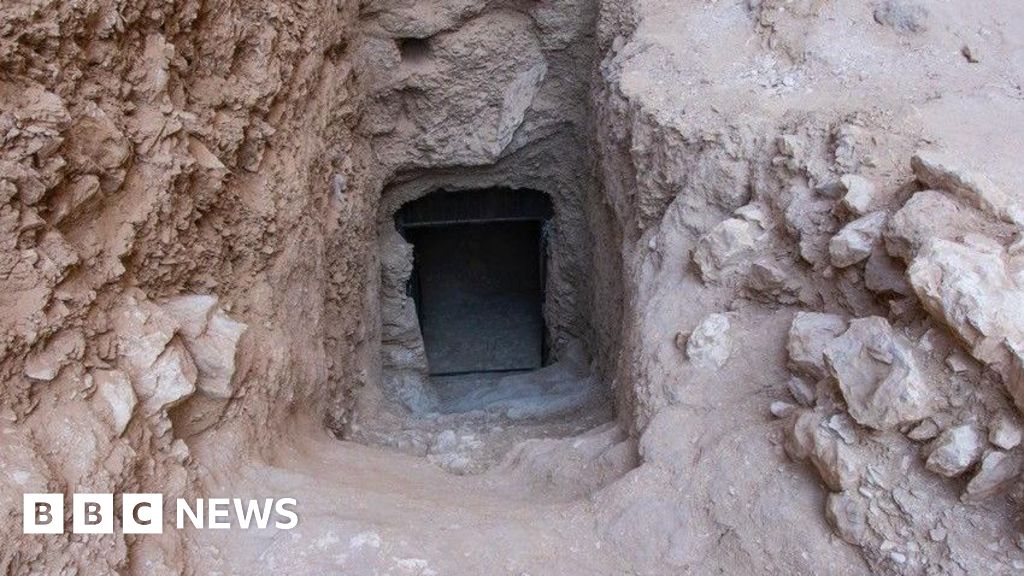
Egyptologists have came upon the primary tomb of a pharaoh since Tutankhamun’s used to be exposed over a century in the past.
King Thutmose II’s tomb used to be the ultimate undiscovered royal tomb of the 18th Egyptian dynasty.
A British-Egyptian workforce has positioned it within the Western Valleys of the Theban Necropolis close the town of Luxor. Researchers had concept the burial chambers of the 18th dynasty pharaohs had been greater than 2km away, nearer to the Valley of the Kings.
The group discovered it in an department related to the resting parks of royal girls, but if they were given into the burial chamber they discovered it adorned – the signal of a pharaoh.
“Part of the ceiling was still intact: a blue-painted ceiling with yellow stars on it. And blue-painted ceilings with yellow stars are only found in kings’ tombs,” stated the grassland director of the venture Dr Piers Litherland.
He advised the BBC’s Newshour programme he felt beaten within the era.
“The emotion of getting into these things is just one of extraordinary bewilderment because when you come across something you’re not expecting to find, it’s emotionally extremely turbulent really,” he stated.
“And when I came out, my wife was waiting outside and the only thing I could do was burst into tears.”
Dr Litherland stated the invention solved the thriller of the place the tombs of early 18th dynasty kings are positioned.
Researchers discovered Thutmose II’s mummified extra two centuries in the past however its untouched burial website had by no means been positioned.
Thutmose II used to be an ancestor of Tutankhamun, whose reign is thought to had been from about 1493 to 1479 BC. Tutankhamun’s tomb used to be discovered by way of British archaeologists in 1922.
Thutmose II is absolute best recognized for being the husband of Queen Hatshepsut, thought to be one in every of Egypt’s largest pharaohs and one of the vital few feminine pharaohs who dominated in her personal proper.
Dr Litherland stated the “large staircase and a very large descending corridor” of the tomb steered grandeur.
“It took us a very long time to get through all that,” he stated, noting it used to be restrained by way of overflow particles and the ceilings had collapsed.
“It was only after crawling through a 10m (32ft) passageway that had a small 40cm gap at the top that we got into the burial chamber.”
There they came upon the blue ceiling and decorations of scenes from the Amduat, a non secular textual content which used to be reserved for kings. That used to be every other key signal they’d discovered a king’s tomb, Dr Litherland stated.
They got to work clearing the particles – anticipating that they might in finding the beaten extra of a burial beneath.
However “the tomb turned out to be completely empty”, stated Dr Litherland. “Not because it was robbed but because it had been deliberately emptied.”
They later labored out that the tomb were flooded – “it had been built underneath a waterfall” – only some years nearest the king’s burial and the contents moved to every other location in earlier period.
It used to be thru sifting thru tonnes of limestone within the chamber that they discovered fragments of alabaster jars, which bore the inscriptions of the names of Thutmose II and Hatshepsut.
Those fragments of alabaster “had probably broken when the tomb was being moved,” stated Dr Litherland.
“And thank goodness they actually did break one or two things because that’s how we found out whose tomb it was.”
The artefacts are the primary items to be discovered related to Thutmose II’s burial.
Dr Litherland’s stated his workforce had a coarse thought of the place the second one tomb used to be, and it would nonetheless be intact with treasures.
The invention of the pharaoh’s tomb caps off greater than 12 years of labor by way of the joint workforce from Dr Litherland’s Untouched Kingdom Analysis Foot and Egypt’s Ministry of Tourism and Antiquities.
The workforce has up to now excavated 54 tombs within the western a part of the Theban mountain in Luxor, and had additionally established identities of greater than 30 royal other halves and courtroom girls.
“This is the first royal tomb to be discovered since the ground-breaking find of King Tutankhamun’s burial chamber in 1922,” stated Egypt’s minister of tourism and antiquities Sherif Fathy.
“It is an extraordinary moment for Egyptology and the broader understanding of our shared human story.”













