
 Dennis Osadebe

BBC Information, Nairobi
 Gerald Karicha
The reported disappearance of greater than 80 executive critics over the latter six months has brought about a abundance family backlash in Kenya.
A pass judgement on has warned he’s going to imprison manage safety officers for contempt of courtroom on Monday in the event that they fail to look for a 3rd past to account for a contemporary fibre of alleged abductions.
The case is connected to the disappearances documented by means of Kenya’s Nationwide Fee on Human Rights since national protests in opposition to proposed tax hikes started latter June.
No less than 24 are stated to nonetheless be lacking.
The police and executive abandon kidnapping and illegally detaining protesters, however the nation has a historical past of state-sponsored abductions, and a few Kenyans concern they’re going back on that dull age.
The Inspector Common of Police Douglas Kanja and Directorate of Prison Investigations Director Mohamed Amin had been ordered to assemble in courtroom seven social media influencers who disappeared in December.
5 all of sudden reappeared in early January at diverse places around the nation.
Mr Kanja’s legal professionals requested the courtroom for extra past to report statements from them and report a record.
Billy Mwangi is among the 5. The 24-year-old was once dropped off by means of his alleged abductors 75km (46 miles) from his place of origin in Embu, in central Kenya, in an obvious employment of intimidation.
Billy’s father, Gerald Mwangi Karicha, instructed the BBC his son was once traumatised.
“The boy has not shared a lot,” he stated. “All I can say is that when he came, he was not his usual self. He looked to be in shock.”
Billy, a school pupil who were a vocal critic of the federal government on social media, disappeared on 21 December 2024 hour at a barbers’ store in Embu.
In step with observers, hooded males arrived in a Toyota Fielder and a double-cabin pick-up, bundled him into one of the vital automobiles and sped off.
Inside hours, his crowd’s worst fears started to spread.
“Most weekends, we are together watching football. His club is Chelsea; mine is Arsenal,” Gerald stated.
He referred to as Billy to talk about a soccer fit at the night of his disappearance, simplest to search out his son’s telephone switched off.
The barbers’ store proprietor upcoming knowledgeable him of the kidnapping, triggering a frantic seek.
Billy’s mom collapsed when she heard the scoop and the weeks that adopted had been agonising for the crowd.
Once he was once discovered, Billy was once taken to health center for a regimen check-up. His crowd says he’s nonetheless getting better from the injury, however his let fall has introduced them some measure of leisure.
Like many that have reappeared later alleged abductions, Billy has stated tiny about his ordeal, possibly out of concern.

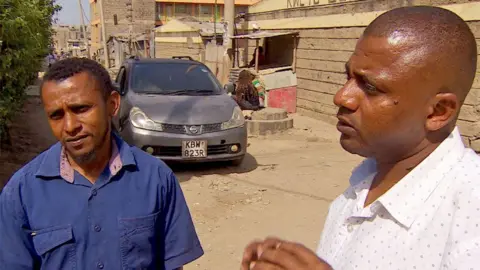
Jamil and Aslam Longton additionally saved quitness later they had been exempt in September from 32 days in captivity.
The brothers had been warned, says Jamil, that they might be killed in the event that they going to the media.
3 months upcoming, a central authority reputable publicly referred to their case as a lawful arrest.
The siblings took this as affirmation that a central authority company was once answerable for what that they had been via and located the braveness to talk out.
“The constitution of Kenya is very clear,” says Jamil. “You should be arrested and taken to court within 24 hours. Ours was 32 days. We were never given a lawyer to represent us anywhere.
“We weren’t allowed to peer our crowd or keep in touch to our crowd. So this isn’t an arrest, that is an snatch.”
The brothers told the BBC that Aslam had helped organise protests against tax rises in the town of Kitengela near the capital, Nairobi, and had been warned by security agents to stop his activism.
One day in August the two were pulled into a car by their home, hooded and handcuffed, and taken to an unknown location where they were held in small dark cells.
Aslam says he was regularly beaten, his tormenter demanding to know who was funding the protests.
“I used to be very scared,” he says. “When the door was once opened that guy would include a fable cable and a steel rod.
“I was scared he had come to beat me or finish me off – there were only two options to beat me or to kill me.”
Jamil describes their abductors as closely armed, in a position to trace their mobiles telephones and assured enough quantity to pick out them up in wide sunlight, working with a degree of sources and stage of flexibleness that human rights teams have reported in lots of circumstances.
However this doesn’t ruthless they’re reputable safety operatives, says executive spokesman Isaac Mwaura, denying that the climate is at the back of abductions.
“Organised security may also be part of organised crime,” he instructed the BBC.
“It could also be for political reasons… Our political detractors have really railed on this issue. They actually run with it just to settle up political scores.”
Mr Mwaura declined to touch upon the case of presidency minister Justin Muturi, one of the crucial damning indictments of Kenya’s safety companies.
Muturi says his son was once picked up by means of the Nationwide Perception Carrier (NIS) and simplest exempt later he made a right away attraction to President William Ruto.
“That is a matter of investigation, because that is his side of the story,” stated Mr Mwaura. “But what is a counter-story of the National Intelligence Service?
“I’d wish to say categorically that the president of the republic of Kenya, who’s the top of presidency, has no longer sanctioned any methods of snatch in anyway, as a result of he’s a person who believes within the rule of regulation.”
In fact, Ruto has publicly promised to stop the abductions, forced to respond to public outrage, and to concern from Western allies.
Many are distressed that the apparently systematic disappearance of anti-government activists has resurfaced in this way, recalling similar methods under the authoritarian leadership of Daniel arap Moi in the 1980s and 1990s.
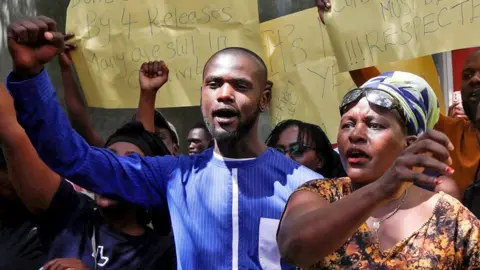 Reuters
Gitobu Imanyara, a journalist and activist who campaigned for multi-party politics in the early 1990s, was arrested and beaten by Moi’s regime. He has no doubt he is seeing the “Moi playbook” in action now.
But, he says, times have changed. Constitutional amendments have established more mechanisms of accountability and “there’s a better section of Kenyan crowd that might not be intimidated”.
“The democratic territory has expanded such a lot the federal government can’t want away democratic voices of dissent,” he told the BBC.
Plus with social media, “the assurance spreads out virtually instantaneously”, he stated.
“We can’t be censored the way in which we old to be censored in the ones days once we may just simplest worth landlines.”
Reports of disappearances have tapered off in recent weeks.
But despite the announcement of police investigations, no-one has been charged, let alone convicted, for carrying them out.
Several advocacy groups have petitioned the attorney general asking that abduction cases be referred to the International Criminal Court (ICC).
As for the families of those still missing, the nightmare continues.
“We’re so depressed, so devastated,” says Stacey Mutua, the sister of Steve Mbisi, one of the seven who disappeared in December.
“We hope they’ll let fall him. [Most] of the abductees had been freed, however he’s nonetheless lacking. We’re praying he’ll be discovered.”
You may also be interested in:
 Getty Pictures/BBC













