
 Dennis Osadebe
 BBC
Right here in Lesotho it’s referred to as white gold – the aqua which performs such an remarkable function within the nation’s economic system.
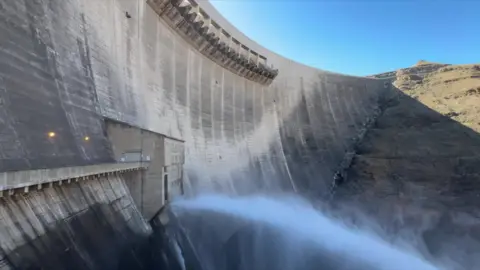
The engineering miracle on the centre of that is incongruous within the nation’s highlands – sited a number of the shepherds in conventional Basotho blankets and dust huts that produce up this rural branch.
The Katse dam is a critically notable piece of design. Status at 185m (600 ft) grand, it’s Africa’s 2d biggest crooked dam.
Finished in 1996, it methods a part of the Lesotho Highlands Aqua Mission, which used to be the results of a trade in signed between the governments of Lesotho and apartheid South Africa a decade previous.
The rustic could be solely surrounded by means of its a lot higher neighbour, however it has one thing portions of South Africa inadequency – a ordinary provide of aqua.
Because of its distinctive geography – Lesotho is the one nation on this planet that lies solely above 1,000m – the rustic receives a quite prime quantity of precipitation.
This is the place Katse is available in.
Aqua is funnelled out of the dam, coming into a form of tunnels, that finally takes it into the Vaal river gadget in South Africa. It’s Africa’s greatest aqua switch scheme.
The federal government says Lesotho receives $200m (£154m) a yr from South Africa for the aqua – greater than double what the rustic impaired to get later the commitment used to be renegotiated previous this yr.
Alternatively, regardless of being aqua affluent prosperous, Lesotho rest economically penniless. And nowhere is that extra obvious than in Ha Ramokoatsi village.
In spite of being round simply 1km from the dam, its 200 citizens nonetheless must depend on a petite herbal spring, tucked away within a petite cave at the hillside, for his or her provide of aqua.

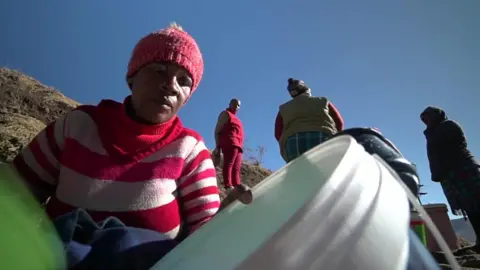
At 10:00 at the pace the BBC visits, there’s a stable queue of ladies, keeping deserted paint buckets to hold the aqua house.
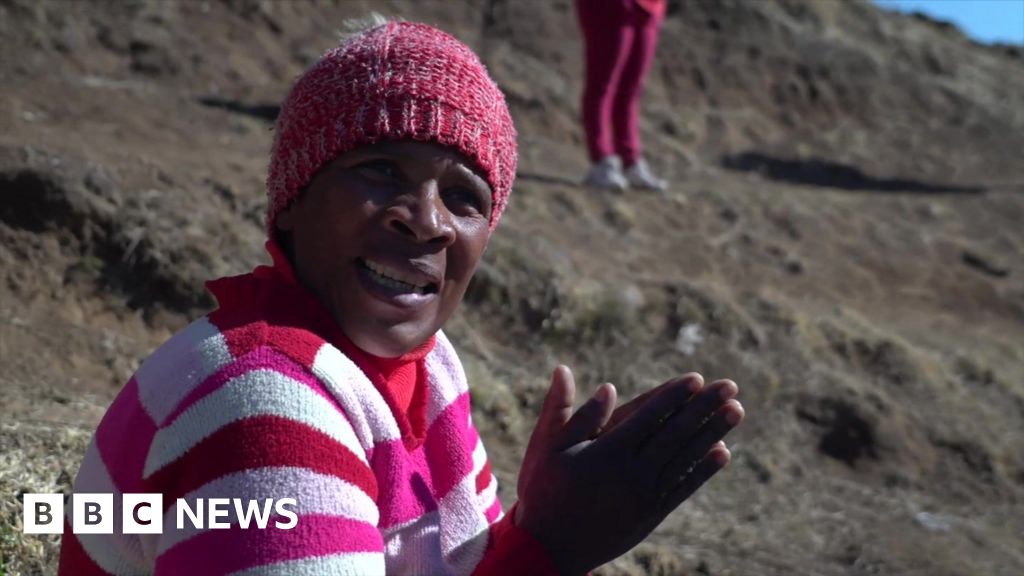
Some had been right here since 03:00. Within the queue we meet 50-year-old Manteboheleng Mosiyoa, who arrived 5 hours in the past.
“The water situation here is terrible,” she says, visibly wrathful.
“Sometimes when it rains, a dead dog can be washed into the spring. We have to just take it out as we need the water, even if it is contaminated.”
She provides that eating the aqua has had condition repercussions, and displays us an itchy rash on her wrist, which condition staff say is a results of ingesting grimy aqua.
“We regularly get sick, even small children. They drink this water and they have upset and painful stomachs.
“Now and again whilst you come to the aqua you notice tiny worms, however we nonetheless drink the aqua, as a result of there’s no approach we will be able to continue to exist with out it.”
As we speak the spring runs dry, meaning Ms Mosiyoa is left to scoop out the remaining water from a litter-filled, stagnant pool.
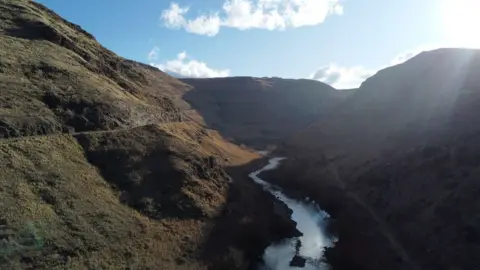
Village officials say that despite a series of promises from politicians – dating back to 2020 – that running water would be installed, they have heard nothing.
Village chief Hlojeng Khethisa shows me written minutes in a notebook from meetings held with the previous government.
“My message to this executive is they must come right here and spot how we are living. We will’t have this pretty dam constructed round our village and but we’re nonetheless residing in poverty.”
That is not a story that you will hear on the tours of the dam, offered by the Lesotho Highlands Development Authority, which runs the project.
Our guide is eager to tell tourists about the fact that Lesotho generates half its electricity through hydro-power, and the roads that have been built thanks to money earned from the dam.
Katse was the first dam, with a second opening in 2003. A third is set to start operating in 2028, with plans for a total of five dams.
Despite the growth, Minister of Natural Resources Mohlomi Moleko admits that the project has not always been in the interests of the communities that live around it.
“Now we have to – as Basotho – refocus. Our major center of attention in the future is to present aqua to the Basotho, and 2d the aqua switch.
“We are now looking at the provision of water for locals by 2030. That’s what we’re going to be looking at.” He provides that “he would bet his life” that the roll-out will probably be finished by means of after.
The call for for Lesotho’s herbal sources is simplest prone to develop.
A lot of Lesotho’s aqua is diverted to Gauteng province, South Africa’s financial heartland, and residential to its greatest town, Johannesburg.
It’s the biggest town on this planet now not constructed on a aqua supply, and the town of gold is getting thirstier.
Faucets within the town an increasing number of run brittle because of a mixture of crumbling infrastructure, a rising nation and reservoirs emptying out because of atmosphere alternate.
“Lesotho’s water is very important, as it basically drives part of South Africa’s GDP,” says Schoolmaster Anja du Plessis, a aqua control professional on the College of South Africa.
“Water demand however is not sustainable. Consumers use a lot of water, over 200 litres a day, but 46% of water that goes through the system does not reach the consumer, due to neglected infrastructure. It’s a man-made issue at this point in time.”
A trade in has additionally just lately been signed to speed Lesotho’s aqua greater than 700km, into Botswana.
Not one of the financial advantages of this will probably be a lot relief to the citizens of Ha Ramokoatsi.
In spite of with the ability to see the Katse dam from the window of her area, Ms Mosiyoa says it has purchased not anything sure to her date.
“This dam hasn’t done anything for us. We know nothing of the money Lesotho gets. Nothing has been done for us. We’re really struggling.”
Extra BBC tales on Lesotho:
 Getty Photographs/BBC













