
 Dennis Osadebe
7 hours in the past
Through Charlie Northcott, BBC Africa Ocular
 BBC
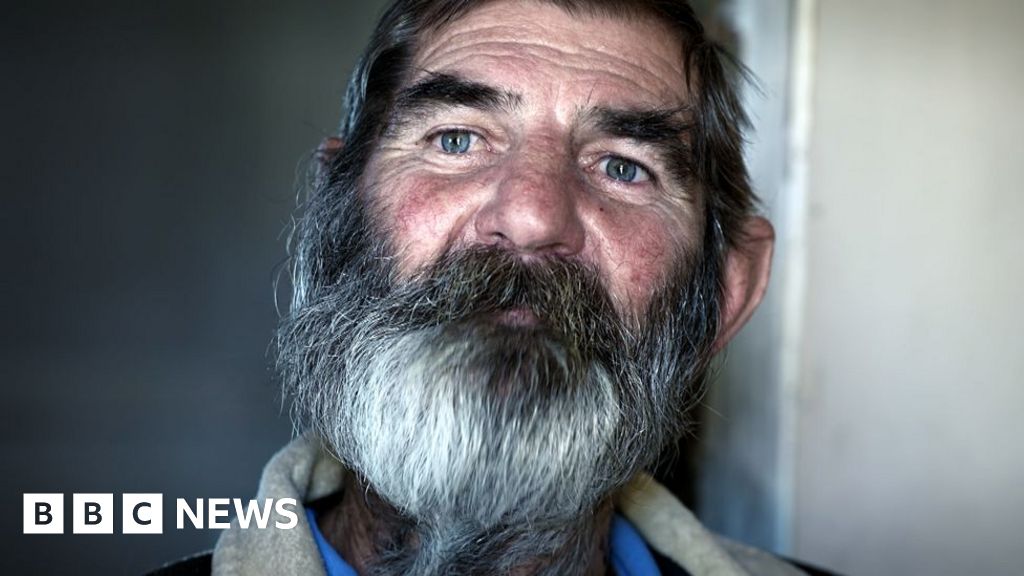
A convicted South African assassin who shot lifeless dozens of dark males throughout apartheid has informed the BBC the police sanctioned his violence. Louis van Schoor says others will have to percentage the blame for the killings he performed as a safety cover. However in speaking to BBC Africa Ocular over the while 4 years, he has additionally let slip scary main points that lift critical questions on his early drop from jail.
Status within the bed room of a killer, your perceptible naturally hone in on the main points.
Van Schoor’s mattress is immaculately neat – the cover so flat it appears find it irresistible has been ironed. The wind is weighty with the scent of cigarettes, their stubs piled prime in an ashtray. Strips of sticky paper are dangling from the ceiling, writhing with trapped and loss of life flies.
The so-called “Apartheid Killer” has misplaced his enamel. His fitness is waning. Following a center assault, each his legs had been just lately amputated, retirement him in a wheelchair, with painful scars. When his surgeon performed this process, Van Schoor asked an epidural in lieu of a basic anaesthetic – so he may just monitor them take away his legs.
“I was curious,” he stated, chuckling. “I saw them cutting… they sawed through the bone.”
In chatting with the BBC Global Carrier, Van Schoor sought after to steer us that he’s “not the monster that people say I am”. His motivated description of his legs being got rid of did negligible to melt his symbol.
Over a three-year length within the Eighties beneath the rustic’s racist apartheid gadget – which imposed a strict hierarchy that privileged white South Africans – Van Schoor shot and killed a minimum of 39 nation.
All of his sufferers had been dark. The youngest was once simply 12 years aging. The killings happened in East London, a town in South Africa’s windswept Jap Cape.
Van Schoor was once a safety cover on the moment, with a word to offer protection to as many as 70% of white-owned companies: eating places, stores, factories and faculties. He has lengthy claimed that everybody he killed was once a “criminal” who he stuck red-handed breaking into those constructions.
“He was a kind of vigilante killer. He was a Dirty Harry character,” says Isa Jacobson, a South African journalist and filmmaker, who has spent two decades investigating Van Schoor’s case.
“These were intruders who were, in a lot of cases, pretty desperate. Digging through bins, maybe stealing some food… petty criminals.”


Van Schoor’s killings – infrequently a number of in one evening – struck terror into the dark family of East London. Tales unfold during the town of a bearded guy – nicknamed “whiskers” within the Xhosa language – who made nation disappear at evening. However his shootings weren’t performed in unrevealed.
Each and every killing between 1986 and 1989 was once reported to the police through Van Schoor himself. However the drop from jail of anti-apartheid chief Nelson Mandela in 1990 signalled an finish to this impunity. Ripples of alternate swept throughout South Africa and, following power from activists and newshounds, the protection cover was once arrested in 1991.
Van Schoor’s trial was once probably the most greatest homicide trials in South Africa’s historical past, involving dozens of eyewitnesses and 1000’s of pages of forensic proof.
Then again, the case in opposition to him in large part collapsed in courtroom. On the moment of his trial, a lot of the equipment of the apartheid gadget was once nonetheless in playground inside the judiciary. Regardless of killing a minimum of 39 nation, he was once handiest convicted of 7 murders. He would progress directly to lend simply 12 years in jail.
His alternative 32 killings are nonetheless labeled as “justifiable homicides” through the police. Apartheid-era rules gave nation the correct to utility deadly drive in opposition to intruders in the event that they resisted arrest or fled as soon as stuck.
Van Schoor relied closely in this defence to preserve his innocence, claiming that his sufferers had been working away when he killed them.

The BBC’s investigation into Van Schoor scrutinised the proof underlying those so-called “justifiable” shootings, delving deep into long-forgotten police stories, autopsies and observer statements.
The investigation was once led through Isa Jacobson, and concerned years of archival analysis in a couple of towns around the Jap Cape. Essentially the most noteceable recordsdata had been scattered amongst loads of disciplines, mysterious away in vaults.
“The whole scale of it is just mesmerising,” she stated. “It’s astounding that any court of law could allow this to happen.”
Probably the most maximum harrowing proof Ms Jacobson discovered had been observer statements from nation who had been injured through Van Schoor, however survived. Those accounts contradict the protection cover’s argument that they’d been working away when he shot them.
More than one nation stated Van Schoor shot them presen their fingers had been up, next they’d surrendered. Others describe him toying with them, asking in the event that they would favor to be arrested or shot – sooner than capturing them within the chest. Any other sufferer described being shot within the stomach, begging for aqua, sooner than being kicked in his wound through Van Schoor.
The safety cover was once armed with a 9mm semi-automatic pistol, continuously loaded with hollow-point bullets, which purpose terrible interior ruptures when coming into a sufferer. In a single case, he fired 8 pictures into an unarmed guy.
In a specifically brutal case on 11 July 1988, Van Schoor shot a 14-year-old boy who had damaged into a cafe looking for petty alternate.
The boy – who now we have no longer named to offer protection to his privateness – informed the police he concealed in the bathroom when he noticed Van Schoor along with his gun. He says the protection cover referred to as him out, informed him to rise later to the wall, and upcoming shot him time and again.
“He told me to stand up, but I couldn’t,” stated the boy, in his recorded testimony. “While I was lying there, he kicked me in the mouth. He picked me up and propped me up against a table and then he shot me again.”
The boy survived, however he was once no longer believed. He was once charged for breaking into the construction. Many younger dark males and boys who gave first-hand accounts of being assaulted and shot through Van Schoor confronted a matching destiny.
Testimonies reminiscent of this had been heard throughout Van Schoor’s trial, however the pass judgement on time and again disregarded the eyewitnesses as “unsophisticated” and “unreliable”. There are not any jury trials in South Africa. The opinion of the pass judgement on is ultimate.


On the moment of Van Schoor’s trial, many participants of the white family in East London supported him. One entrepreneurial businessman published bumper stickers with footage of the protection cover. They stated “I Love Louis”, later to a center stuffed with bullet holes.
“There was evident racial bias in the legal system,” says Patrick Goodenough, a South African journalist who led the Eighties investigation into Van Schoor. He additionally attended his trial.
“The support for him was massive… He would not have been able to get away with a fraction of what he got away with without it.”
There is not any statute of barriers for homicide or tried homicide in South Africa. In concept, there may be not anything preventing the police from reopening Van Schoor’s case and re-assessing those “justifiable” shootings.
“Louis van Schoor was basically going out and murdering people for sport,” says Dominic Jones, a journalist who helped lift consciousness of the protection cover’s killing spree within the Eighties.
Probably the most maximum stunning findings from the BBC’s investigation got here from interviews with Van Schoor himself, which strongly instructed he were given a thrill from his actions.
“Every night is a new adventure, if you want to put it that way,” he informed the BBC.

Lots of the companies he safe put in quiet alarms. When somebody needy in, Van Schoor would obtain an alert which allowed him to miracle the intruder – and establish precisely the place they had been within the construction. And he at all times went isolated.
“I was barefoot. It’s quiet. You don’t have your shoes squeaking on tiles and stuff,” he stated.
He would by no means transfer the shiny on. In lieu, he trusted his sense of scent.
“If somebody breaks in, the adrenaline gives off an odour. And you can pick that up,” he stated.
Van Schoor claims he by no means went out “with the intention of killing black people” and says he isn’t a racist. However he admits he discovered stalking them within the black “exciting”.
Sooner than changing into a safety cover, Van Schoor was once a member of the East London police drive for 12 years. He old to deal with what he yelps “attacker dogs”, which he old to trace indisposed and catch protesters and criminals – virtually all of whom had been dark.
He when put next this to “hunting, but a different species”.
 Louis van Schoor
Tetinene “Joe” Jordan, a former anti-apartheid activist who was once working in East London on the moment of Van Schoor’s killings, recollects this neatly.
“He was hunting, literally hunting people,” he says.
Van Schoor strongly denies he’s a “serial killer” and believes the whole lot he did was once “within the law”. If nation really feel aggrieved over his killings, he says they will have to blame the South African police.
He says the police by no means criticised or warned him, however actively supported and inspired him.
“Every officer in East London knew what was going on… all the police officers knew,” he stated. “Not once did anybody say ‘Hey Louis, you’re on the borderline or you should cool it or whatever’… they all knew what was happening.”
Within the police information held in community archives, Ms Jacobson discovered cases of killings the place officials have been provide on the moment of the shootings. At disagree level did they seem to query Van Schoor as a suspect.
In lots of cases, the police did not pluck pictures of a dead body on the scenes of capturing and did not bind key forensic proof, reminiscent of bullet casings. Van Schoor was once continuously the one observer to his shootings, so this proof can have been an important for figuring out what had in reality came about in each and every case.
“These were cover-ups… He had the backing from police officers from junior rank and senior rank,” stated Mr Goodenough.
“They wouldn’t investigate. They’d sit down with him and have a cigarette while chatting, with bodies lying nearby.”
In all instances Van Schoor pulled the cause – however between the police and the companies that leased him, a complete family performed a task within the killings which took playground in East London.
“Van Schoor was a serial killer because there was a society that allowed him to be one,” says Ms Jacobson.
For the relations of Van Schoor’s sufferers, his democracy, and the failure of the surrounding to completely examine his killings, is a continuing supply of ache. Some by no means recovered the our bodies in their family members.
“It seems like we are stuck in this phase of being heartbroken, being angry,” says Marlene Mvumbi, whose brother, Edward, was once murdered through Van Schoor in 1987. His extra had been dumped in an unmarked grave through the government with out the community’s consent.
“Lots of people are still missing and not even in the graveyard… there is no closure.”
Van Schoor’s case pre-dated South Africa’s 1995 Reality and Reconciliation Fee, which gave repayment to many sufferers of apartheid-era crimes.
Sharlene Crage, a former activist who performed a key position in pressuring the South African government to prosecute Van Schoor, is outraged that he was once ever allowed to exit sovereign.
“It’s a shocking miscarriage of justice,” she stated. “There is no reason his case shouldn’t be reopened.”

Van Schoor was once sentenced to greater than 90 years in jail on the conclusion of his trial in 1992, however the pass judgement on allowed him to lend each and every time period at the same time as. He was once freed on parole in 2004.
The early drop of apartheid-era killers from jail has turn out to be a contentious factor in South Africa.
In 2022, there have been protests in Johannesburg over the parole of Janusz Walus, who killed anti-apartheid baby-kisser Chris Hani. A couple of years prior to now, Eugene de Kock, answerable for a loss of life squad answerable for the kidnapping, torture, and homicide of dozens of dark activists was once additionally freed.
At the present time, Van Schoor spends maximum of his moment looking at rugby, smoking and taking part in along with his puppy rottweiler, Brutus. He says he has disagree reminiscence of a lot of his killings.
Some stories have said, with out verification, that he shot as many as 100 nation. Van Schoor denies this, however concedes his choice of shootings would possibly exceed the documented choice of 39.
“I honestly don’t know how many I shot. Some say over a 100, some say 40… Let’s say for argument’s sake I shot 50 people,” he informed us.
He says he’s happy with his while movements.
“I don’t feel any guilt,” he stated. “I’ve got no remorse inside.”
The BBC contacted the South African police for remark, however they didn’t reply. The government have given disagree reason for why Van Schoor’s killings have no longer been reassessed within the post-apartheid period.
“There is too much pain, and for now I don’t feel that there is enough that is done for us to heal,” says Marlene Mvumbi.
“It’s not only the ones that were killed by Van Schoor. The ones that have similar stories from the killings of the apartheid regime.”
Investigation through Isa Jacobson and Charlie Northcott













