
 Dennis Osadebe
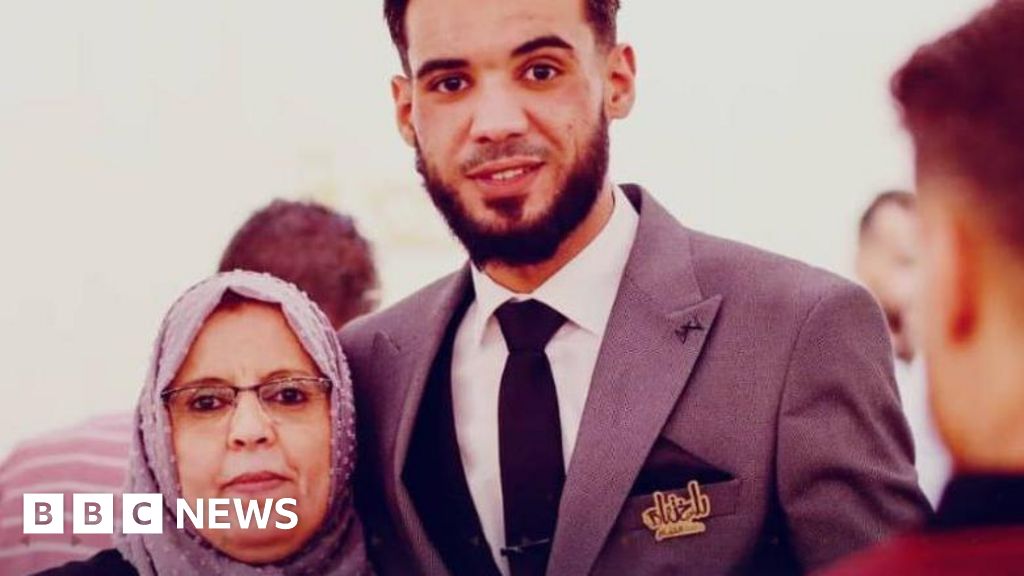
 Abdul Aziz Aldali
One generation on, the pictures of the fatal deluge that swept via Libya’s coastal town of Derna, killing 1000’s, linger within the recollections of those that survived.
“Life stopped. It’s only the body that is still alive. I’m not the same person,” says Abdul Aziz Aldali, a tender resident.
He misplaced his mom, father and nephews, who had come for a sleepover at their house, when Typhoon Daniel strike town at the evening of 10 September.
“I consider them martyrs. My neighbours, the Nasser family, lost 24 martyrs. The water reached them first,” Mr Aldali says.
Derna is constructed at the delta of the Wadi Derna river. The tide flows via two dams earlier than crossing town and emptying into the ocean.
The unseasonably large rains – along side the failure to do upkeep paintings on growing old infrastructure – beaten the dams, which in the end ruptured at round 02:00 native presen on 11 September.
“A huge wave came through [the house]. Water filled up two floors in less than a second. The water was moving us around the house in the darkness,” Mr Aldali recollects.
“The water was taking me up and down. I swim very well, but it’s hard to control when the water keeps flipping you.”
Ultimately, the waves propelled him outdoor.
“I spotted a network tower. A wave came and pushed me towards it, so I clung to it and tried to resist as much as I could.”
A deluge of aqua struck town with an estimated power of 24 million tonnes, sparing nobody.
“I looked at the people – small children who couldn’t save themselves. Those who were destined to live survived. Those who weren’t passed away,” Mr Aldali recollects.

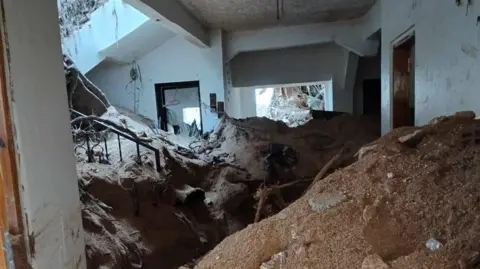 Abdul Aziz Aldali
Like many alternative citizens, Mr Aldali has left town. He has now relocated to Umm al-Rizam, a old fashioned village which is a 40-minute pressure south of Derna.
Greater than 5,900 crowd died, in step with the UN Administrative center for the Coordination of Humanitarian Affairs (Ocha), and a pair of,380 extra are reported lacking in a town with a community of about 90,000.
Locals imagine the collection of crowd killed within the flooding is far upper.
“Almost all of my friends lost a family member. People in Derna believe more than 10,000 died in the flood,” says Dernawi journalist Johr Ali, who’s now based totally in Turkey’s primary town, Istanbul, and has been following tendencies in his house the town.
For lots of Dernawis, the injury of the loss is compounded via the agonising indecision of now not understanding the destiny in their lacking family members.
“I only found [the bodies] of my nephews,” says Mr Aldali says. “This world is worth nothing without my parents. I only ask Allah to reunite me with them in heaven”.
The Normal Authority for Seek and Identity of Lacking Individuals (Gasimp) has spent the while twelve months accumulating DNA samples from human residue within the hope of discovering fits with surviving community individuals.
“We collected the bodies, took samples from the teeth and other bones, issued reports with the cause of death, and buried the bodies,” Gasimp director Dr Kamal Sewi says.
However discovering the residue of the sufferers has been tricky, with some frame portions found out so far as 60km (37 miles) out to sea or underneath collapsed constructions.
A unique cemetery at the outskirts of Derna has been arrange for the sufferers, however the graves are nonetheless anonymous as a result of maximum our bodies have now not been formally known, escape 1000’s of households with out the closure they desperately thirst for.
Numeric codes are saved outside and inside every burial spot. Those will in the end be assigned a reputation if the DNA of a dead body particular person is matched with that of a dwelling relative.
Alternatively, the dimensions of displacement led to via the deluge has difficult this step of identity.
“It is easier to match DNA samples from direct relatives like parents or siblings,” Dr Sewi says, however discovering the ones related community individuals has been a problem.
“People moved from the city because they no longer have a home, but they did not come to report the missing,” Dr Sewi says.
This has additional not on time the identity procedure since the groups must seek for second- or third-generation family members, which makes DNA alike extra difficult.
“[Identification] is not a process that will take one or two months to complete,” Dr Sewi says.
However time the lives of many Dernawis stay in limbo as they look forward to information in their family members, town’s reconstruction is easily underneath approach.
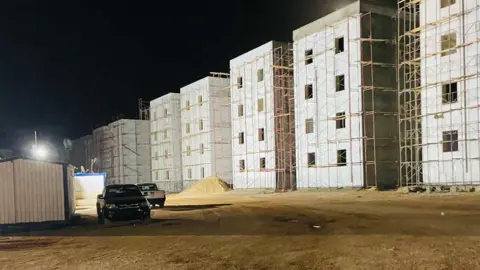 Moataz Fadil
Roads were cleared, colleges and mosques are being repaired, and untouched properties have sprung up.
The so-called Korean constructions, a fancy of high rental blocks painted in white have transform the satisfaction of native government, who’ve additionally organised press excursions to show the completed paintings.
It’s been finished greater than a decade later then-ruler Muammar Gaddafi’s executive commissioned a South Korean corporate to create the advanced.
Building paintings was once suspended later the outbreak of a civil struggle in 2011, however resumed later the flooding.
Some displaced households have additionally returned to Derna, attracted via the chance to obtain reimbursement of as much as 100,000 Libyan dinars ($21,000; £16,000) and subsidised hire.
However monetary backup to a couple households – along side the reconstruction try – has been not on time via bureaucratic bottlenecks, and allegations of monetary mismanagement.
A supply with the investigative information organisation The Sentry instructed the BBC that the method gave the look to be “opaque”, and lacked sunny laws.
“Some families who thought they were eligible are still waiting,” he added.
There also are mounting issues that the sufferers of the floods have transform pawns within the energy effort between Libya’s rival governments – headquartered within the capital, Tripoli, and within the jap town, Bengazi.
Belqasem Haftar – a son of army strongman Gen Khalifa Haftar, who governs the jap a part of Libya – is well-known the fix efforts throughout the Derna Reconstruction Charity.
 Getty Pictures
With greater than $2bn allotted to the charity, it provides the Haftars huge affect to increase their energy bottom.
“It is a blank cheque with zero oversight,” Libya analyst Anas El Gomati, who heads the Sadeq Institute think-tank, told the AFP news agency.
A spokesman for Gen Hatar’s Libyan National Army did not respond to a BBC request for comment.
The source at The Sentry, who preferred to remain anonymous because of the sensitivities around the issue, pointed out that the governor of Libya’s central bank had fled the country after a fall-out with the government there.
“Money allocated to the reconstruction of Derna contributed to making the central bank in Tripoli closer to the Haftar family, but the government in Tripoli was bitterly against this,” he added.
As the power struggles and chaos continue to rage, Dernawis like Mr Aldali are warily trying to rebuild their lives.
“We ask the people to pray for those who are behind the maintenance we’re witnessing now and to make the country look better than it was. May Allah have mercy upon them,” he says.
You may also be interested in:
 Getty Pictures/BBC













