
 Dennis Osadebe

BBC Information, Kampala
 BBC
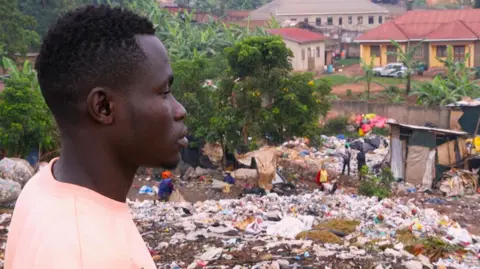
Preventing again the tears, 22-year-old garbage collector Okuku Prince remembers the week his very best good friend’s dead frame was once discovered at a large garbage unload in Uganda’s capital, Kampala.
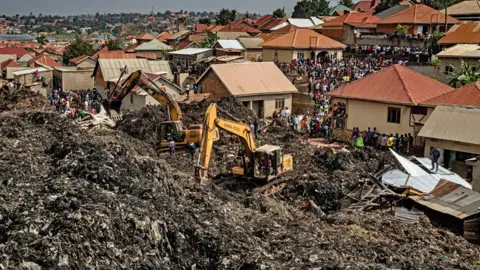
The landslide on the Kiteezi unload utmost August killed 30 nation, together with his good friend Sanya Kezia.
“I think some people are still underneath the garbage,” he tells the BBC.
Lots of them eked out a dwelling via bath and promoting no matter discarded pieces they discovered that also had worth – the rest from fishing nets to plastic bottles, glass jars and the elements of aging digital units.
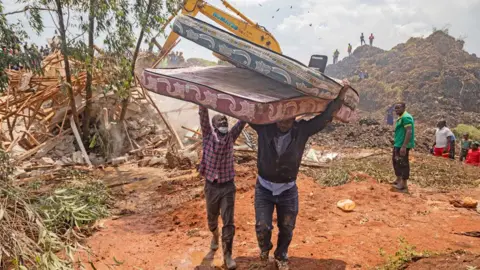
A blame-game erupted nearest the terrible shatter, with Kampala’s town council and central govt accusing each and every alternative of negligence, life one of the vital useless nonetheless languished below tonnes of garbage with out the honour of a burial.
When govt tractors did ultimately dig up Kezia’s frame, there have been accidents to the 21-year-old’s face.
It was once scary for his good friend to peer him enveloped via stinking, rotting misuse.
“We’re not safe here. Unless they [repair] it, maybe level it. Otherwise, people are not safe,” says Mr Prince, who prior to turning into a rubbish-picker have been finding out regulation on the Islamic College of Uganda.

 AFP
Not able to manage to pay for tuition charges nearest his community become financially disturbed, his day by day regimen is now a a ways yell from libraries and lecture halls.
Adolescence unemployment is at situation ranges in Uganda, and there are lots of like Mr Prince who ceaselessly chance their condition and vacate their desires simply to form a dwelling.
“I come here to the dump in the morning, collect polythene bags, take them for washing and sell them,” says Mr Prince. “I make 10,000 shillings [equivalent to $2.70 or £2.10] a day.”
The shatter has left him in additional monetary misery as he worn to are living via the aspect of the unload – however has needed to walk on account of protection issues.
The homes of others had been additionally destroyed throughout rescue operations.
Reimbursement cash has been paid to the households of those that died, however to not round 200 nation who misplaced their houses, native government have admitted to the BBC.
Officers are “waiting for the valuation and budget allocation”, says Dr Sarah Karen Zalwango, the pristine head of community condition and the state on the Kampala Capital Town Authority (KCCA).
Some argue that the Kiteezi shatter was once inevitable as a result of unsophisticated ordinary sense was once left out.
“You can’t take four million people, get all that waste, mingled – degradable and non-degradable – and take it to one dumping site. No, that’s not how we [ought to] do it. But we’ve been doing it for over 20 years,” Frank Muramuzi, a Kampala-based city planner, tells the BBC.
The Kiteezi landfill was once inbuilt 1996, with financing from the International Storagefacility, to grant a unmarried, main depository for cast misuse generated via Kampala.
As Kampala has grown, so too has its greatest garbage unload.
At the northern fringe of the town, it now covers 15 hectares (37 acres) – an section the scale of greater than 22 soccer pitches – with its stench spreading additional nonetheless.
Birds of prey can also be perceptible aviation overhead.
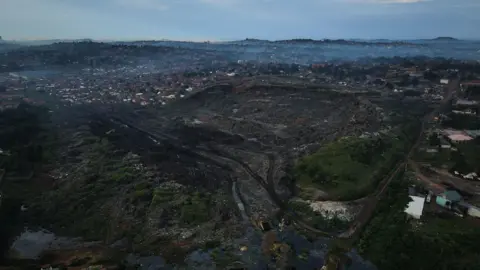
Town’s citizens and companies generate an estimated 2,500 tonnes of misuse each while, part of which results in dumping websites around the town – the most important being Kiteezi.
However the sickness is that Kiteezi lacks the on-site recycling, sorting and incineration amenities that landfills are meant to have.
“With each layer of trash piled up, the bottom layers become weaker, especially as the decay and decomposition of organic waste increases the temperature,” Mr Muramuzi explains.
“Without vents, methane and other gases remain trapped at the bottom, further multiplying the fragility of the loosely held structure.”
But this may simply be fastened, he provides, as long as the federal government commits to periodic tracking and audits which consider environmental, social and financial wishes.
Had that already been in park, “the havoc that happened in Kiteezi would have been avoided”, he says.
So, if the answer is this straightforward, why is it no longer already going down?
The solution appears to be a mixture of energy struggles and fiscal mismanagement.
Last accountability for retaining Kampala “clean, habitable, and sustainable environment” lies with the KCCA, however Mayor Erias Lukwago, from the opposition Discussion board for Democratic Alternate celebration, says his place of business lacks the vital energy to enact the adjustments.
The KCCA says it has many times proposed plans to decommission Kiteezi however says the finances essential to take action – $9.7m – exceed the town’s funds and feature no longer been made to be had via central govt.
“All the support we have been getting is courtesy of development partners and donors like Bill and Melinda Gates, GIZ, and WaterAid… but their capacity is very limited,” the Kampala mayor stated lately.
“If we were getting adequate funding from the central government, we would be very far right now.”
There is not any commitment from the federal government on whether or not it’ll allocate finances for Kampala’s greatest unload.
It did pay $1,350 to each and every of the households of a dead body, announcing to any extent further cash would most effective be impending if govt companies had been “found to be responsible”.
A moment nearest, a document furnished via the rustic’s police and crime investigation branch ended in President Yoweri Museveni – a famous political opponent of Kampala’s mayor – sacking 3 senior KCCA officers, together with the authority’s government and community condition administrators.
 AFP
James Bond Kunobere, Kampala’s cast misuse control officer, admits that utmost yr’s fatal shatter was once a much-needed warning sign.
At the present, the government within the Ugandan capital are drafting plans to show natural misuse into compost and let fall “unnecessary waste” entering the town.
However they would like the community to rush some accountability too. On the week nation pay one of the crucial seven personal misuse corporations running in Kampala to bind their garbage, which is all bundled along side minute idea given to recycling.
“We haven’t changed the mindset of residents to sort waste,” Mr Kunobere tells the BBC.
“If you sort, waste has different destinations. If you mix, it all goes to one – the landfill.”
Mavens say such tasks are remarkable however don’t deal with the larger structural inadequacies at Kiteezi.
And for nation whose lives had been shattered via contemporary occasions there, it’s too minute too overdue.
“They promised us compensation, but I haven’t received anything – almost everyone is complaining too,” Mr Prince tells the BBC.
“We lost our friend. All that transpired in the process was sorrow.”
Supplementary reporting via Natasha Booty.
You might also be all for:
 Getty Photographs/BBC