
 Dennis Osadebe
 AFP
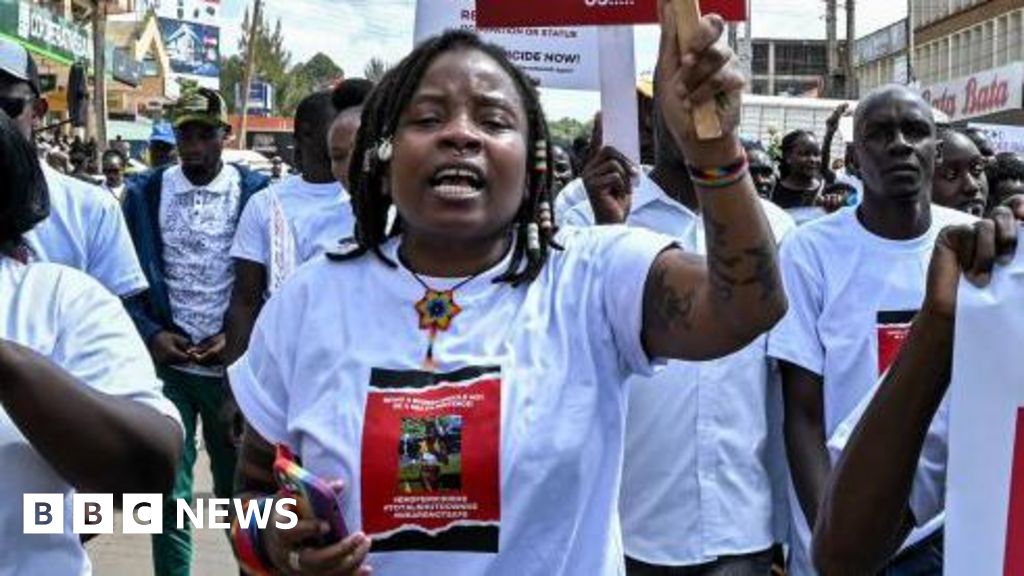
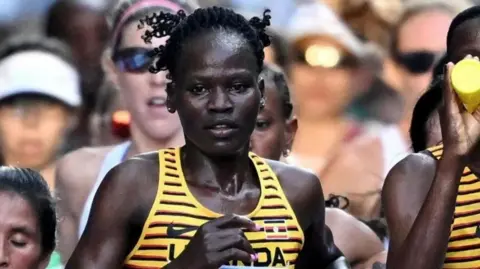
The homicide of Olympic runner Rebecca Cheptegei via her former associate has reignited requires more potent motion in opposition to femicide in Kenya.
The 33-year-old Ugandan died days nearest being doused in petrol and poised alight via her ex-boyfriend at her house in Trans Nzoia county in western Kenya.
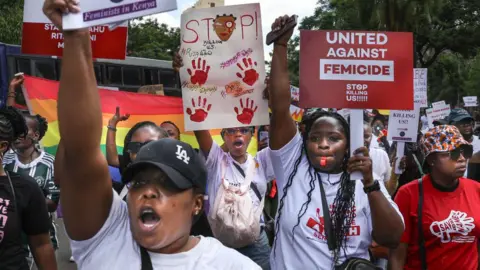
This isn’t an separate incident. Kenya has some of the best possible charges of violence in opposition to ladies in Africa.
Media experiences say that during January unloved greater than 10 ladies within the nation have been sufferers of femicide, outlined via the UN because the killing of girls as a result of their gender.
Jane, now not her actual title, tells the BBC she has been in hiding for the simpler a part of the yr.
She says she is not able to advance again to paintings because of life-changing accidents inflicted via her ex-partner throughout a brutal stabbing.
“His intention was to kill me. He stabbed me and left me for dead. Were it not for the neighbours, I would be dead,” Jane remembers.
She says she continued a long time of worsening abuse ahead of she left. Her breaking-point was once when he began his aggression in opposition to the kids, she says.
“It was hell living with him. I don’t know how I persevered for those many years,” Jane provides.
Her estranged husband continues to annoy her.
“I live in fear. He says he wants to finish me off. I can’t sleep at night. I’m now on medication to help with my mental health. I’m not the perpetrator but I’m living like I’m in jail.”

 Reuters
A 2018 Global Condition Group (WHO) document steered that 38% of girls in Kenya elderly between 15 and 49 had skilled violence from an intimate associate.
Teams that do business in aid to survivors of gender-based violence say there was a year-on-year building up within the selection of instances.
“On average, we receive up to 50 calls and sometimes 20 walk-ins in a day,” Njeri Migwi tells the BBC.
She is the top of Usikimye – Swahili for “don’t be silent”.
In 2021, next President Uhuru Kenyatta declared gender-based violence “a national crisis”.
A yr after, a central authority document discovered 41% of married ladies had skilled bodily violence.
A survey via Africa Information Hub discovered that between 2016 and 2023, there have been greater than 500 reported instances of girls being killed in Kenya.
“In 75% of cases, killings were committed by a person who knew the murdered woman – an intimate partner, relative or friend,” the document says.
Sunita Caminha, UN Girls specialist on finishing violence in opposition to girls and women in East and southern Africa, says that girls and women of various backgrounds were sufferers of femicide in a global marred via common gender discrimination and inequality.
Within the unedited UN document on violence in opposition to girls and women, Africa accounts for the most important percentage, with 20,000 ladies murdered.
 Reuters
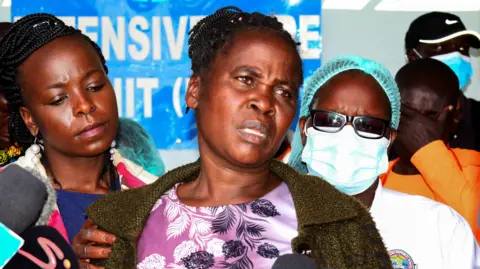
Lengthy-distance runner Joan Chelimo says the killing of Cheptegei has left her traumatised.
“I can’t sleep, imagining that someone was just burnt alive,” she provides.
Cheptegei’s ex-partner therefore additionally died of burn wounds that he sustained within the assault on her.
Ms Chelimo is a co-founder of Tirop’s Angels, an organisation shaped nearest the killing of every other athlete, Agnes Tirop.
She says that Cheptegei reported the abuse she confronted to police, however “nothing happened”.
“So the perpetrators are not held accountable,” Ms Chelimo adds.
Police have denied claims that Cheptegei reported her life was in danger.
Kenya has passed laws to address gender-based violence, but critics say few concrete measures are in place to tackle the scourge.
Judy Gitau, the Africa regional director for campaign group Equality Now, says that “sadly, governments regularly really feel that when they have got a legislation, that’s it – now not working out that regulations don’t kill themselves they usually don’t put into effect themselves”.
Jane says that over the years her reports of abuse were dismissed.
“Many times, the police say these are domestic quarrels. In fact, one policewoman I spoke to said: ‘We cannot arrest him until he does something.’ I asked her: ‘Do you want him to kill me?’
“The next day is when he stabbed me,” Jane remembers.
 AFP
In 2004, police gender desks have been presented in Kenya to create it more uncomplicated for ladies to document instances of gender-based violence, and for investigations to be speeded up.
On the other hand, most effective part of police stations have them. Police say that is as a result of a rarity of sources.
In Trans Nzoia, the place Cheptegei lived, there are 5 police stations, however none has gender desks – the one one is on the county headquarters, says Kennedy Apindi, the top of legal investigations within the county.
“So reporting of these cases is a problem. They are reported late, or they are unreported until you hear about them in the media and that’s when the police come into action,” he provides.
Cheptegei was once the 3rd feminine athlete to die in Kenya allegedly by the hands of an intimate associate within the extreme 3 years.
In 2021, simply 5 weeks nearest Agnes Tirop needy a 10km road-running global document in Germany, she was once discovered killed in her house.
The 25-year-old had a couple of stab wounds on her neck and stomach.
Her associate Ibrahim Rotich was once arrested via police 640km (400 miles) away in Changamwe, on Kenya’s coast.
3 years nearest she was once killed, the case remains to be in court docket, with Mr Rotich out on bond. He has pleaded now not to blame to a fee of homicide.
Alternative instances additionally run for years.
Ms Gitau, who sits on a judiciary committee poised as much as evaluation the timelines for instances involving gender-based violence, says the delays are unfavourable.
“There must be prioritisation of GBV [gender-based violence],” she says.
 Getty Images
Just six months after Tirop’s killing, Kenyan-born Bahrain runner Damaris Muthee Mutua was found dead in her home in Iten, a running hub in Kenya’s Rift Valley.
A police autopsy revealed that the 28-year-old had been strangled.
Nobody has been convicted of her killing.
Police said they were looking for her boyfriend in connection with the death.
Just like Cheptegei, both athletes allegedly reported quarrels over money and property with their partners before meeting their deaths.
In many East African communities, gender-based violence is driven by patriarchal beliefs, placing women in subordinate roles. Their independence is limited, and violence is normalised as a form of control.
Ms Gitau is calling for more safe houses for survivors.
“Deep down, our attitudes, the norms that we hold as a country, still view women in a certain light,” she says.
Expressing a similar view, Ms Chelimo says the substantial amount of money that female athletes make, or stand to earn, leaves them vulnerable.
“They go against traditional gender norms… Female athletes are now becoming more independent, financially independent, and the other gender is really upset about it,” Ms Chelimo adds.
The government says it is running sensitisation programmes, while reviewing legislation to tackle gender-based violence.
“We don’t want this to happen to any other woman, whether an athlete, or from the village, or a young girl. We need to make sure that the gender police officers are doing their work,” Rachel Kamweru from Kenya’s Atmosphere Gender Area tells the BBC.
Jane says her lifestyles rests within the govt’s arms, and she or he hopes that it’ll do extra to give protection to ladies like her from their ex-partners.
“As long as he is free, I’ll never have peace,” she says.
You may additionally be curious about:
 BBC / Getty Photographs













