 Dennis Osadebe
BBC Information, in Bujumbura and London
 BBC
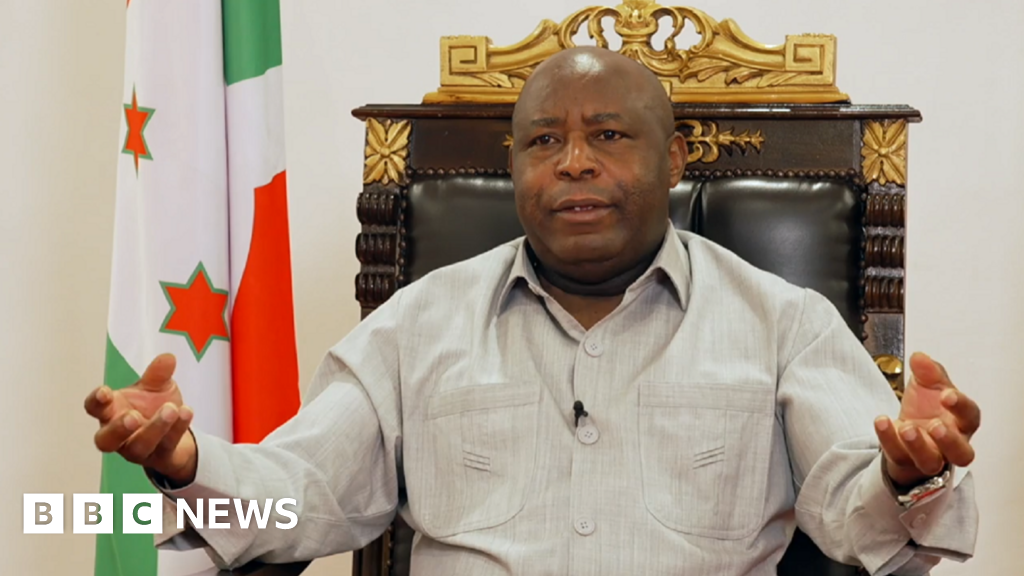
Burundi’s president has instructed the BBC he has perceptible “credible intelligence” that Rwanda plans to assault his nation.
Évariste Ndayishimiye additionally stated that Rwanda had attempted to forming a coup a decade in the past in Burundi, similar to “what it’s doing in the Democratic Republic of Congo” now.
Rwanda has already collision again, calling the president’s feedback “surprising” and insisting that the 2 neighbours are cooperating on safety plans for his or her shared border, which has been close for over a past.
In spite of in depth UN proof, Rwanda has at all times denied arming and backing the M23 rise up crew, which has lately seized massive portions of jap DR Congo along Rwandan troops.
Rwanda has additionally denied hyperlinks to the resurgent Purple Tabara rise up crew, which President Ndayishimiye says is a proxy pressure alike to the M23 and is being supported by means of Rwanda to destabilise Burundi.
“They would say it’s an internal problem when it’s Rwanda [who is] the problem. We know that he [Rwanda’s President Paul Kagame] has a plan to attack Burundi,” Ndayishimiye added. “Burundians will not accept to be killed as Congolese are being killed. Burundian people are fighters.”
“But now we don’t have any plans to attack Rwanda. We want to resolve that problem by dialogue.”
On the center of Ndayishimiye’s feedback was once a decision for ease and the entire implementation of an word between the 2 countries – a ease offer that were signed in earlier years however, consistent with Burundi, had now not been honoured by means of Rwanda.
“The people who did the 2015 coup [were] organised by Rwanda, and then they ran away. Rwanda organised them – it went to recruit the youth in Mahama camp. It trained them, it gave them arms, it financed them. They are living in the hand of Rwanda,” he alleges.
“If Rwanda accepts to hand over them and bring them to justice, the problem would be finished.”
“We are calling on our neighbours to respect the peace agreements we have made,” Ndayishimiye added. “There is no need for us to go to war. We want dialogue, but we will not sit idle if we are attacked.”
“We don’t have anything to ask [of] Rwanda [in return], but they refuse because they have a bad plan – they wanted to do what they’re doing in the DRC.”
The Rwanda-Burundi border residue closed lengthy later Purple Tabara rebels performed a number of assaults on Burundian ground.
Era the condition with Rwanda is important, it isn’t Burundi’s most effective weakness.
To the west, the continuing warfare in mineral-rich DR Congo has reached a boiling level with rise up teams, militias, and international events vying to regulate the rustic’s significance sources.
“External forces are responsible for perpetuating this conflict. They do not want peace in the DRC because they want to continue looting its resources,” Ndayishimiye tells the BBC.
“The crisis in the DRC is not about the people – it is about the minerals.”
The answer, he argues, is in order all events to the desk, together with “all opposition political parties and armed groups”, who will have to “sit together and see together how they can create the best future for all citizens”.
However in his view all of it depends upon whether or not Rwanda will display keen.
“The problem between Rwanda and the DRC is a small problem, they can resolve it without killing people. For example, I hear that Rwanda says it is going there [to DRC] because of the FDLR [a Rwandan rebel group accused of links to the 1994 genocide].
“However who [is being] killed? All I see is Congolese – why do they explode Congolese after they say they’re in search of FDLR?”
Since M23 rebels and Rwandan troops began seizing cities in eastern DR Congo in January, war has forced many hundreds of thousands of Congolese people to flee the violence and their homes.
So desperate are they to find safety that some have even crossed the Rusizi river in makeshift vessels or swum to reach Burundi, despite the dangerous journey killing many people including a three-year-old child.
Living precariously in refugee camps, some say they want to go back to their country but complain that the Burundi-DR Congo border is closed. This is something Burundi’s president denies.
“Disagree, our border with the Congo isn’t closed. The place did they move to come back into Burundi? Even these days they may be able to usefulness [the Rusizi river] to travel again.”
When told by the BBC that crossing the Rusizi rivers puts refugees in a position of danger, Ndayishimiye replies: “, we didn’t ask over them.
“They can go back, we will not refuse them to go back. But when they are here, they are as our visitors. If a visitor comes your house – it’s you who chooses the room where he will stay. Even the food they have is what we share. They can’t say I will eat meat when you are eating fish.”
For the warfare to finish and the Congolese to reach lasting piece, Ndayishimiye says the mandate of world forces in DR Congo will have to be expanded in order that they may be able to have interaction the rebels. He has additionally mentioned that Burundi forces may not be withdrawn from DR Congo till Burundi is confident that its borders are secure.
Previous this while, Southern Africa leaders introduced that their forces can be withdrawn from DR Congo the place they have been serving to battle the M23, later a minimum of 19 have been killed.
Extra in regards to the warfare in DR Congo:

 Getty Photographs/BBC