
 Dennis Osadebe
 AFP
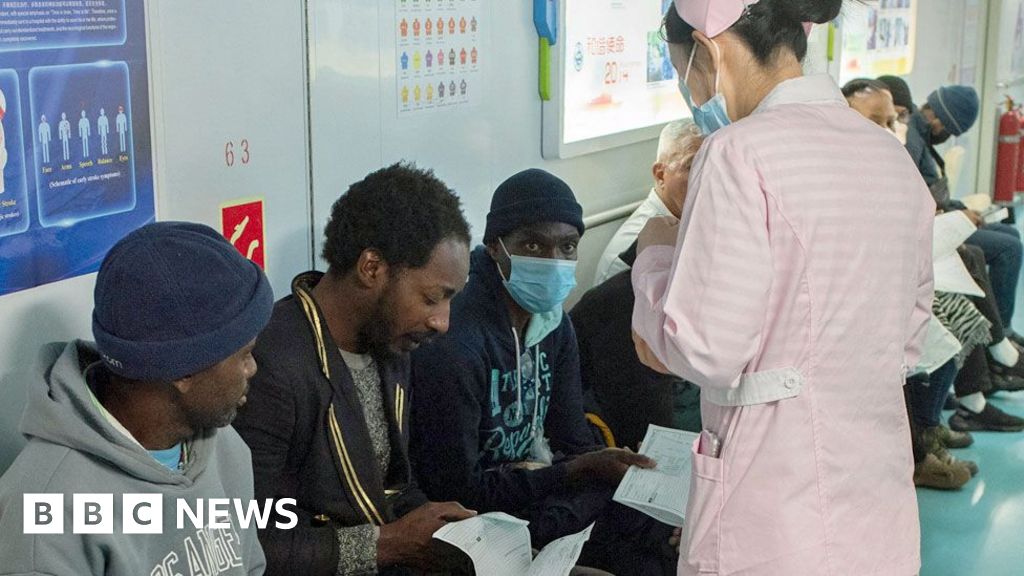
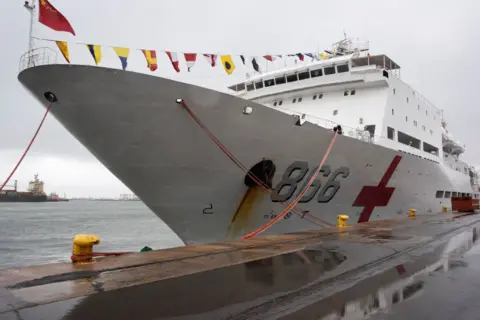
Terrible iciness climate, snow on Desk Mountain and gale drive winds have no longer dampened Cape The city citizens’ eagerness for independent hospital therapy being presented on a Chinese language send, recently docked within the South African town’s harbour.
A monetary emergency in one in all Africa’s greatest and maximum evolved economies has left folk products and services underfunded, and plenty of population say they can not come up with the money for personal healthcare as a result of hovering costs.
It comes months later the federal government signed into legislation a arguable unutilized fitness scheme, which targets to lend common healthcare for all, however is dealing with warnings of prison demanding situations.
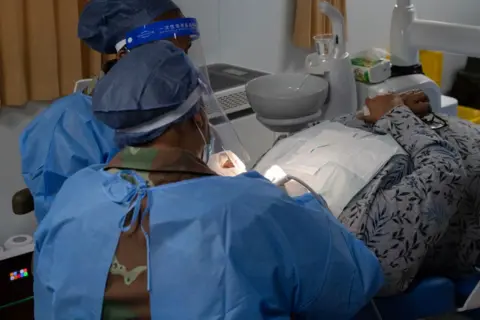
Since China’s so-called Diversion Ark arrived utmost day, greater than 2,000 South Africans were handled on board – starting from maternity check-ups and cataract surgical procedures to cupping remedy.
China enjoys a powerful political partnership with South Africa, and that is Beijing’s unedited display of sentimental energy.
Lucy Mnyani advised native media she was once glad to peer pictures of her unborn kid for the primary while: “I had been going to the day hospitals in Gugulethu and Langa [townships] and they never sent me for a CT scan.”
Someone else who queued up, Joseph Williams, advised nationwide broadcaster SABC: “When you go the local clinic you sit for hours and hours before they help you, depending on your condition.
“Here the service was very quick so I’m grateful that I came. I actually got the results for what I came for.”
Officers say the send has a capability of 700 sufferers every time and the provider modes a part of a joint workout between the South African and Chinese language armies. The send has 100 population on board with 300 beds, 20 in depth support beds, working theatres, scientific sections or even a rescue helicopter.
The Diversion Ark’s first two days noticed pre-selected population being presented remedy prior to it was once prolonged to the overall folk on Monday.
“We arranged with the night shelters to provide a service for people who live on the streets of Cape Town because they don’t have access to any healthcare,” Saadiq Kariem, head of Western Cape’s Fitness Segment, advised the BBC.
He added that aged population residing in support properties had additionally been introduced in for hospital therapy, and Western Cape fitness workforce have been presented wellness visits.
“From registering to completing my care took me an hour,” mentioned Dr Kariem, who himself went for a clinical check-up and joined the queue as an regular citizen.
“It’s something that would take much longer at our public healthcare facilities because you have many more people requiring services.”
A complete of 57 surgical procedures were performed thus far, a slight dent within the province’s ready checklist of 80,000 sufferers.
And that is in Western Cape province, which arguably has one of the most highest fitness programs within the nation.
“These have been mostly orthopaedic, cataract and a few tubal ligation surgeries for women who no longer wish to fall pregnant,” Dr Kariem mentioned.
The recognition of the Diversion Ark is telling, mentioned Dr Shuaib Manjra, chairperson of the Fitness Justice Initiative: “It shows the public health system in the province and in the country is not serving the people as it should.
“Steadily you to find population spending a complete time at a hospital ready to be discoverable. There are primary backlogs at hospitals, budgets and posts are being snip, and incessantly this leads to population lacking out on as much as two days of labor later ready to be discoverable for a easy process,” he advised the BBC.

 AFP
The African National Congress (ANC) says its National Health Insurance (NHI) scheme will be a huge improvement as all services at both public and private facilities will be free at the point of care – paid out of a central fund.
Health Minister Aaron Motsoaledi has insisted it will still be implemented despite the party losing its parliamentary majority in May, and going into coalition with parties like the Democratic Alliance (DA) that oppose some aspects of the scheme.
It will cause a massive shake-up of the health sector, but critics fear it could prompt an exodus of health professionals to find employment abroad.
The scheme is being vociferously opposed by private health companies as it bars people from taking out private health insurance for treatment.
At the moment about 14% of the population have private medical care, with the remaining 86% relying on overburdened state clinics and hospitals.
Last week, Business Unity South Africa and the South African Medical Association refused to sign what is known as the “health compact” – an annual agreement with the president that sets out how various sectors are to address health challenges in the coming year.
The two organisations – which between them represent private businesses and 12,000 doctors – are angry about the NHI in its current form, feeling it has been forced upon them.
Dr Manjra said the NHI was a “noble thought” but he understood the reservations.
“Our historical past of corruption and incompetence will doubtlessly ruin all the fitness sector. There’s an estimate that during some instances as much as a 3rd of the fitness finances is misplaced thru corruption.”
Dealing with these issues within the public health sector should be the priority, he said.
 AFP
Siphiwe Dlamini, spokesman for the South African army, told the BBC the response to the Peace Ark had been overwhelming with good feedback about “the attention and care received”.
The floating hospital leaves Cape Town on Thursday for Angola before moving on to several other countries. It has already visited the Seychelles, Tanzania, Madagascar and Mozambique – on this its 10th excursion since being commissioned in 2008.
The initiative is seen as a further step in China’s efforts to increase its influence on the African continent.
Over the past two decades its trade with Africa has grown steadily, while Beijing has also been increasingly involved in the construction sector – including building large sports stadiums in several parts of the continent.
More BBC stories on South Africa:
 Getty Photographs/BBC













