
 Dennis Osadebe
 Getty Photographs
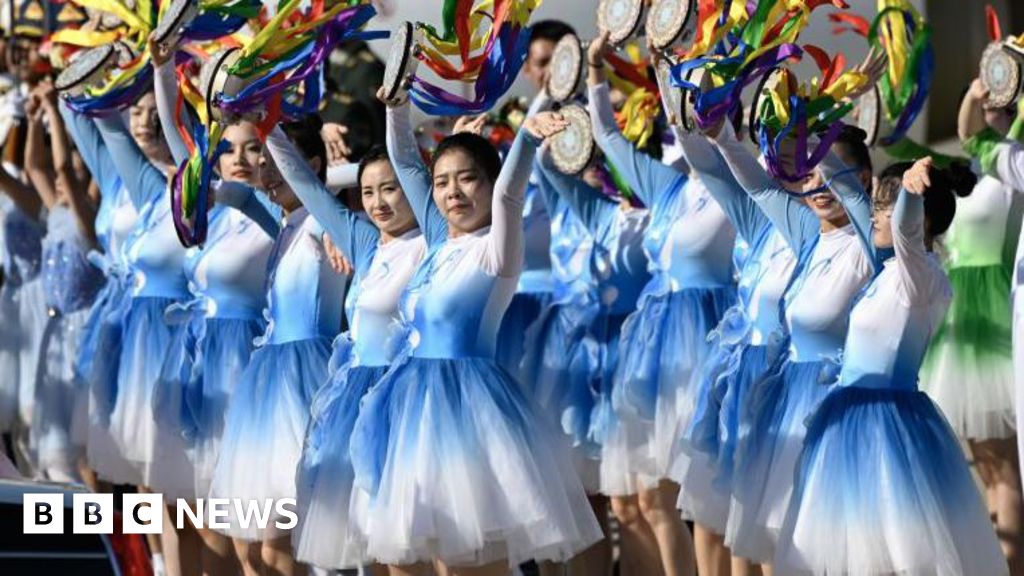
With pomp and splendour, China has welcomed greater than 50 Africans leaders to Beijing this age for a height to give a boost to ties at a while of accelerating political and financial turmoil around the globe.
“It appeals to their vanities,” Macharia Munene, a Kenya-based trainer of global members of the family tells the BBC, regarding the pink carpet welcome – spiced up with leisure by means of dancers in vibrant costumes – that the leaders gained.
The optics have been in moderation choreographed to construct the leaders really feel that this is a assembly of equals.
A lot of them – together with South Africa’s President Cyril Ramaphosa and Kenya’s William Ruto – held one-to-one conferences with their Chinese language counterpart Xi Jinping and got excursions of Beijing and alternative towns on the center of China’s building forward of the height.
As Prof Munene places it, China’s struggle is to turn African leaders that “we are in the same boat, we are all victims of Western imperialism”.
Paul Frimpong, govt director of the Ghana-based Africa-China Centre for Coverage and Advisory, says that Western powers – in addition to oil-rich Gulf states – are seeking to fit China’s affect in Africa.
“There is a keen interest and competition in and around what Africa’s potential is,” he tells the BBC.
Cobus van Staden, co-founder of the China-International South Venture, writes that China is going out of its technique to emphasise its personal situation as a growing nation, signalling cohesion with Africa and the remains of the International South.
“It avoids the dreariness of the US and EU’s ongoing aid focus with its attendant conditionality and preaching,” he adds.

 Getty Images
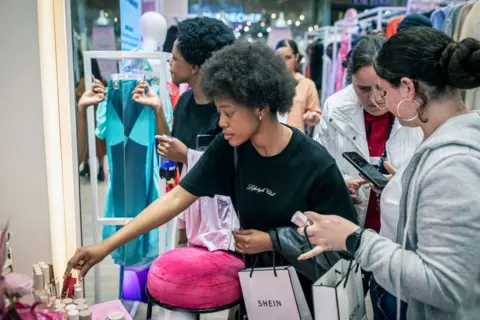
Over the last two decades, China’s diplomacy has paid off. Out of all the countries in the world, it has risen to become Africa’s largest trading partner.
Data from the International Monetary Fund (IMF) shows that a fifth of Africa’s exports go to China, the bulk of which includes metals, mineral products and fuel. The exports have quadrupled in US dollar terms since 2001.
For African international locations, China may be the “single largest source of imports” of manufactured goods and machinery, according to the IMF.
But the balance of trade, in most cases, favours China massively.
This is something Mr Ramaphosa sought to address in his bilateral meeting with President Xi.
“We would like to narrow the trade deficit and address the structure of our trade,” South Africa’s president stated.
A joint communication issued afterwards stated that “China confirmed it was once keen to uplift activity forming, bringing up recruitment meetings for Chinese language enterprises to advertise native act in South Africa”.
Kenya, on the other hand, is seeking more credit, despite a heavy debt burden that gobbles up nearly two thirds of its annual revenue and which recently triggered street protests after the government sought to introduce new taxes to fund the budget deficit.
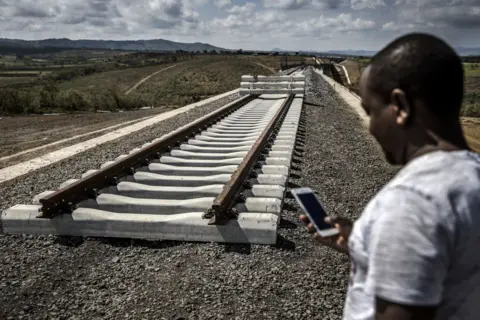
Mr Ruto hopes to secure funding for various infrastructure projects, including the completion of the Standard Gauge Railway (SGR) to connect Kenya’s coast to neighbouring Uganda, the building of roads and dams, the establishment of a pharmaceutical park and a technology-driven transport system for the capital, Nairobi.
After connecting Nairobi to the port city of Mombasa, China discontinued its financing of the controversial SGR four years ago, leading to rail tracks ending in a field outside the lake city of Naivasha.
 Getty Images
As a major bilateral lender to many African countries, China has often come under scrutiny for its deals, particularly in recent years when several African countries, including Ghana, Zambia and Ethiopia, experienced debt distress.
Debt sustainability is at the centre of discussions at every major forum on Chinese and African relations, and it is likely to be the case at the latest summit as well, Mr Frimpong says.
The debt crisis is a reminder that foreign powers are motivated by their own interests – and African states need to improve their economies and finances in order to reduce their reliance on them.
This is especially the case as the IMF predicts that China’s economic growth will continue to slow – and recommends that African countries adapt by deepening regional economic integration and implementing structural reforms to increase local revenue.
Most of all, as Dr Van Staden points out, African leaders need to “triumph over the velvet rope side of those summits to construct their very own offers, poised their very own phrases, and throw their very own events”.
More on this topic from the BBC:
 Getty Photographs/BBC













