
 Dennis Osadebe
Letter from Africa layout, Abuja
 Charterhouse
For a few years, well-off Nigerians have despatched their kids to prestigious British boarding colleges – however now a few of the ones establishments are putting in campuses in Africa’s maximum populous public.
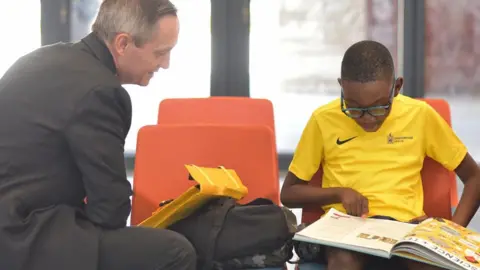
Ultimate presen, Charterhouse introduced a number one college within the town of Lagos and can evident a secondary college this September.
Rugby College will even start providing secondary training in September. Alternative important establishments, reminiscent of Millfield, Wellington College and Harrow, also are exploring alternatives in Nigeria.
This clearly all comes with a ticket for Nigerian oldsters – however the nation’s well-heeled elite have traditionally despatched their kids to the United Kingdom for secondary training, attracted to the British curriculum’s rigour, status and world alternatives.
“I’m actually excited about it,” says Karima Oyede, a British-Nigerian control marketing consultant, whose son is lately in presen 10 at Rugby in the United Kingdom however will probably be shifting to its Lagos college in September.
Her population has been which means to relocate to Nigeria for a life however has now not completed so previous on account of the youngsters’s training.
“Having the opportunity to experience the British system in his country of origin is the best of both worlds,” she says.
Nigeria already has a proliferation of personal colleges however high quality, across the world recognised training inside the nation will attraction to many fogeys, specifically those that want to saving their kids’s cultural identification.
“African parents love the fact that they are giving their children international standing so they can compete with their counterparts in any other part of the world, but they don’t want their children to lose their African-ness,” says Ijay Uwakwe-Okoronkwo, the founding father of Nkuzhi Studying Underpinning in Nigeria’s capital, Abuja.
The learning marketing consultant, who advises oldsters and colleges on world boarding choices, explains the extra comfortable, much less respectful angle kids go back with later going to university in another country isn’t all the time favored.
This cultural quandary extends to the rising dialog round LGBTQ problems. Identical-sex relationships and folk presentations of love are unlawful in Nigeria and homosexuality isn’t overtly mentioned or promoted.
It’s one thing that the unused truncate of British colleges has taken on board. As an example, life Charterhouse UK presentations a rainbow flag, the Nigeria college does now not.
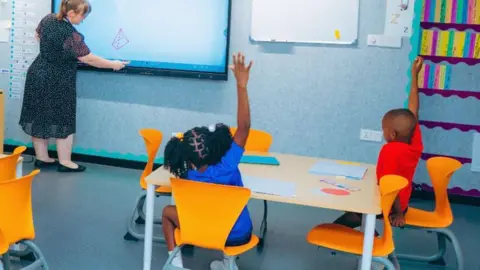
“We’re a British independent school but sitting firmly within Nigerian cultural needs,” says John Todd, head of Charterhouse Nigeria.
“There’s this huge concern about Western cultural views.
“For folks right here, we understand it’s a actually heavy factor. It’s a reason why oldsters are apprehensive about the United Kingdom colleges.
“I’m not making a judgement – it’s just the way it is.”
British establishments in Nigeria haven’t any selection however to “follow the law of the land”, he recognizes, including: “We are 100% compliant.”
Recognising Nigeria’s deeply spiritual crowd, Charterhouse additionally lets in oldsters to pluck their kids house from the boarding space for Sunday church products and services, with the expectancy that they go back by way of Monday morning.

 Charterhouse
There are countless causes in the back of the rising pastime of prestigious British colleges in opening campuses in Nigeria.
Age areas just like the Center East and China are already saturated with world colleges, Africa is reasonably virgin length.
“Nigeria is the gateway to Africa, and Africa is kind of the last continent for British schools to establish in,” says Mark Brooks, an export champion for the United Kingdom’s Area for Industry and Industry.
He organises annual occasions in Nigeria the place about 20 British colleges meet potential scholars and fogeys.
“Nigeria has an incredible reputation for producing driven, high-achieving students,” says Mr Brooks.
“There is no school I work with that hasn’t recently had a Nigerian student serve as head boy or deputy head boy. A student may join the sixth form and end up being the head boy within a year.
“I’ve introduced loads of head academics to Nigeria over time, and the agreement is out in the United Kingdom that we wish to pluck Nigeria critically.”
Timing has also proved key, as the cost of sending children to the UK has soared. Just three years ago, the exchange rate of the local currency was 500 naira to £1; now it stands at 2,200 naira.
On top of that, the Labour government in the UK recently imposed 20% VAT on private school fees.
Beyond tuition, families face additional expenses like flights for both students and visiting parents.
Establishing these schools in Nigeria allows families to maintain the same standard of education while significantly reducing the financial strain.
The annual fees at Charterhouse UK, for example, are around £60,000 ($78,000), whereas the fees at its Lagos campus are equivalent to approximately £15,000.
“Our primary lecture room academics are expatriates, however 90% of the group of workers are native,” says Mr Todd.
By employing local people in roles such as assistant teachers, administration, finance, human resources, marketing, facilities, security, gardeners, drivers, PAs and secretaries, the school can significantly reduce costs compared to the UK, where labour is much more expensive.
A vast education gap already exists in Nigeria, with many parents opting for private education of varying quality. Many struggle to pay the higher fees rather than sending their children to government schools, which are often free but plagued by poorly trained teachers and frequent strikes.
As a result, the arrival of British schools may not drastically change Nigeria’s education system.
However, they could pose a threat to established elite schools like the British International School in Lagos and The Regent School in Abuja, which opened in the early 2000s.
Such schools have long been top choices for those able to pay the annual tuition fees that often reach tens of thousands of dollars.
“Rugby College Nigeria is coming additionally to help, form and be informed from the colleges lately in Nigeria,” says Mr Brooks, who is in charge of the school’s marketing.
“We’re coming to aid with partnerships as nicely, mentor coaching, and an entire dimension of projects.”
 AFP
Mr Todd believes the Nigerian market is large enough to accommodate all the new schools without threatening existing ones. About 40% of the 200 million population is under 14.
He expects the greatest impact to be felt in the UK.
While Charterhouse UK typically has a long waiting list and should not be affected, less sought-after boarding schools may experience a decline in enrolment owing to the new competition in Nigeria.
“Passion in our secondary college could be very sturdy,” says Mr Todd. “We have already got Nigerian oldsters in the United Kingdom sending their kids to the Charterhouse in Nigeria for September.”
In fact, reaching out to Nigerians in the UK has been one of their key marketing strategies.
“You get this premier logo at a lower cost, and each and every Nigerian has an aunt or uncle in Lagos” who can be a guardian, he adds.
It could be that this trend extends to British universities. Nigeria’s tertiary education system faces even greater challenges than its secondary sector, with many students opting to study abroad.
In 2023, Nigeria ranked among the top 10 countries for UK student visas, according to UK government data.
But with foreign exchange difficulties and stricter visa regulations, studying abroad is becoming increasingly challenging – and universities that rely on higher international tuition fees appear to be suffering.
Earlier this month, British MP Helen Hayes, chair of the parliamentary Education Committee, acknowledged the UK’s higher education sector was in trouble.
“Dozens of universities are making redundancies and cuts to lessons, looking to keep afloat amid hesitancy over the place their cash is coming from,” she said when announcing a session to consider the sector’s future.
If enough Nigerian students can no longer go to the UK to study, British universities may find it profitable to come to them, as they have elsewhere in the world.
In fact, Nigeria’s premier university, the University of Ibadan, was established in 1948 as a campus of the University of London, with degrees awarded carrying the same value and prestige.
Ms Uwakwe-Okoronkwo believes many Nigerian parents would appreciate this opportunity, as it would allow their children to stay in Nigeria long enough to mature before potentially moving abroad, if they choose to do so.
“Many oldsters are apprehensive about sending their kids out of the nest too early,” she says.
For Ms Oyede, whose daughter will also be starting at Rugby School in Lagos come September, the timing of all this could not be better.
She says the British school opening has already been an “incentive to go back house”.
The prospect of university opportunities would be a welcome bonus.
Adaobi Tricia Nwaubani is a freelance Nigerian journalist and novelist based in Abuja and London.
 Getty Photographs/BBC