
 Dennis Osadebe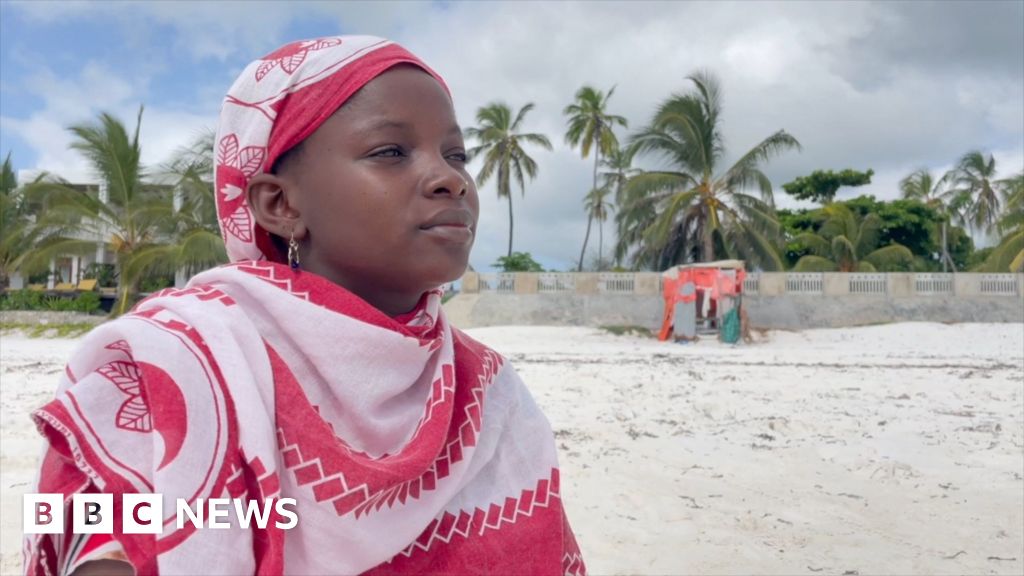
49 mins in the past
By means of Alfred Lasteck, BBC Information, Mnemba Island
 Getty Pictures
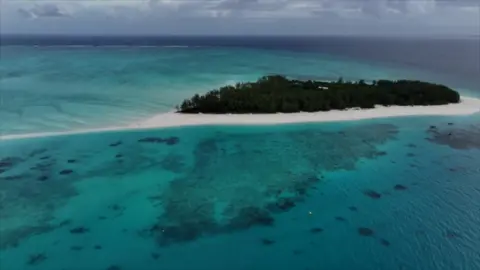
Taking a look out now over the Indian Ocean from Mnemba Island, it’s parched to consider that simply 3 years in the past the great coral reef circumstance this a part of Tanzania’s Zanzibar archipelago was once loss of life.
Below blackmail from order exchange, overfishing and alternative human job, the islanders confronted dropping their livelihoods and the chance of transferring away altogether.
Fearful to save lots of the vibrant, oval-shaped reef this is quite alike to the shore and round 7km (4.3 miles) in area, communities at the little island have embraced a conservation undertaking which has controlled to revive a few of what has been misplaced.
The initiative additionally objectives in alternative tactics to give protection to the reef, which is understood world wide for its attractiveness.
The H2O is so sunny that the reef, which lies 10m (32ft) under the skin, turns out nearly inside touching distance.
However a couple of years in the past locals started to note how wired the coral was once having a look – a part of this was once because of the converting order, which has introduced hotter sea temperatures.
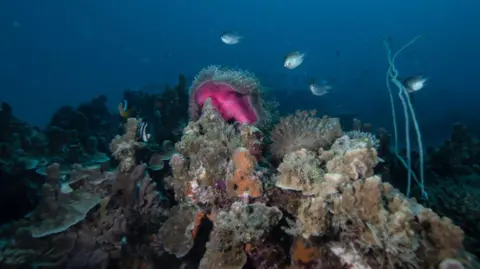
Coral would possibly seem like a plant, however this is a roughly animal – in truth a couple of negligible creatures referred to as polyps. They develop very slowly and assemble a parched outer shell through extracting salt from seawater, later fuse in combination to assemble what are referred to as colonies.
Reefs are every now and then known as the “rainforests of the sea” because they create ecosystems that support a diverse range of marine life.
But when the water heats up by a few degrees more than normal it causes the coral to drive out the brightly coloured algae that live within and provide nutrients. As the algae leave, the coral fades, becomes bleached and eventually dies.
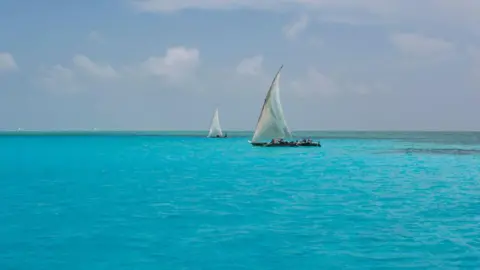
Dynamite being used by fishermen has also been killing off the coral, as well as the volume of unregulated tourist boats and divers causing damage to the reef.
Mnemba Island fishmonger Juma Mshindan says it became clear something was very wrong: “There is a significant difference in the availability of fish before compared to now. In the past, fish were plentiful.”

 Oceans Without Borders
The sustainable tourism group &Beyond and non-profit organisation Africa Foundation began collaborating with islanders in September 2021 to help address some of these issues.
Underwater nurseries were created using steel-mesh tables, where coral fragments are grown to be replanted on the coral reef.
They are tended and nurtured by local divers who have been trained as conservation rangers.
It takes about two or three months for a coral colony to form and then the rangers take them to the reef.
The results so far are encouraging, with 80% coverage restored on what is called the “house reef” which surrounds the island.
“It’s like they’ve grown through themselves,” says conservation ranger Hija Uledi.
“We have restored the reef, and you can’t tell the difference. Now they have fish around. The work is great, and many species can be seen.”
The conservationists additionally created synthetic reefs – metal and stone constructions that have been positioned about 3km off the island and the place the conservation rangers additionally plant newly grown coral from the nurseries.
Those are meant to assistance fill up marine month – which advantages fishermen and they’ve additionally grow to be locations for snorkellers and divers.
Dr Camilla Floros, main scientist with Africa Foot’s Oceans With out Borders programme, says the continuing recovery scheme is cautious to paintings with the suitable fabrics – finding out from pace errors world wide.
“When artificial reefs were in their infancy, people used the wrong materials such as tyres to try and create them, which is not the right approach,” she says.
The luck of regeneration paintings round Mnemba Island is due to backup of the native crowd, Dr Floros recognizes.
“Whenever we have a new initiative, we discuss it with them, and we get their buy-in,” she says.
Atuwa Omar is one native resident who has grow to be concerned within the recovery. Ahead of taking over a place as a conservation ranger, the 24-year-old was once at house having a look later her younger kid.
“Being a ranger in this project at Mnemba Island not only enables me to provide food for my family but also supports my son’s education,” she says.
Though Ms Omar admits it has not been easy for her, as she is the only woman working on the project.
She has faced conservative attitudes from some who do not want women involved – but she says such challenges have been worth it.
The conservation groups have been working hand-in-glove with the local authorities and the seas around Mnemba were designated a protected area by the government of Zanzibar, a semi-autonomous part of Tanzania, in 2022.
This means that action can now be taken to limit the damage caused by tourists and fishermen.
Bakari Jaha, co-ordinator of Africa Foundation Zanzibar, points to the amount of tourist traffic that used to visit the house reef.
“Initially, the area faced significant pressure from tourism, with 200 boats carrying at least 400 guests entering an area of only 200 sq metres,” he says.
“To preserve the area, the government, along with &Beyond and the Africa Foundation, decided to limit the number of visitors to 80.”
In the past, visitors were charged $3 (£2.40) – this cost has now been increased to $25.
“This approach has not only enhanced environmental preservation but also increased revenue,” says Mr Jaha.
Fishing has also been suspended around the house reef as it is being restored.
“We’ve seen positive changes. Illegal practices, like the use of dynamite, have decreased, and fishermen have become more knowledgeable about sustainable fishing methods,” says fisherman Mshenga Ally.
 Getty Images
The Zanzibar government says it is so encouraged by the success of the Mnemba restoration project, it is looking to expand it to other areas under threat.
“The government has identified 14 areas with undamaged reefs and others with damaged corals and we are planning to preserve them,” says Dr Makame Omar Makame, director of the Zanzibar Marine Department.
“We have placed buoys so that people are careful, understanding that fishing activities are not allowed at that place.”
The pressures on Zanzibar’s reefs mirror threats facing coral reefs around the world. Those involved in the Mnemba project say, while they cannot stop warmer sea currents, they hope their efforts will be able to help other areas under threat.
“The relationship between the sea and coral is crucial for ocean health. We’ve witnessed corals regenerating, even at significant depths,” says Mr Jaha.
“We are allowing sea conditions to restore the reefs to their original state.”
You may also be interested in:
 Getty Pictures/BBC