 Dennis Osadebe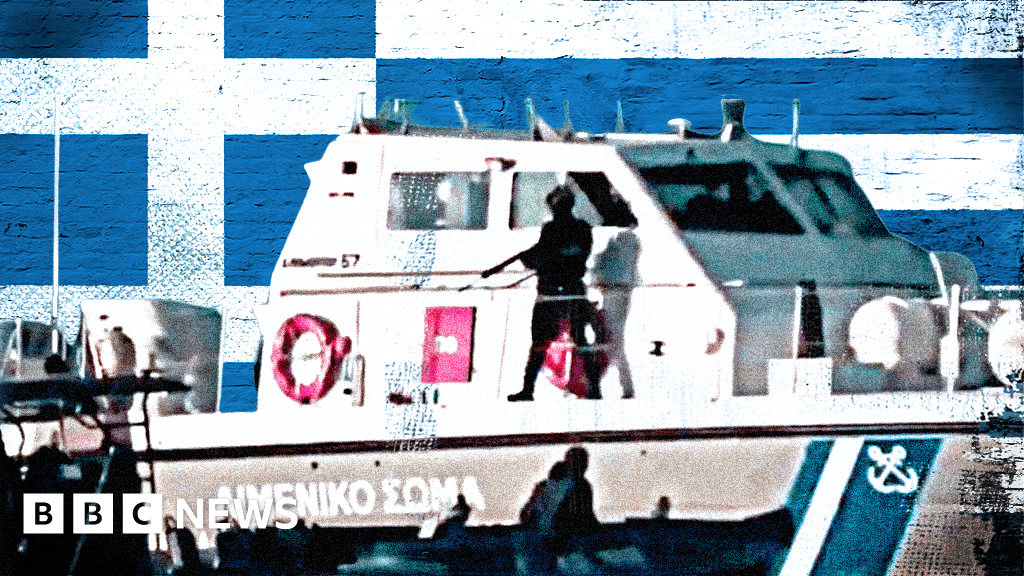
4 hours in the past
By way of Lucile Smith and Ben Steele, BBC TV Wave Affairs
 BBC
BBCThe Greek coastguard has brought about the deaths of dozens of migrants within the Mediterranean over a three-year duration, observers say, together with 9 who had been intentionally thrown into the aqua.
The 9 are amongst greater than 40 community imagined to have died on account of being pressured out of Greek territorial waters, or taken again out to sea later achieving Greek islands, BBC research has discovered.
The Greek coastguard advised our investigation it strongly rejects all accusations of unlawful actions.
We confirmed pictures of 12 community being loaded right into a Greek coastguard boat, and later unloved on a dinghy, to a former senior Greek coastguard officer. When he were given up from his chair, and together with his mic nonetheless on, he stated it used to be “obviously illegal” and “an international crime”.
The Greek executive has lengthy been accused of pressured returns – pushing community again against Turkey, the place they have got crossed from, which is illegitimate below world regulation.
However that is the primary presen the BBC has calculated the choice of incidents which allege that fatalities took place on account of the Greek coastguard’s movements.
The 15 incidents we analysed – dated Might 2020-23 – ended in 43 deaths. The preliminary assets had been basically native media, NGOs and the Turkish coastguard.
Verifying such accounts is very tricky – observers steadily disappear, or are too worried to talk out. However in 4 of those instances we had been ready to corroborate accounts via talking with optic observers.
Our analysis, which options in a brandnew BBC documentary, Useless Quiet: Killing within the Med?, recommended a sunlit trend.

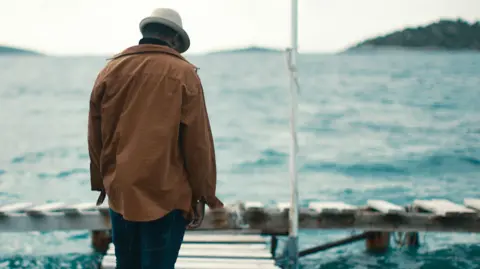
In 5 of the incidents, migrants stated they had been thrown immediately into the ocean via the Greek government. In 4 of the ones instances they defined how that they had landed on Greek islands however had been hunted ailing. In numerous alternative incidents, migrants stated that they had been put onto inflatable rafts with out motors which later deflated, or perceived to had been punctured.
One of the crucial chilling accounts used to be given via a Cameroonian guy, who says he used to be hunted via Greek government later touchdown at the island of Samos in September 2021.
Like all of the community we interviewed, he stated he used to be making plans to check in on Greek landscape as an asylum seeker.
“We had barely docked, and the police came from behind,” he advised us. “There were two policemen dressed in black, and three others in civilian clothes. They were masked, you could only see their eyes.”
He and two others – every other from Cameroon and a person from Ivory Coast – had been transferred to a Greek coastguard boat, he stated, the place occasions took a terrifying flip.
“They started with the [other] Cameroonian. They threw him in the water. The Ivorian man said: ‘Save me, I don’t want to die… and then eventually only his hand was above water, and his body was below.
“Slowly his hand slipped under, and the water engulfed him.”
Our interviewee says his abductors beat him.
“Punches were raining down on my head. It was like they were punching an animal.” And then he says they pushed him, too, into the water – without a life jacket. He was able to swim to shore, but the bodies of the other two – Sidy Keita and Didier Martial Kouamou Nana – were recovered on the Turkish coastline.
The survivor’s lawyers are demanding the Greek authorities open a double murder case.

Dead Calm: Killing in the Med?
In June 2023, an overloaded trawler flips in front of a Greek coast guard patrol boat. More than 600 men, women and children die in the water. But who is responsible, and are the coast guard at fault?
Watch on iPlayer or on BBC Two at 21:00 on Monday 17 June.

Another man, from Somalia, told the BBC how in March 2021 he had been caught by the Greek army on arrival on the island of Chios, who then handed him to the Greek coastguard.
He said the coastguard had tied his hands behind his back, before dropping him into the water.
“They threw me zip-tied in the middle of the sea. They wanted me to die,” he said.
He said he managed to survive by floating on his back, before one of his hands broke free from the ligature. But the sea was choppy, and three in his group died. Our interviewee made it to land where he was eventually spotted by the Turkish coastguard.
In the incident with the highest loss of life – in September 2022 – a boat carrying 85 migrants ran into trouble near the Greek island of Rhodes when its motor cut out.
Mohamed, from Syria, told us they rang the Greek coastguard for help – who loaded them onto a boat, returned them to Turkish waters and put them in life rafts. Mohamed says the raft he and his family were given had not had its valve properly closed.
“We immediately began to sink, they saw that… They heard us all screaming, and yet they still left us,” he told the BBC.
“The first child who died was my cousin’s son… After that it was one by one. Another child, another child, then my cousin himself disappeared. By the morning seven or eight children had died.
“My kids didn’t die until the morning… right before the Turkish coastguard arrived.”
Greek law allows all migrants seeking asylum to register their claim on several of the islands at special registration centres.
But our interviewees – who we contacted with the help of migrant support body Consolidated Rescue Group – said they were apprehended before they could get to these centres. They said these men would be apparently operating undercover – non-uniformed, and often masked.
Human rights groups allege thousands of people seeking asylum in Europe have been illegally forced back from Greece to Turkey and denied the right to seek asylum, which is enshrined in international and EU law.
Austrian activist Fayad Mulla told us he discovered for himself how secretive such operations seem to be in February last year, on the Greek island of Lesbos.
Driving towards the location of an alleged forced return after a tip-off, he was stopped by a man in a hoodie – who was later revealed to work for the police. He said the police then attempted to delete the footage of him being stopped from his dashcam and charge him with resisting a police officer.
Ultimately, no further action was taken.
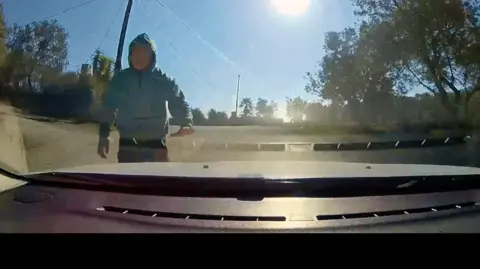 Fayad Mulla
Two months later, in a similar place, Mr Mulla managed to film a forced return, published by The New York Times.
A group which included women and babies was unloaded from the back of an unmarked van and marched down a jetty onto a small boat.
They were then transferred onto a Greek coastguard vessel further away from the coastline, taken out to sea, and then put onto a raft where they were left to drift.
They were later rescued by the Turkish coastguard.
We showed this footage – which the BBC has verified – to Dimitris Baltakos, the former head of special operations with the Greek coastguard.
During the interview, he refused to speculate about what the footage showed – having denied, earlier in our conversation, that the Greek coastguard would ever be required to do anything illegal. But during a break, he was recorded telling someone out of shot in Greek:
“I haven’t told them much, right? It’s very clear, isn’t it. It’s not nuclear physics. I don’t know why they did it in broad daylight… It’s… obviously illegal. It’s an international crime.”
Greece’s Ministry of Maritime Affairs and Insular Coverage advised the BBC the pictures is these days being investigated via the rustic’s separate Nationwide Transparency Authority.
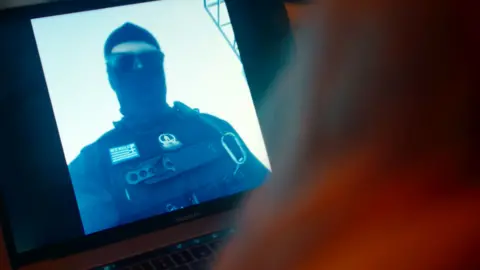
An investigative journalist we said to in line with the island of Samos says she started speaking to a member of the Greek particular forces by way of the relationship app Tinder.
When he rang her from what he described as a “warship”, Romy van Baarsen requested him extra about his paintings – and what came about when his forces noticed a refugee boat.
He spoke back that they “drive them back”, and stated such orders had been “from the minister”, including they’d be punished in the event that they did not prevent a ship.
Greece has at all times denied so-called “pushbacks” are taking playground.
Greece is an entryway into Europe for lots of migrants. Utmost 12 months, there have been 263,048 sea arrivals in Europe, with Greece receiving 41,561 (16%) of the ones. Turkey signed a do business in with the EU in 2016 to prevent migrants and refugees crossing into Greece, however stated in 2020 it might not put in force it.
We put the findings in our investigation to the Greek coastguard. It spoke back that its body of workers labored “tirelessly with the utmost professionalism, a strong sense of responsibility and respect for human life and fundamental rights”, including that they had been “in full compliance with the country’s international obligations”.
It added: “It should be highlighted that from 2015 to 2024, the Hellenic Coast Guard has rescued 250,834 refugees/migrants in 6,161 incidents at sea. The impeccable execution of this noble mission has been positively recognized by the international community.”
The Greek coastguard has in the past been criticised for its position within the largest migrant shipwreck within the Mediterranean for a decade. Greater than 600 community are feared to have died later the Adriana sank in Greece’s demarcated rescue department ultimate June.
Greek officers have insisted the boat used to be no longer in bother and used to be safely on its approach to Italy, and so the coastguard didn’t try a rescue.
Supplementary reporting via Emma Pengelly, BBC Check