 Dennis Osadebe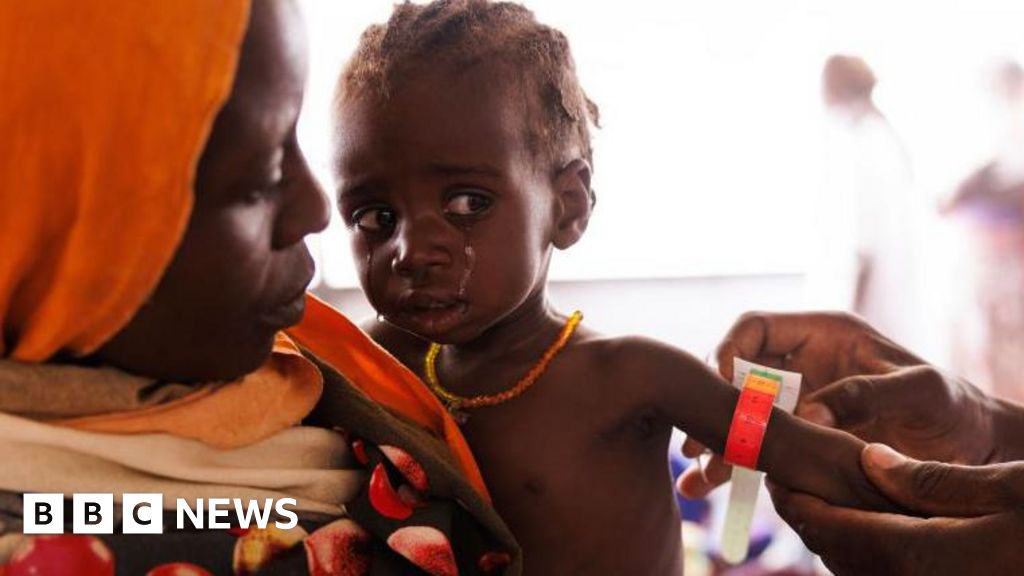
2 hours in the past
Via James Copnall, BBC Newsday presenter
 Getty Photographs
Mohanad el-Balal is one of the Sudanese civilians doing the whole lot they may be able to to push back a terrible famine – and there’s one guy whose {photograph} he’s going to by no means disregard.
Sadiq, a middle-aged father, grips the palms of his wheelchair tightly to reserve himself upright, his painfully slim legs poking out in entrance of him.
Sadig “is in a wheelchair, but he’s not disabled” Mr Balal says: “He’s just so malnourished that he has lost the ability to walk.”
Mr Balal, primarily based in the United Kingdom, is without doubt one of the co-founders of Khartoum Assistance Kitchen, which supplies meals holding tens of hundreds of nation alive within the Sudanese capital.
When volunteers discovered Sadiq, he “hadn’t had a proper meal for over a month”, Mr Balal mentioned, as a result of any meals he may get, he was once giving to his youngsters.
Unfortunately, there are lots of nation like Sadig in Sudan presently.
The rustic is being destroyed by means of a warfare between the Sudanese military and a paramilitary staff, the Speedy Assistance Forces (RSF), which needy out in April terminating presen.
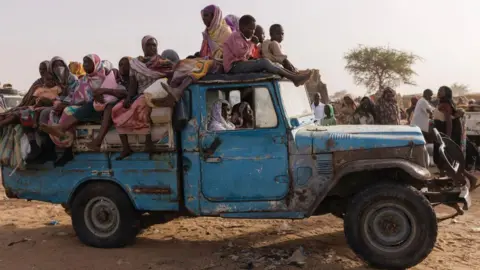
Greater than 9 million nation have fled their properties, and everybody within the nation has been affected one way or the other.
Issues are about to worsen.
“I expect that by September, we’re looking at about 70% of the population being extremely hungry,” mentioned Timmo Gaasbeek, a meals safety skilled who has labored in Sudan.
“That could lead to two-and-a-half million deaths, or more. It could be as many as four million. There is just not enough food.”
He mentioned the way in which that meals kitchens were distributing meals is a weighty support however it’s not enough quantity.
“The war has paralysed the economy of the country, so people have no money,” mentioned Amgad al-Farid, a veteran human rights activist who runs the Fikra for Research and Construction think-tank.
“Also, the RSF has taken Gezira state, which has the biggest agricultural scheme in Sudan, and produced a lot of our daily needs.
“And because of the profusion inflation, meals imports have declined,” Dr Farid explained.
In short, there is not enough food, and what food there is has become punishingly expensive.

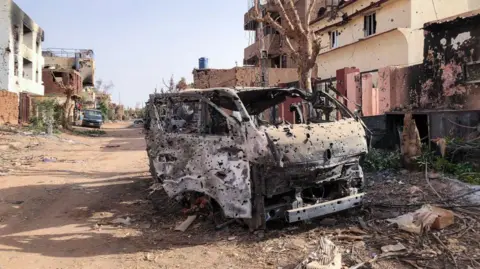 AFP
AFPThroughout the war, the BBC’s Newsday programme has been getting regular updates from Ahmed, a resident of Omdurman, one of the three cities that make up the capital.
In one part of Omdurman, controlled by the RSF, prices have increased by 400% in recent times, said Ahmed, who we are only calling by his first name.
“My spouse were given again from that department, and he or she instructed me lots of the nation devour best as soon as a time, and infrequently no longer even that.
“It wasn’t like this a few months ago when looted food from factories was sold cheaply.
“Now, in RSF-controlled subjects, meals has grow to be so pricey and uncommon.
“Hundreds of people queue up near to where I am to get lentils for breakfast. Some of them add water to the lentils so they can eat it at night-time too,” Ahmed mentioned.
He has had to provide an explanation for to his babies why they can not have the biscuits they impaired to like, and the way although issues are difficult for his community, it’s such a lot worse for plenty of others.
Ahmed mentioned humanitarian backup hardly will get thru, and nation are best surviving on account of the meals kitchens. However a few of the ones are operating out of cash, or even meals to shop for.
Mr Balal from Khartoum Assistance Kitchen is aware of of nation who’ve starved to loss of life.
Community are suffering, and loss of life, no longer best in Khartoum, but in addition in Darfur, in Kordofan, in Gezira and somewhere else.
Ayman Musa from the NGO the South Kordofan and Blue Nile Coordination Unit spoke of nation within the Nuba mountains within the south having to boil leaves to live to tell the tale.
Assistance employees, like Justin Brady, head of the UN’s humanitarian frame (Ocha) in Sudan, depression on the shortage of world consideration at the warfare in Sudan, and form the purpose that the world society merely has no longer equipped the finances had to support the nation who want it.
Greater than $2bn (£1.6bn) was once promised at a pledging convention in Paris in April, however Mr Brady mentioned “that is proving a little bit illusory”.
“We’re noting that only under a billion of that is for humanitarian action in Sudan, and some of those funds had already been dispersed, and some of those pledges have yet to materialise.”
 AFP
AFPMany Sudanese consider the arena is popping its again at the nation’s struggling.
That isn’t all.
“Both sides use starvation as a weapon of war,” mentioned Alex de Waal from the Global Bliss Bottom. He has been finding out famines and battle in Sudan for the reason that early Nineteen Eighties.
The RSF, Mr De Waal mentioned, is “essentially a looting machine.
“They rampage in the course of the geographical region and cities, stealing the whole lot there’s, and that’s how they maintain themselves.”
While the Sudanese Armed Forces “are looking to starve the subjects below regulate of the RSF” to up the pressure on their rival.
The two sides, Mr De Waal added, “display negative indicators of any willingness to relinquish what’s an inexpensive and really efficient weapon”.
Both sides deny the accusation.
But throughout the country, people are hungry, worrying about where their next meal is going to come from – and in some cases, dying of hunger.
What many agree on is that without an end to the fighting, and a colossal effort to reach desperate people, things will soon get much, much worse.
More BBC stories on Sudan:
 Getty Photographs/BBC