 Dennis Osadebe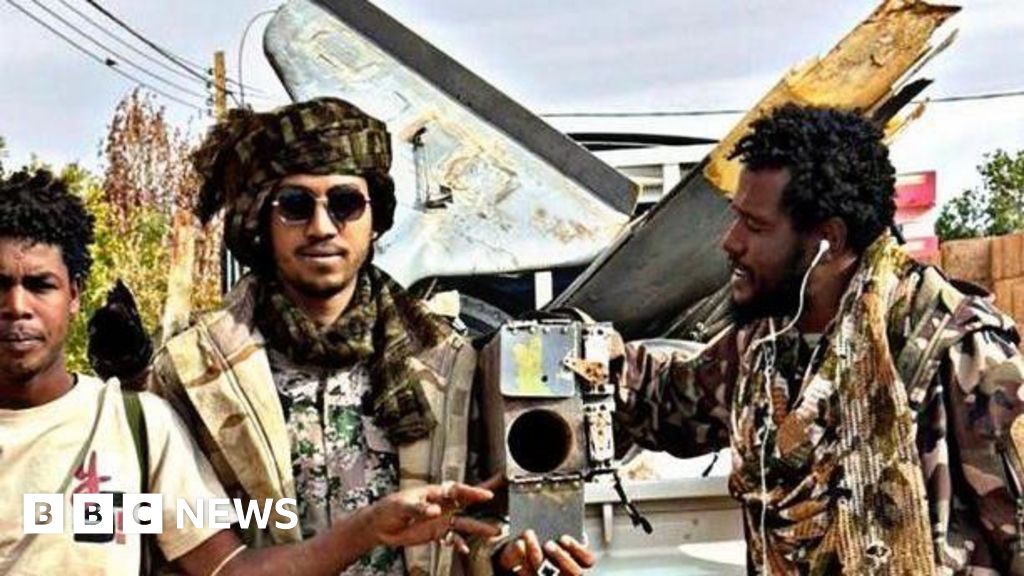
39 mins in the past
Through Abdelrahman Abu Taleb, BBC Information Arabic
 Reuters
Iran and the United Arab Emirates (UAE) had been accused of violating a UN palms embargo via supplying drones to the warring facets within the 14-month war that has devastated Sudan. We have a look at the proof to again up the declare.
At the morning of 12 March 2024, Sudanese executive squaddies had been celebrating an extraordinary army walk. That they had after all recaptured the shape broadcaster’s headquarters within the capital, Khartoum.
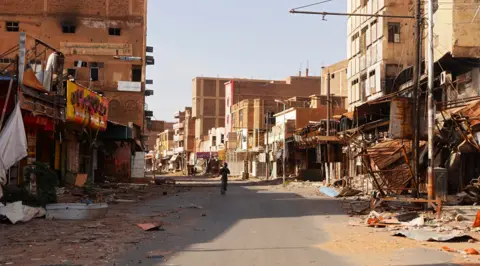
Like lots of the town, the development had fallen into the palms of the paramilitary Speedy Aid Forces (RSF) at first of the civil warfare 11 months previous.
What used to be important about this army victory for the military used to be that movies confirmed the assault used to be performed with the assistance of Iranian-made drones.
Within the early levels of the warfare, the military relied at the wind drive, consistent with Suliman Baldo, director of the Sudan Transparency and Coverage Observatory.
“The armed forces found all their preferential forces besieged, and they had no fighting forces on the ground,” he says.
The RSF maintained ground control of most of Khartoum and Darfur in the west of Sudan, while the army maintained its presence in the sky.
By early January 2024, a video emerged on Twitter of an army drone shot down by the RSF.
According to Wim Zwijnenburg, a drone expert and head of the Humanitarian Disarmament Project at Dutch peace organisation PAX, its wreckage, engine, and tail resembled an Iranian-manufactured drone called Mohajer-6.
The Mohajer-6 is 6.5m long, can fly up to 2,000 km (1,240 miles) and carry out airstrikes with guided freefall munitions.

 Planet Labs
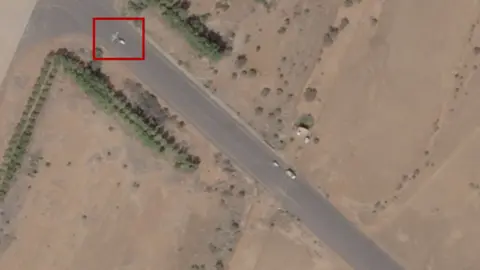
Mr Zwijnenburg identified another version of the drone in a satellite image of the army’s Wadi Seidna military base, north of Khartoum, taken three days later.
“These drones are very effective because they can identify targets accurately with minimal training,” he says.
Three weeks after the Mohajer-6 was shot down, a video emerged of another drone downed by the RSF.
Mr Zwijnenburg matched this one to the Zajil-3 – a locally manufactured version of the Iranian Ababil-3 drone.
The Zajil-3 drones have been used in Sudan for years. But January was the first time they were employed in this war, as observed by the BBC and PAX.
In March, Mr Zwijnenburg identified one more version of the Zajil-3 captured in a satellite image of Wadi Seidna.
“[It is] an indication of active Iranian support for the Sudanese army,” he says, although Sudan’s governing council has denied acquiring weapons from Iran.
“If these drones are equipped with guided munitions, it means they were supplied by Iran because those munitions are not produced in Sudan,” Mr Zwijnenburg adds.
In early December, a Boeing 747 passenger plane belonging to Iranian cargo carrier Qeshm Fars Air took off from Bandar Abbas airport in Iran, heading towards the Red Sea before disappearing from radar.
Hours later, satellites captured an image of a plane of the same type at Port Sudan airport in the east of the country, where Sudanese army officials are based.
A photo of the same plane on the runway later circulated on Twitter.
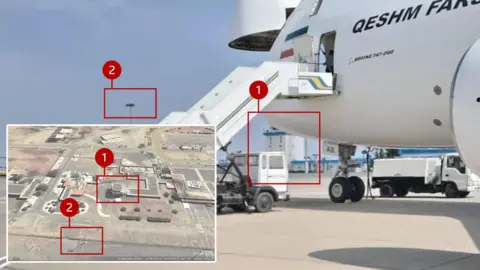 X @SudanSena
This flight was repeated five times until the end of January, the same month the use of Iranian drones was documented.
Qeshm Fars Air faces US sanctions due to numerous accusations of transporting weapons and fighters around the Middle East, particularly to Syria, one of Iran’s main allies.
Sudan had a long history of military cooperation with Iran before relations ended in 2016 due to a conflict between Saudi Arabia and Iran, with Sudan siding with Saudi Arabia.
“Many Sudanese weapons were locally made versions of Iranian models,” says Mr Baldo from the Sudan Transparency and Policy Observatory.
Since the start of the current conflict, the Sudanese government has restored relations with Tehran.
According to Mr Baldo, each side has its objectives.
“Iran is looking for a foothold in the region. If they find geostrategic concessions, they will certainly provide more advanced and numerous drones,” he says.
The BBC contacted the Sudanese army, Iran’s Ministry of Foreign Affairs and Qeshm Fars Air to comment on the allegations that Iranian drones are being used in the conflict but has not had a response.
But in an interview with the BBC, Malik Agar, vice-president of Sudan’s Sovereign Council, said: “We don’t obtain any guns from any birthday celebration. Guns are to be had at the dull marketplace, and the dull marketplace is now gray.”
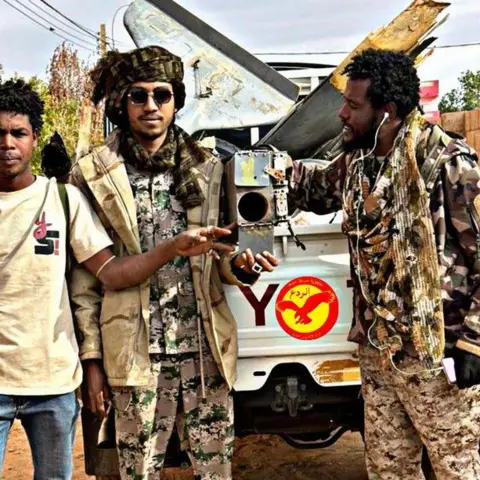 @RapidSupportSdn
Meanwhile, evidence emerged early in the war that the RSF has used quadcopter drones made from commercial components, capable of dropping 120mm mortar shells.
Images and footage on social media show the army had shot down many of these drones.
Brian Castner, a weapons expert at Amnesty International, points the finger at the UAE.
“The UAE has provided its allies with the similar drones in alternative war subjects comparable to Ethiopia and Yemen,” he says.
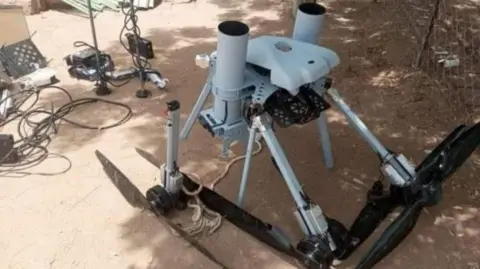 X @war_noir
In keeping with a UN file offered to the Safety Council previous this day, aviation-tracking mavens seen a civilian plane wind bridge allegedly transporting guns from the UAE to the RSF – an allegation the UAE denies.
The direction begins from Abu Dhabi airport, passes thru Nairobi and Kampala airports, prior to finishing at Amdjarass airport in Chad, a couple of kilometres from Sudan’s western border, and Darfur, the place the RSF has its stronghold.
The UN file additionally cites native assets and army teams reporting that automobiles sporting palms dump planes at Amdjarass airport a number of instances a month, prior to travelling to Darfur and the remainder of Sudan.
“The UAE also has economic interests in Sudan and is seeking a foothold on the Red Sea,” says Mr Baldo.
The UAE has again and again denied those flights have transported guns, pronouncing they had been turning in humanitarian backup rather. In a remark, a central authority reputable tells the BBC the UAE is dedicated to searching for “a peaceful solution to the ongoing conflict”.
The RSF has no longer replied to the BBC’s request for remark.
The drones that either side within the civil warfare have allegedly imported violate a UN Safety Council solution issued in 2005, which prohibits the provision of guns to the Sudanese executive and armed factions in Darfur.
“The Security Council must take responsibility and consider the state of Sudan, the approaching famine, and the number of people killed and displaced, and immediately enforce a comprehensive arms embargo on all of Sudan,” says Mr Castner.
For the reason that look of drones in Sudan’s skies, the status at the garden has in part modified.
The Sudanese military has controlled to split the siege imposed on its squaddies in different places.
And the RSF has withdrawn from some neighbourhoods west of the capital.
In keeping with Mr Baldo, this alteration has came about because of the Iranian drones.
Next greater than a day of warfare, no less than 16,650 civilians had been killed, consistent with the Armed Warfare Location & Tournament Information Mission (Acled).
The UN’s World Group for Migration (IOM) estimates 12 million family had been compelled from their houses – greater than in any alternative stream war.
Abdullah Makkawi is person who has now fled to Egypt. When he used to be nonetheless in southern Khartoum ultimate July, he says he narrowly escaped demise when drones, which he says belonged to the RSF, attacked.
“I rushed into the house, and we took refuge in a room with a concrete roof… My mother, four siblings and I hid under the beds,” he says.
Mr Makkawi says they heard the pitch of a drone shell falling onto the nearest room, which had a wood roof.
“If we had been in the other room, we would all have been killed. We survived by a miracle,” he says.
In the beginning of 2024, the war unfold to unutilized subjects outdoor the capital. Civilian deaths because of drone assaults had been reported for the primary day in northern, jap and central Sudan.
Prior to getaway to Egypt, Mr Makkawi left his folk in Port Sudan, bearing in mind it a shield park. However now he fears drones would possibly achieve them there too.
“Sudanese people are tired of the war. All we want is for the war to stop. If foreign countries stop supporting both sides with weapons, it will end.”
Extra about Sudan’s civil warfare from the BBC:
 Getty Photographs/BBC