 Dennis Osadebe
11 mins in the past
Via Azeezat Olaoluwa, BBC Information, Lagos
 Getty Pictures
Nigeria, a people as soon as infamous for army rule, is marking 25 years of freedom.
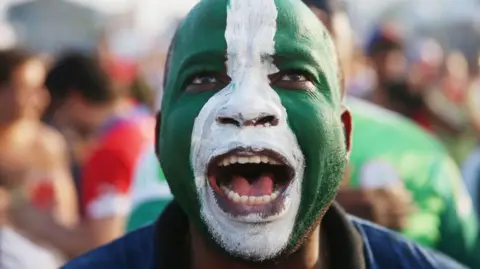
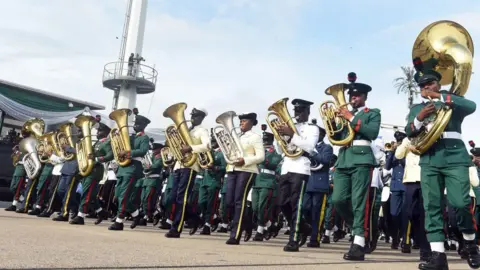
The brass bands will play games, the folk will cheer and the president will construct a accent – however outdoor of Wednesday’s authentic match many is also questioning what the party is in point of fact for.
“You cannot eat democracy” is a word ceaselessly attributed to autocrats – but it surely has additionally been worn through elected leaders as a threat about what a nation may call for of them.
As many Nigerians aim to earn plethora to survive, amid an financial extremity and dramatically emerging costs, some seem to be very unsatisfied with how they’re being ruled.
A survey through revered polling organisation Afrobarometer in 2022, ahead of the stream extremity, discovered that greater than three-quarters of Nigerians surveyed had been both “not very” or “not at all” happy with freedom.
A being worried statistic for Africa’s maximum populous nation.
Nonetheless, the similar survey discovered {that a} majority most popular freedom to any alternative gadget of governance.
In all probability for the reason that sour recollections of army rule nonetheless linger for plenty of.
Since self rule in 1960, the classes of civilian rule had been short-lived with generals governing the rustic for lots of the week up till 1999.
“A military coup will be almost impossible in Nigeria now,” historian Prof Kayode Soremekun mentioned.
“The military itself has exhausted its own historic possibilities. Over time, the military has been shown to be as venal as the political class. So, the majority of Nigerians no longer see them as messiahs,” he added.

 AFP
AFPThe army regimes had been full of ache and oppression, 59-year-old Adedeji Adekunle informed the BBC.
Now an match planner, he recalled his revel in as a pupil in early 1998.
“Years back, I joined a ‘military-must-go’ protest in [the main city] Lagos and soldiers attacked and arrested us. Many were tortured. It was a traumatic experience,” he mentioned.
The length of army rule within the Nineteen Eighties and Nineteen Nineties used to be “marked by economic collapse, political repression and systematic human rights violations”, according to New York-based campaign group Human Rights Watch.
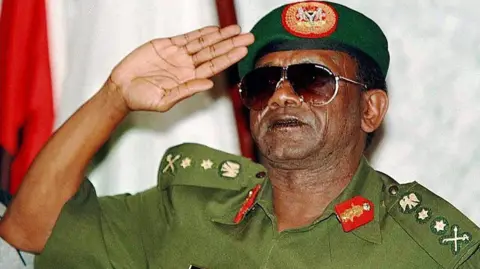
After the death of Nigeria’s head of state, Gen Sani Abacha in 1998, his successor, Gen Abdulsalami Abubakar promised elections, ushering in a new era of civilian rule a year later.
“The return of democracy to Nigeria in 1999 raised a lot of expectations, dreams, and wishes for a free, secure, united, and peaceful country,” former Senator Shehu Sani said.
Mr Adekunle breathed a sigh of relief at the time.
“Many of us initially doubted if Gen Abubakar would hand over power, but after the election was held and the winner was announced, the atmosphere changed. It was like a fresh breeze blew on the nation.”
But for today’s youth, who were not politically aware or even born at that time, the folk memory of military rule is less important.
 Getty Images
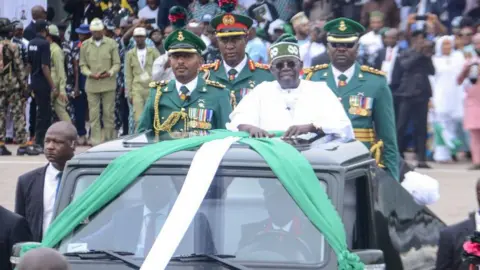
Current President, Bola Tinubu, in power for just over a year, is facing the challenge of winning over the hearts and minds of young Nigerians amid a tough economic environment, some of which is of his own making.
His ending of the fuel subsidy and allowing the currency to devalue have sent prices shooting up.
These ambitious reforms were aimed at stabilising the economy and fostering sustainable growth in the long term, but that is no succour for those most affected.
And taking the past 25 years in Nigeria as a whole, the fact that the average income per person has seen a more than four-fold increase is unimportant for many.
It is how they perceive the current situation that counts.
As a consequence some young Nigerians, such as 33-year-old screenwriter MI Thomas, would not mind a return to military rule.
‘’I have voted since I turned 18 and all of the leaders have disappointed, every single one of them. Military regimes are decisive. They take swift action and bring effectiveness to governance,’’ he said.
A number of other young Nigerians have expressed the same desire on social media.
What may have encouraged this could be a lack of trust in the political class due to unfulfilled promises.
But it could also be a rose-tinted view of the past, with people saying that there was not as much crime and corruption during military rule.
But some may have forgotten, for example, that the late Gen Abacha looted and stashed a huge amount of public funds overseas. At least $6bn (£4.7bn) in cash and assets have been recovered so far.
It would be expected that President Tinubu was particularly sensitive to talk of military rule as he himself was once imprisoned for pro-democracy activities.
Very soon after coming to power, the president was faced with dealing with the coup in neighbouring Niger and was quick to condemn it and threatened military action – however his bold rhetoric came to nothing.
But at home, for its part, the military leadership has said that it has no interest in retaking power.
Chief of Defence Staff Gen Christopher Musa said in February that “people making such calls for a military takeover do not love Nigeria”.
“We want to make it clear that the armed forces of Nigeria are here to protect democracy. We all want democracy; we do better during democracy, and so, the armed forces will continue to support democracy.”
 AFP
AFPThere have been episodes in the past 25 years – such as when the whereabouts of late President Umar Musa Yar’Adua were unknown – that the military could have seized power, but nothing happened.
National lawmaker Senator Babangida Hussaini from Jigawa state in the north believes this is because reforms had been introduced to tame “the over-ambitious military and strengthen some institutions of governance and democracy”.
The senator admits that while “we may not have met the expectations of Nigerians… overall, we have made progress”.
There are also some, such as development studies professor Fidelis Allen, who have questioned whether the absence of military rule can be equated with true democracy.
Nigerians have voted at regular intervals since 1999 but there are still questions over whether those in office are truly accountable to the electorate in terms of how public money is spent, and if they are honest and open about their decision making.
Prof Soremekun believes that more work needs to be done to strengthen democracy.
“It is good in itself; but it must also deliver dividends to the Nigerian people,” he said.
And for those, like Mr Adekunle, who still remember military rule, there is no choice.
“Democracy is sweet, it offers people freedom. There’s nothing good with military governance.”
More BBC stories on Nigeria:
 Getty Pictures/BBC