 Dennis Osadebe

16 mins in the past
Fergal Keane,BBC Information, @fergalkeane47

 BBC
BBCThey had been shade family, shifting past the bright of miniature fires on a wintry weather first light. There used to be deny trace upcoming that I used to be about to come across some of the unusual points of interest of my moment in South Africa.
On this a part of the rustic, wintry weather is a chilly, crisp season that burns the veld brown. The field is parched like flint and when the air blows around the plains, mud covers the squatters and all that they create.
I may pay attention digging, and coming nearer I noticed a lady hacking on the earth. Within reach alternative women and men had been doing the similar factor. That they had impaired farmland equipment, machetes, items of stone, the rest to produce holes into which they positioned items of plastic, tin and plank.
I requested the lady what she used to be doing. “We are hiding our shacks,” she advised me.
This used to be a squatter camp outdoor Johannesburg in 1994 as South Africa ready to vote in its first non-racial elections.
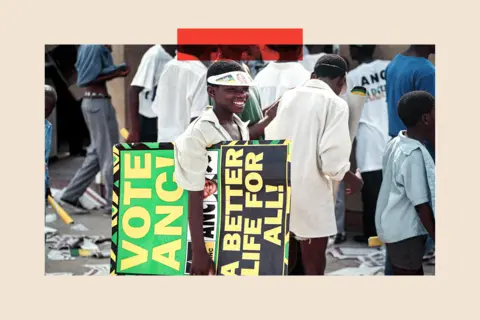
To peer that vote in a people brutalised by means of apartheid used to be to observer an awe-inspiring date within the tale of humanity. The primary citizens – most commonly the aged – who quietly forged their ballots driven historical past inexorably ahead.
Thirty years then South Africa is an excessively other nation. Autonomy has continued. The worry and racist brutality of the month is long past. However there’s prevalent disillusionment with the ruling African Nationwide Congress (ANC) in energy since Nelson Mandela changed into the rustic’s first twilight president.
Again upcoming, the lady hiding her shack advised me that her title used to be Cynthia Mthebe. Her tale has stayed with me for over 30 years.
Because the solar rose, the squatter camp progressively vanished below the earth. One presen prior to, there have been a public of a number of quantity shacks and flimsy tents. Now there have been best family, wrapped in blankets, sitting round fires.
Kids dressed of their college uniforms had been warding off within the path of the primary street, a couple of mile away past the boxes. It doesn’t matter what humiliation they suffered right here, folks fought to provide their younger an schooling.
Cynthia had seven youngsters upcoming, and took assist of them on her personal. Her husband walked out at the population a number of years prior to and had no longer been heard from since.
Each month she, and the alternative squatters, buried their properties in order that they wouldn’t be bulldozed by means of the federal government. And each night Cynthia got here again, dug up her house and slept there with the youngsters. That they had been teargassed, shot at with rubber bullets, however nonetheless they returned. There used to be nowhere else to proceed.
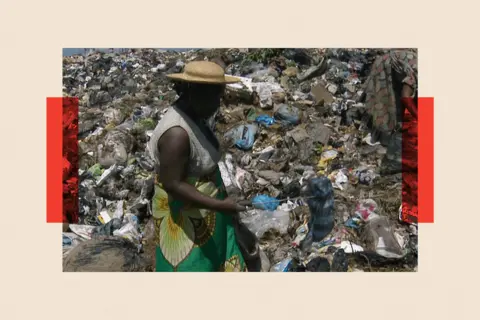
“I want to live in a nice house with my children because I’m suffering. I want to be the same like white people. I’m suffering because I’m black,” she mentioned again upcoming. Cynthia fed her population by means of running on a garbage unload, accumulating tin cans which she bought in go back for a pittance. Simply plenty to maintain moment at the margins of life.
 Getty Images
Within the unfolding narrative of her moment is the tale of thousands and thousands of South Africa’s poorest family. She used to be born on a white-owned farm in 1946 – two years prior to Afrikaner nationalists got here to energy and started imposing the coverage of apartheid.
Racial discrimination used to be written into regulation. Each facet of the moment of non-whites – from the place they may are living, what jobs they may do, who they may marry – used to be policed brutally by means of the white govt. Torture, disappearances, day-to-day shame haunted twilight lives.
Beneath so-called Brilliant Apartheid, the surrounding would unload thousands and thousands of blacks into barren tribal “homelands” the place they got nominal self government. Actually they had been rejected to poverty below the guideline of despotic native leaders. Later there have been the rules below which family had been racially categorised. Some of the race exams concerned pushing a pencil thru an individual’s hair. If it got here thru with out obstruction they had been categorised white. If no longer they had been forged into apartheid’s global of discrimination.
One in all Cynthia’s many painful recollections of apartheid is of her moment running as a maid in a white family in Johannesburg. She used to be presented some leftover meals and started to consume it from a plate belonging to her employers. “The madam of the house told me I should never do that, to eat from the same plate as them. It was like I was a dog,” she advised me.
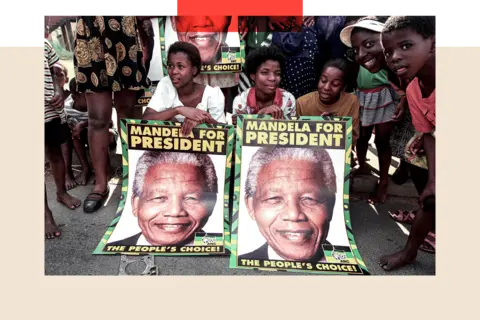
Cynthia Mthebe used to be one of the most tens of thousands and thousands to whom Nelson Mandela had promised a land of equality and justice nearest his loose from jail in 1990. In his Nobel Prize acceptance pronunciation 3 years then the ANC chief spoke of South Africans turning into “the children of Paradise”.
As South Africa entered the last days of its 2024 election campaign, I headed into the rural heartland of the country’s north-west to see Cynthia, far from the squatter camp of Ivory Park where we first met.
 Getty Images
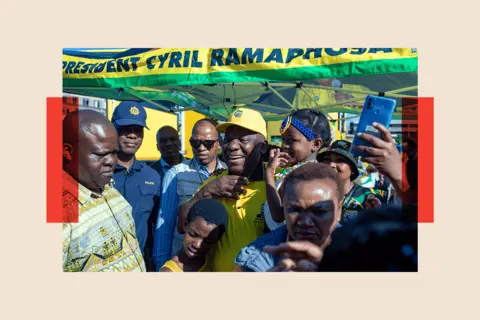
Mandela has been dead for more than a decade and his party, Africa’s oldest liberation movement, is sliding in popularity. There is widespread disillusionment over official corruption – estimated to have cost billions of pounds – and poor governance. South Africa remains the most unequal society on earth with the average white family likely to be 20 times wealthier than their black counterparts according to one study. Successive polls have shown the ANC is in danger of losing the overall majority it has held since the first democratic elections in 1994.
The last stretch of the journey to Cynthia takes me along a dirt track, past meandering cattle, a man hoeing his vegetable patch, and groups of women and children returning from church. There are the sounds of cowbells tinkling, and kwaito (a distinctively South African take on House music) booming from a radio in one of the small brick cabins that dot the landscape in Klipgat, the settlement where Cynthia moved seven years ago.
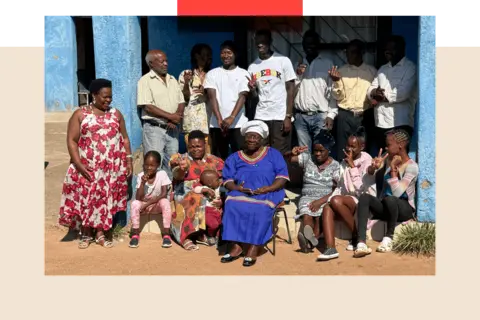
I recognise the blue house with the lemon tree in the garden. I have been here before. In 30 years I never lost contact with Cynthia and her family. I see the elderly woman approach across the yard. She leans on the arm of her granddaughter Thandi, one of Cynthia’s family of nine children, 13 grandchildren, and seven great-grandchildren.
Cynthia puts her hands out to clasp mine and then enfolds me in her arms. “Fergal it is you,” she says. Cynthia is now fickle. The lady whose willing visuals as soon as watched over her population within the squalor of the squatter camps now lives in an international of darkness and sounds.
 Getty Images
She is also diabetic. The years of working the rubbish dumps and living in shacks have exacted a heavy toll. Yet her house is a place of security and peace. The facilities at the local clinic are better than those available in the city. Cynthia also gets a monthly welfare grant of 2,000 rands (about $108; £85).
But the house was built by her children, from money they patiently saved doing whatever work they could find. Her eldest daughter Doris found a job in a white-owned shop. Eldest son Phillip works in the markets in Pretoria, about an hour away. Grandchildren also help out. When I originally filmed with Cynthia back in the 1990s there was an outpouring of support from BBC audiences who sent money to help the family.
The Mthebes have held together as a family through their own efforts, not because of what was given to them by the state or anyone else. “Even now things are not better,” says Cynthia. “I’m trying… (to survive) by all means.
“But I don’t have power because we haven’t got food if I haven’t got money, because the grant is too small.” These days it is Doris who provides much of what her mother needs to live on, while also helping her own son and daughter.
Cynthia is angry with the government. “There are no jobs… the people are suffering. But they [the ANC] say vote for me, vote for me always. I’m not going out to vote. For what? Because it doesn’t matter. The government doesn’t do nothing for us.”
She points to the absence of running water in her home, the frequent power cuts in the area due to the running down of the nation’s energy grid, much of that caused by corruption and a failure to invest.
The ANC admits it has made serious mistakes but points to the legacy of inequality from more than three centuries of white rule, something that could not be overcome in 30 years. The party says it has built millions of houses, delivered essential services to the poor, and more clinics and hospitals. The official estimate is that 1.4 million are still waiting for homes – many believe that number is a considerable underestimate. The fact is that so much more could have been done had not so much money and energy been wasted by corruption and factional struggles inside the ruling party.
Cynthia’s view of South Africa and the ANC – she was a proud supporter of Mandela in 1994 – is heavily impacted by her family’s experience. Her middle son, Amos, was shot by criminals and is now lame, struggling to find any work in a country with an unemployment rate of more than 30%. Crime in South Africa hurts black South Africans most.
Around 25,000 people were murdered last year, one of the highest murder rates in the world. Cynthia’s second daughter Joyce was abandoned by her husband and is also unemployed. Another son, Jimmy, died from alcohol abuse in a township near Johannesburg.
The family asked me to show them the original films I had made back in the 1990s. We sat in the heat of the tin-roofed sitting room as the past unrolled on my laptop screen. Cynthia in the tent at night. Cynthia working on the rubbish dump. The smaller children helping her. Jimmy, already lost to alcohol, staring into the distance.
Watching their own history, tears streamed down the faces of Doris and Amos and Thandi. A great-granddaughter clasped her hand to her mouth in shock at the sight of Cynthia digging through the dump.
Then Doris spoke. “I want to thank you Mum. I am who I am because of you. I love you.” Amos wiped his eyes and, struggling to speak, said: “What can I say about a mother like that. I am so proud of her.”
Cynthia had only been able to hear the sounds of that past world from the computer, and now listened to the words of her children. She was smiling. An old, blind woman surrounded by love. A brave survivor of her nation’s struggles.
BBC InDepth is the pristine house at the website online and app for the most efficient research and experience from our govern reporters. Beneath a particular pristine emblem, we’ll carry you pristine views that problem guesses, and deep reporting at the largest problems to aid you produce sense of a posh global. And we’ll be showcasing thought-provoking content material from throughout BBC Sounds and iPlayer too. We’re initiation miniature however considering fat, and we need to know what you assume – you’ll be able to ship us your comments by means of clicking at the button underneath.